utorak, 20. listopada 2015.

Minóy - Plain Wrap Purgatory


Apstraktne emocije iz kamenog doba snimljene zvukom.

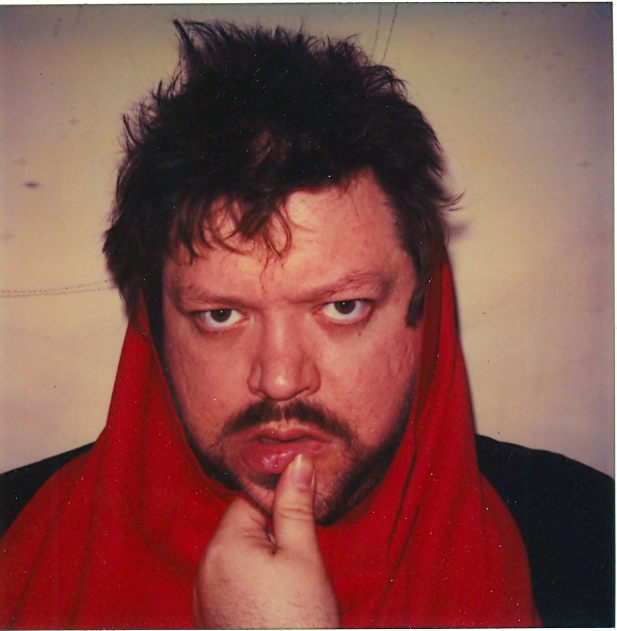
   Minóy or Stanley Keith Bowsza (October 30, 1951 - March 19, 2010) was a prolificAmerican  DIY sound artist, a home taper active in mail-art. He has created numerous releases on cassettes and gained a high rank position in cassette culture spheres. If you are still not familiar with this unique persona I suggest you to read this and this articles. Or get a fresh book/cassette/cd here.
Since I heard The Dying Man, a collaboration release made by David Prescott and himself, I got hooked and after a quite of time that passed - I'm still under the spell of the magician of his own, the spell that holds me with empathy identified with endless embracing.
Plain Wrap Purgatory is a droning sound collage with eerie vocals, typical Minoy-ish. Intense, licentious, emotional, abstract... He is sharing with us his darkest secrets but he is so cold, so indifferent.
What is he doing? Is this real? It seems he is so into his musical rite, he transforms his creature to some unknown far above dimensions... stahlfabrik.blogspot.hr/2014/08/minoy-plain-wrap-purgatory-sound-of-pig.html

DOWNLOAD.   


Minóy  edited by Joseph Nechvatal
download book

Minóy is a rescue operation with several life rafts. Minóy-the-book provides an introduction and overview to the important noise music artist Minóy — the pseudonym of American electronic art musician and sound artist Stanley Keith Bowsza (1951-2010). Minóy’s audio compositions, often conjuring up an enigmatic world of almost dreadful depth, earned him a key position in the homemade independent cassette culture scene of the 1980s.

Minóy-the-CD+cassette+mp3s (available HERE) makes available nine of Minóy’s audio compositions that span the years 1985 to 1993. These were drawn from recently discovered archival material and selected by the editor and artistic director of the project, Joseph Nechvatal, in collaboration with composer Phillip B. Klingler (PBK). Klingler (co-producer and sound engineer) houses the Minóy archive and has re-mastered the tracks, most of which have never been heard before (it was thought that Minóy stopped recording in 1992).

Minóy-the-book contains two written monograms of Minóy, one by close friend Amber Sabri and one by artist and art theoretician Joseph Nechvatal. There are three additional essays by Nechvatal, the first of which, “The Obscurity of Minóy,” recounts the history of the recovery of the audio material from obscurity. In the subsequent essays (“The Aesthetics of an Obscure Monster Sacré” and “Hyper Noise Aesthetics”), Nechvatal reflects on the artistic benefits of obscurity and situates Minóy’s deep droning palimpsest soundscapes within an original aesthetic-theoretical context of an obscure monster sacré, and also examines Minóy’s legacy in terms of current aesthetic responses to the surveillance state, couching Minóy’s mysterious and excessive compositions in terms of a general art of noise. In total, Minóy’s work undergoes a critical intricacy in terms of a contemporary art practice engaged in the fragile balance between production of, and resistance to, perceptibility. Nechvatal brings a subversive reading to Minóy’s work by presenting it as a form of hyper-noise artistic gazing, based in the flipping of figure and ground. The book also contains sixty black and white portrait images from the Minóy as Haint as King Lear series that photographer Maya Eidolon (Amber Sabri) created before his death in collaboration with Minóy (then known as Haint) and Stuart Hass (Minóy’s lifetime partner).

  • Listen to a selection of Minoy tapes and hear a special spoken response by Minoy to his favorite piece of equipment ( thanks to Tom Furgas and Greg Mathieson).
    Hear more Minoy material at the downloads in the sidebar ( grey box ) below.

    Minoy often recorded his powerful electronic sounds during the middle of the night.
    Minoy often recorded his powerful electronic sounds during the middle of the night.
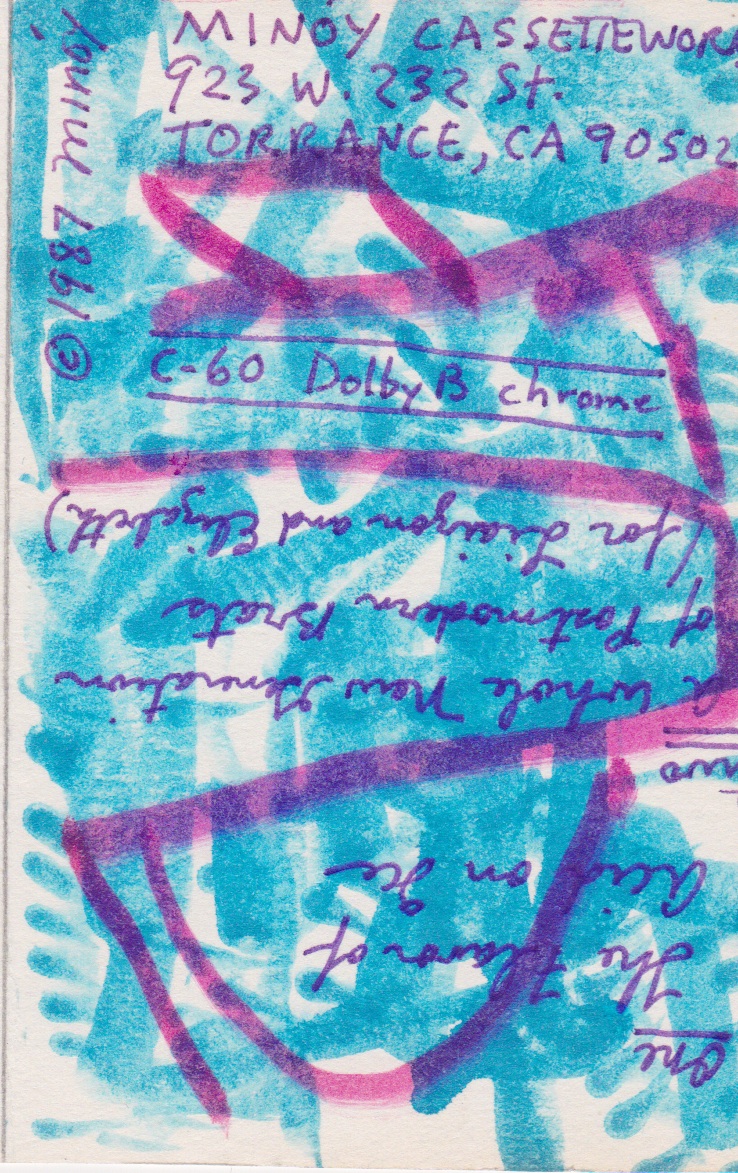
    The inner cover to "The Flavor Of Acid On Ice"
    The inner cover to “The Flavor Of Acid On Ice”
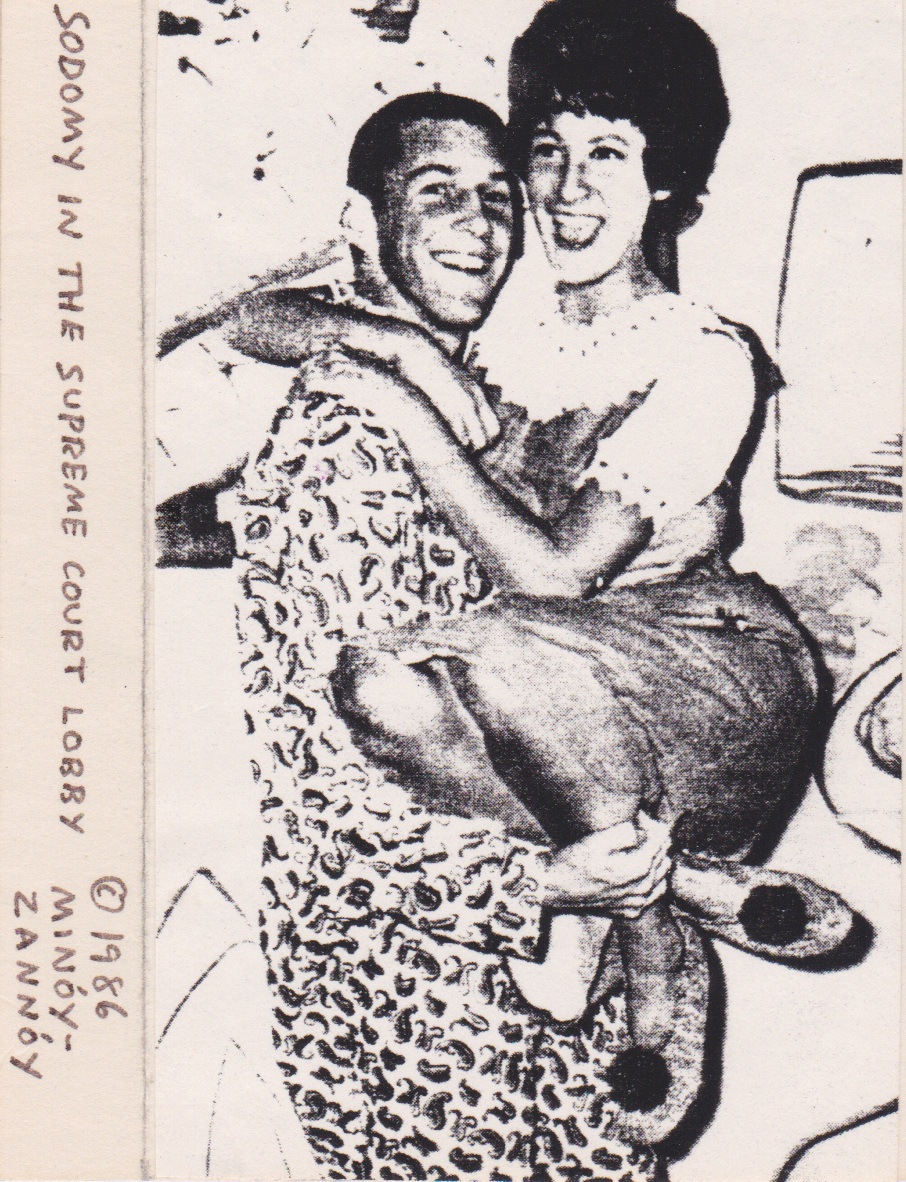
    The first tape I ever received from Minoy, "Sodomy In The Supreme Court Lobby". Released in 1986.
    The first tape I ever received from Minoy, “Sodomy In The Supreme Court Lobby”. Released in 1986.
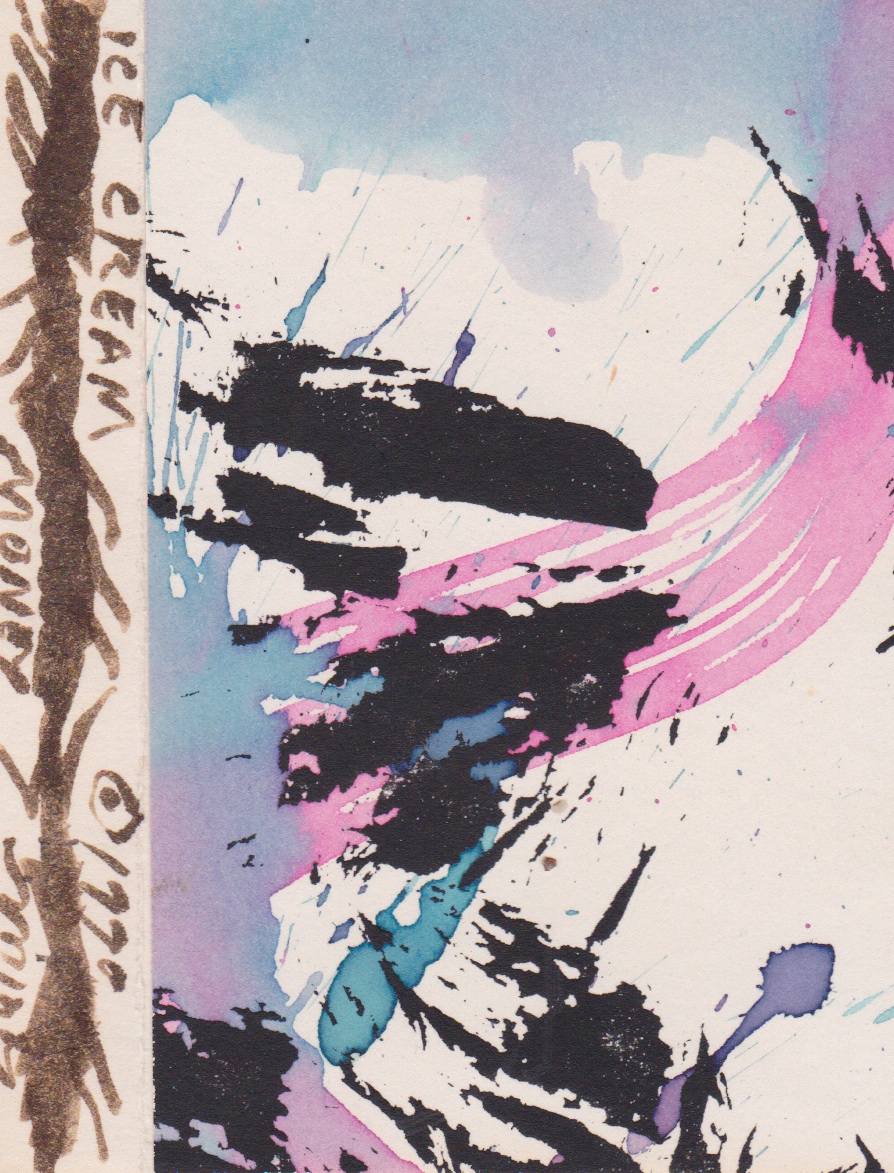
    The hand written inner cover to "Ice Cream Money".
    The hand written inner cover to “Ice Cream Money”.
    "Ice Cream Money" released in 1990.
    “Ice Cream Money” released in 1990.
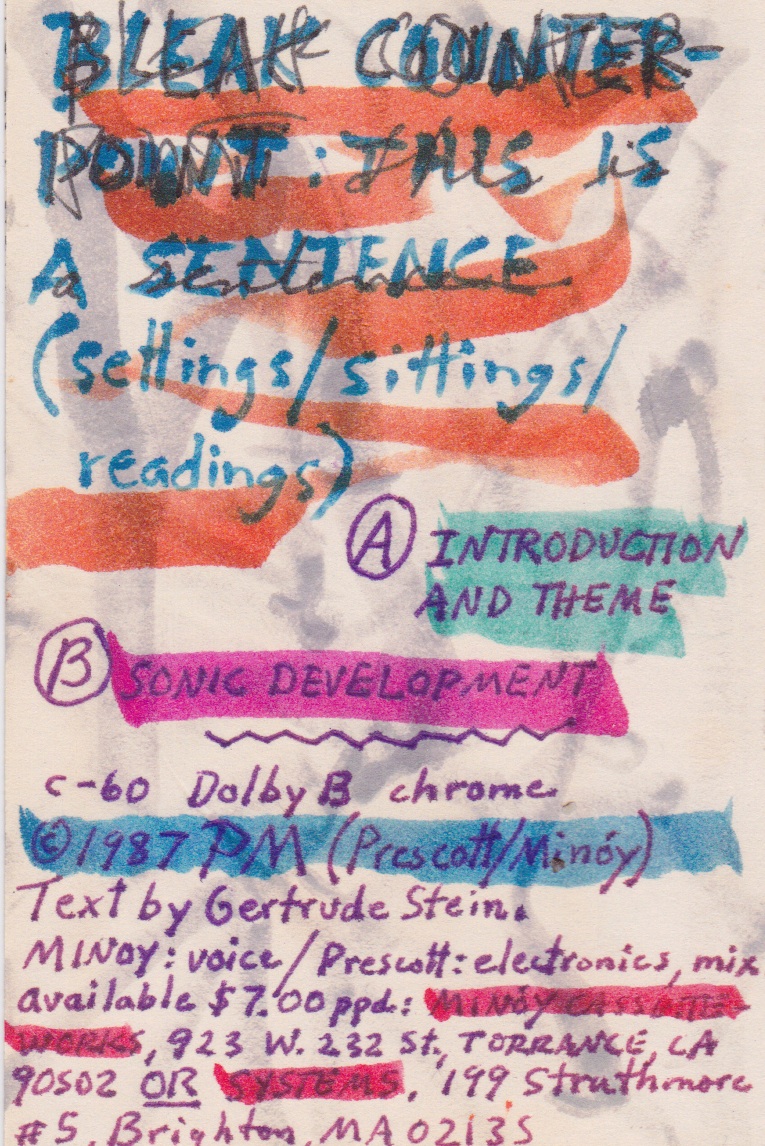
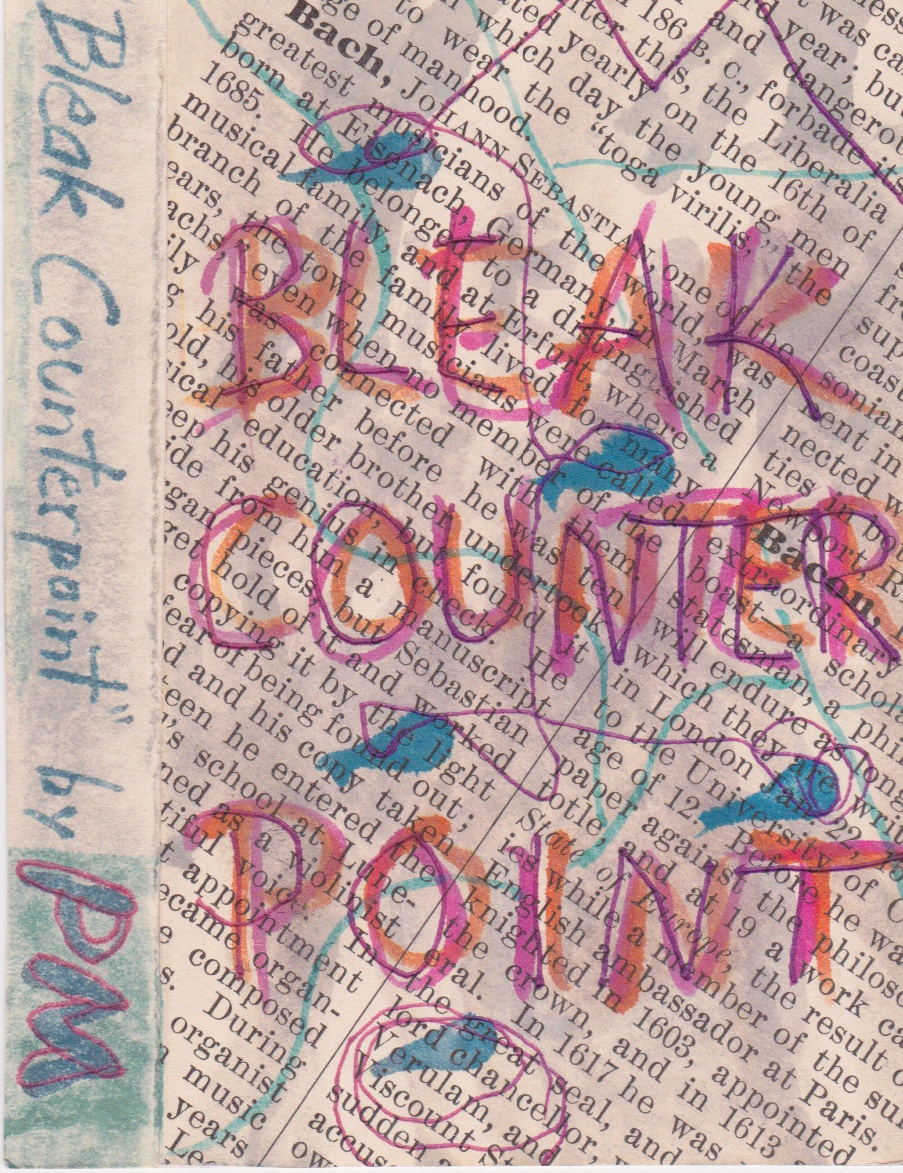
    The inner cover for "Bleak Counterpoint".
    The inner cover for “Bleak Counterpoint”.
    "Bleak Counterpoint" was a collaboration between Minoy and east coast electronics musician David Prescott. This one came out in 1987.
    “Bleak Counterpoint” was a collaboration between Minoy and east coast electronics musician David Prescott. This one came out in 1987.
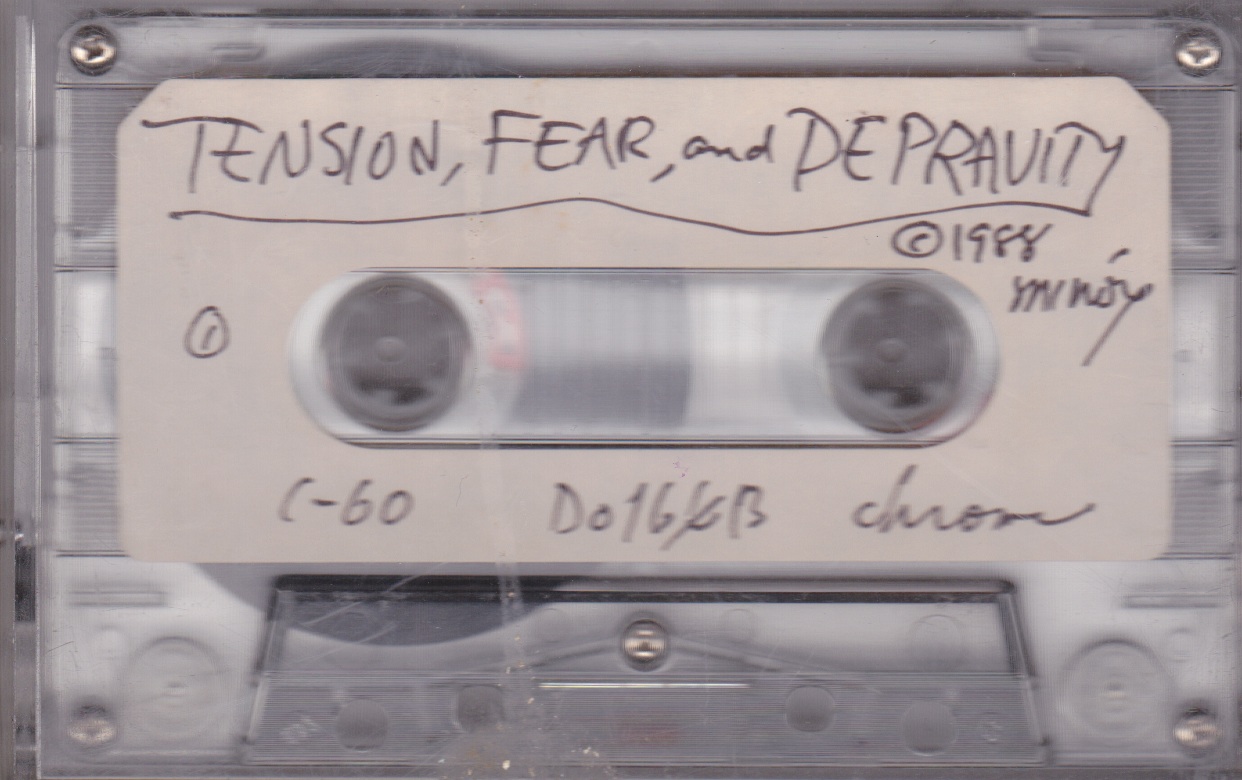
    Most of the tapes I received from Minoy did not feature paper covers but were simply hand inscribed in their plastic shells.
    Most of the tapes I received from Minoy did not feature paper covers but were simply hand inscribed in their plastic shells.
    Photos used in Electronic Cottage article.
    Photos used in Electronic Cottage article.
    I have no mouth and I must scream...Minoy.
    I have no mouth and I must scream…Minoy.
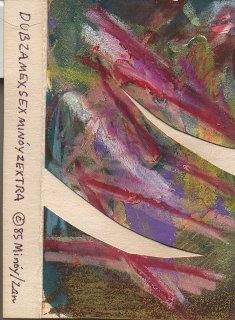
    A Minoy/ Zan Hoffman collaboration from Mike Honeycut's collection.
    A Minoy/ Zan Hoffman collaboration from Mike Honeycut’s collection.
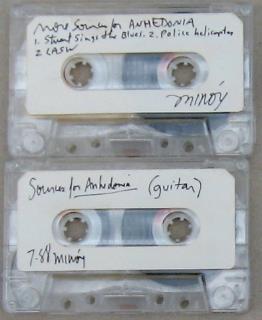
    A couple of Minoy tapes from Mike Honeycut's collection.
    A couple of Minoy tapes from Mike Honeycut’s collection.
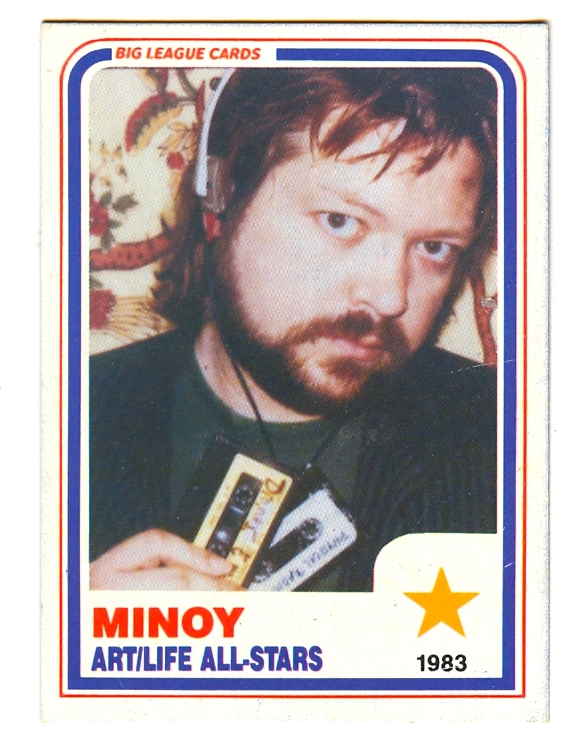
    Minoy's baseball card. Courtesy of Hal McGee.
    Minoy’s baseball card. Courtesy of Hal McGee.
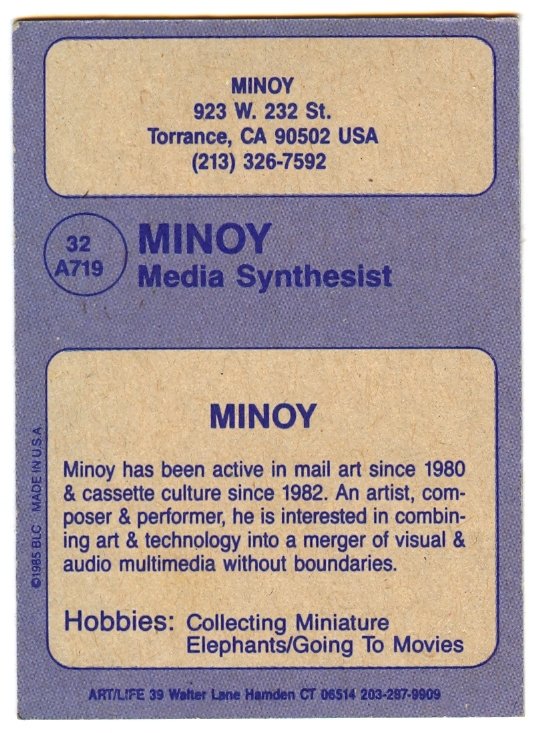
    The back of the Minoy baseball card. Courtesy of Hal McGee.
    The back of the Minoy baseball card. Courtesy of Hal McGee.
    Minoy poster on Philip B. Klingler's wall.
    Minoy poster on Philip B. Klingler’s wall.
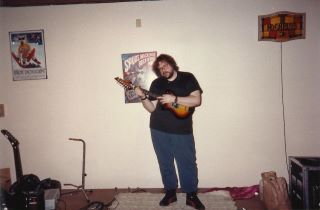
    Minoy with guitar.
    Minoy with guitar.
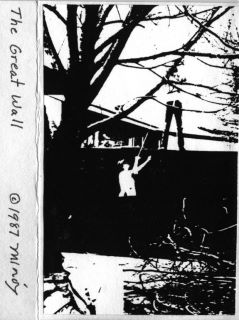
    "The Great Wall" by Minoy 1987. From the collection of Mike Honeycut.
    “The Great Wall” by Minoy 1987. From the collection of Mike Honeycut.
     To the left above, the cover  for "The Flavor Of Acid On Ice" and to the right, the plastic shell which had been coated with an odd resin of adhesive material that was hand colored. 1987. That was a gift to me from Jack Jordan back then.
    To the left above, the cover for “The Flavor Of Acid On Ice” and to the right, the plastic shell which had been coated with an odd resin of adhesive material that was hand colored. 1987. That was a gift to me from Jack Jordan back then.

    Business card tucked into my copy of Sodomy In The Supreme Court Lobby"
    Business card tucked into my copy of Sodomy In The Supreme Court Lobby”

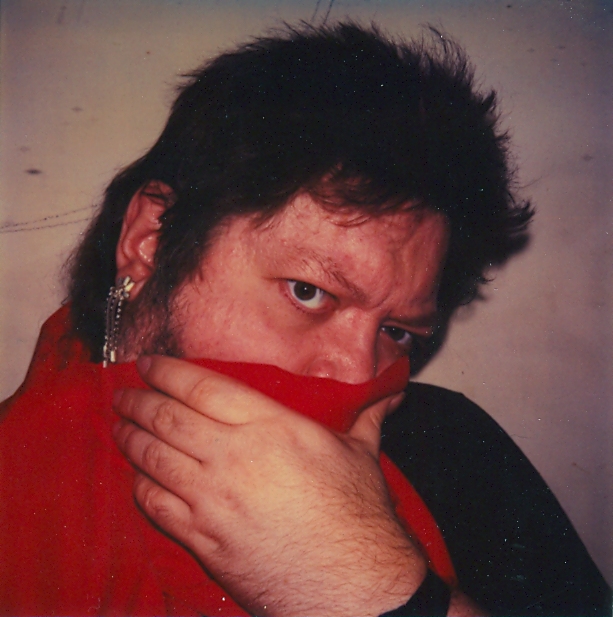
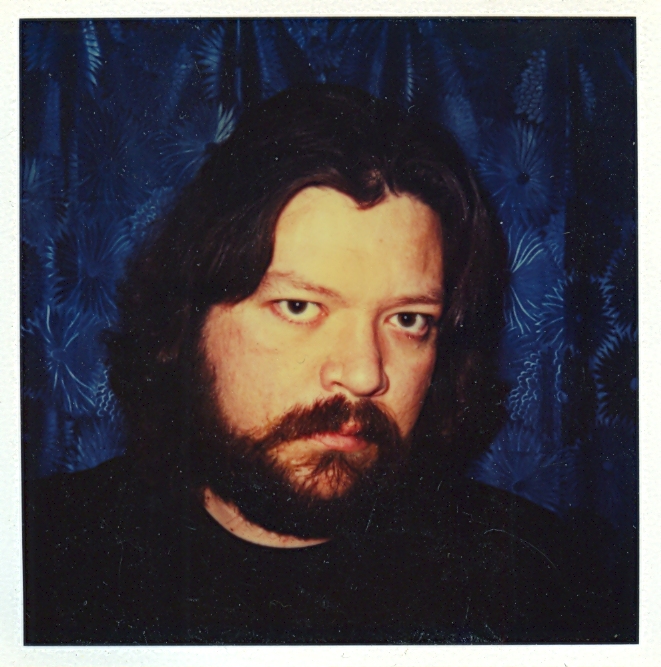
    The artist known as Minoy.
    The artist known as Minoy.

    Stanley Keith Bowsza, also known as Minoy died in 2010. I just found this out recently when notified by Philip B. Klingler on facebook Here was the info
    The information also got posted by his long time partner, Stuart, here
    The name Minoy is supposed the have an accent above the “O”. You will see it in the photos of the tapes. I could not get my text program to do it though.
    I tried to remember when I first heard of Minoy. I thought it had been 1986 but it was actually later, probably early in 1988, maybe 1987. He had blindly sent a copy of “Sodomy In The Supreme Court Lobby” to KKUP for my radio show. No letter, no accompanying info that I recall. I think there was some handwritten communications on the tape cover itself or on a small piece of paper tucked into the plastic cassette shell.
    I don’t think I played it on the show that same day because I was afraid there might be obscenity or foolish, meaningless noise. But not long after I immersed myself in his strange world of sound and came to see how unique it was.Now, by 1988 there had been a lot of noise, electronics, industrial and more in the home recording underground but here was something a little different and certainly as challenging as anything I’d come across in my aural travels.
    My friend Jack Jordan exposed me to many Minoy tapes in about 1988 and we even did a radio show together where we mixed about 60 of his tapes into a long set. Jack was a huge fan and champion of Minoy right from the start. Hear the show here
    Not long after, I wrote Minoy and we started trading tapes and he would send his latest work. I never even knew his name then.The period in the late 1980s seemed the most productive from where I sat and the legend of Minoy grew. To look at, he seemed rather scary or maybe angry. To communicate with though he was anything but. He was always a gentleman to me and although I wouldn’t call him a prolific letter writer he would jot a sentence or two in a communique and add a tape or two.
    I didn’t like all the Minoy I heard. I wasn’t big on the growling, meandering vocals he did. It was uncomfortable to me. His best work to me was the droning collage electronics that would sometimes abruptly stop, poke around in some weird found sound space and then continue on. One of my favorite tapes was “Tennessee Dance Mix” an all out noise attack of torrential waves of sound. I once sat transfixed in my car for almost a half an hour after I got home because I could simply not leave my car until it was over.

    Even in his most outward days he still seemed reclusive though. When he made the front cover of Hal McGee’s Electronic Cottage Magazine I was sort of shocked. You mean, he actually responded to an interview? He didn’t bite somebody’s head off? He sat still for this? At one point in this article he even talked about people he wanted to collaborate with. And one of them was me! Ah, but we never did.
    That ranks up there with not going to see The Beatles at Candlestick Park in 1966, or Hendrix and The Doors in San Jose in 1968 as lifetime regrets.

    When I began The Living Archive in 2009 I knew I wanted Minoy to be the first Artist Spotlight. He is an iconic figure to me…and maybe larger than life because I didn’t meet him in person. I had hoped somehow that he would see the article, the tribute to him, and come forward from the shadows. Maybe he had a bunch of recordings that he had done in the interim that would come to light now.
    But no. He died in 2010 leaving a large legacy of material for us to go through and cherish.
    If you haven’t heard his sounds I hope you download or stream some of what is offered here and at least give them a bit of a listen. It isn’t for everyone. But the power of his music is hard to deny.

    I would like to thank all of the people who helped with this tribute page to Stanley Keith Bowsza aka Minoy: Hal McGee, Damian Bisciglia, Philip B. Klingler, Jack Jordan, Tom Furgas, Greg Mathieson, Mike Honeycutt and everyone who wrote comments. Thanks and condolences also to his long time partner, Stuart for letting the world know about his passing.
    Minoy was certainly one of the legends of the sociological/musical period we call Cassette Culture. Mail artist, noise maker, digital visual artist and enigma.
    My 2009 Artist Spotlight on Minoy here

    Bret Hart
    I reviewed several Minoy releases during the 80’s. I was impressed by the startling sonic violence on the works I heard. The man sounded as angry as his cassette images suggested he might be. There was a depth of tone and texture that was, at the time, nearly unmatched. Disturbing and evocative, like much in the electronic realm can be. He was one of a kind.
    Zan Hoffman
    Don’t wanna “like” this but I must say for those of you who only hear but never wrote Mr. M – he was a gigantic personality! He was keenly aware of modern & contemporary arts and was wildly artistic himself. His audio arts were obnoxiously ahead of there time & it took years for all this to make sense. Surely someone should polish a Wikipedia entry for the boy!
    Tom Furgas
    As an avid home-taper and trader back in the ’80’s I was naturally inclined to network with just about anyone who was interested in trading tapes and exchanging information.  So it was natural that I would hear from one of the greats of home-taping; Minoy.  He and I traded tapes and letters for a short while in the late ’80’s, and I even telephoned him once.  (I specifically remember one statement he made; “Minoy is a myth!”)  His music had (and still has) the power and originality of the greatest electronic composers of the 20th century; I would rank him with such luminaries as Stockhausen and Xenakis!  And this was done with very minimal equipment, I am given to understand.  Just a Sony Walkman recorder, shortwave radio, echo unit, and a few other bits of equipment.  Minoy was never one to be discouraged because he didn’t have access to state-of-the-art equipment.  Many of his works are 30-minute aural workouts, but always continually absorbing and never repetitious or boring.  He didn’t believe in making a lot of obnoxious noise; his music was indeed “music”, but challenging and original.  He had a lot of personal demons and physical illness that often made life sheer Hell for him, but he still created brilliant music and shared it with the listeners and home-tapers who were lucky enough to get to know him.  His taped music is his legacy, and we are fortunate to have it to listen to now that he is gone.
    Al Margolis

    Well serious bummer about Minoy, who i never met and had not been in contact with for many years – i would often here from Zan or Jack Jordan about him or be asked about him – but i no longer knew nothing. And to be honest i cannot remember exactly what i first heard of Minoy’s. looking at an old SOP catalog i see i had a Minoy tack on SOP 15 – Scary World compilation. Which means we must have been in touch by 1985 at the latest. SOP released about 15 of his tapes – as Minoy or as his various collaborations. I think perhaps my favorite Minoy tape is Spaceshot – by PM – Minoy and Dave Prescott – the beginning in fact is brilliant – just Minoy speaking and Dave’s synth..utterly great. And i heard Minoy’s work before i had ever heard Stockhausen’s Hymnen – so that my take on hearing Hymnen was that it fit in this continuum …not the other way around!!!
    And i have some very cool Minoy drawings hanging in our house…we’ll miss ya….

    Bryan Baker
    I only have a few tapes and I’m not sure exactly what. I’ve come across “that which momentously declares itself not to be I and yet must be. It could be nothing else.” It has an art collage of print clippings, foil, and string stuck with melted plastic on the front of the case.
    Roger Moneymaker
    All I can do is shake my head at the passage of time an friends. MINOY was the MAD MONSTA, the Woolly Brain, one of a kind- and a fellow tennesseean! In these end times art is lost in the storm of information. Minoy was a storm of tireless creation. As an artist he found no peace in rest…….now may he Rest in peace. Om nama shivaya.
    Jack Jordan
    Minoy – a legend lost too soon. But you will continue to be emphatically and vigorously alive each time I play your music – which will live on indefinitely and be revered by those adventurous musical souls yet to discover your genius.
    Philip B. Klingler
    I contacted Minoy because of some reviews I’d read of his tapes in Option Magazine. I purchased some of them from him in 1987, sent him a money order. Even though I considered myself to be knowledgeable in music, I had a huge collection of albums, nothing quite prepared me for the unique sound world of Minoy. While living in California I would go record hunting in L.A. and one day I found Ron Lessard’s Due Process “RRRadio Six” album, that LP turned my head around, and then to follow it up with Minoy it was easy to see two distinctly different approaches to abstract sound. Where Ron’s work was playful and dadaist, Minoy’s bedroom isolationist approach produced something that seemed otherworldly, spiritual and more like paintings, which was my own background. I took Minoy’s approach as my own model.
    Collaborating with him was an overwhelming experience, but I don’t think he trusted me at first, he asked to keep our first collaborations anonymous and we created together a “hoax” project called Disco Splendor. The aesthetic that we determined for this project, that of repetitious, banal, meaningless noise was a kind of quest to find out just what “flew” in the cassette underground, what would be denounced as ridiculous or dreadful in this new world? In those days there was no blueprint for what any of us were doing, there had certainly been assimilations in rock music of the experiments of Stockhausen, Pierre Henry, or John Cage, and we knew of those things, but what we were doing with noise had not been tried to such an extreme. There was no internet and it was very difficult to find out what others were doing concurrently that might be similar to our own. (and when I say “we” I am talking about a number of artists, a certain zeitgeist happening simultaneously in different parts of the world) Ultimately, Disco Splendor proved nothing if not that the ears and minds of the artists and fans of experimental music were wide open to new possibilities, and even the most excessive sorts of approaches. So, the project was put behind us and we worked from then on as Minoy/PBK.
    There is a photo from 1988 of my studio wall in California where I have a cork board attached, and pinned on it are pictures of some of my heroes, there’s Jiddu Krishnamurti, Charlie Parker, Max Beckmann, William S. Burroughs… and Minoy. That is how highly I thought of him.
    Minoy had the largest collection of homemade experimental tapes I have ever seen, this was in 1987. It was immense, he had shelves covering the walls of his room. When he showed the tape collection to me on a couple of occasions, I glanced about and noticed his messy bed with blank tapes and papers strewn about, a tape recorder with hand-held microphone. He told me he did most of his soundwork late at night in his bed.
    During a fevered six year period, between 1986 and 1992, Minoy created hundreds of unique audio works. He defined the “mail collaborator”, which suited his personality and phobias- he was an agoraphobic and didn’t like to travel, could not drive a car. He was addicted to his mailbox and would receive stacks of mail. On the days that I spent with him the mail carrier would bring his mail bound in twine there was so much of it. He adopted the name “No Mail On Sundays” for his sound project with Damian Bisciglia, a reference to his postal addiction.
    We performed at the University of California, San Bernardino, the now infamous “Devil Music” concert, and I had assured Minoy before that everything would be fine, coaxed him to do it, told him people would dig it. In retrospect, I think that performance took a toll on him. Even for all the validation Minoy did receive, it was events like this that made him acutely aware of how unacceptable and misunderstood his creative works were to society at large. He was a non-conformist who wanted love.
    Throughout the 2000’s we kept waiting for him to surface, thought to ourselves he is somewhere out there observing all that’s going on, maybe he’s working under a pseudonym. But the truth is very far from that: he quit making music. Nevertheless, the things he did record represent, to me, a pinnacle, they are some of the most remarkably beautiful and imaginative work-of-art albums released on cassette in the 1980’s. We will save what of it we can and I hope it inspires future generations as much as it did me.
    Little Fyodor
    I am very saddened to hear of Minoy’s passing.  I very much admired him for the distinctive quality of the sound of his labyrinthian and highly textured personal brand of “noise”.  Lots of people made experimental and ambient noise back in the cassette days – and still do! – but I don’t know if I’ve ever heard anyone else approach the type of distinctive sound that Minoy made his signature, which I consider a great and wonderful feat of his.  My most direct interaction with him was via his involvement with the Walls Of Genius compilation tape, Madness Lives.  His contribution was called “Guadalajara Dry Heaves”, which, for most its 4 1/2 minutes paired his usual unique soundscape with intermittent interruptions from seemingly random sounds and voices.  Right when one of the voices says “Guadalajara”, the soundscape quickly fades away to be replaced by – you guessed it – the sound of someone suffering through the throes of the remainder of the piece’s title!  This, in turn (before, thankfully, too long!) , is replaced by the sound of a media talking head announcing the release of “We Are the World”!  On which note the piece abruptly ends.  Yes, we got it!  It was a perfect contribution for Madness Lives since WoG’s twofold goal for the comp was to simultaneously represent a genuine cross section of the cassette “scene” as it were while simultaneously bringing out the more, ahem, wacky, you might say, side of said scene, since, after all, that’s what WE were into.  Minoy did a fabulous job of being Minoy yet fulfilling the theme of the comp as well!  Ah well, it’s but a small data point of an interesting person and life amidst a vast sea of earthly culture amidst of much vaster and quite spacious universe.  Death, as the idly swimming fish near the beginning Monty Python’s “Meaning of Life” noted, makes you think.  My hats off to you Minoy, and my condolences to all who knew him a whole lot better than did I.  - livingarchive.doncampau.com/lost_and_forgotten/minoy-the-passing-of-a-legend

Jairus Victor Grove - Something Darkly This Way Comes: The Horror of Plasticity in an Age of Control


Izvrstan novi teoretičar - geopolitika, antropocen, ratovi, nevidljivo nasilje...

jairusgrove.squarespace.com


The Horror of Security
DESCRIPTION
Contemporary geopolitics as curated by the United States is in a permanent beta phase. Neuro-torture, algorithmic warfare, drones strikes, cybernetic nation-building are not means or ends but tests. Can a polis be engineered? Can the human operating system be reformatted? Can violence be modulated until legally invisible while all the more lethal? Each incursion, each new actor or actant, new terrains from brains to transatlantic cables, all find themselves part of a grand experiment. Over the course of this seminar we will explore how classically Realist concepts of order and national interest have been subtly displaced by subterranean violence entrepreneurs that populate the transversal battlefield of security politics. Doomsayers like Paul Virilio, Lewis Mumford, and Martin Heidegger who foretold a kind of terminal and self-annihilating velocity of security's technological saturation are today being shown to have been optimists. Security doesn’t know totality or finality: it bleeds, mutates, and reforms. Furthermore the peril of biopolitics seems now almost romantic. The care and concern for life’s productivity is increasingly subsumed by plasticity—forming and reforming without regard to the telos of productivity, division, or normative order. There are of course orders in our geoplastic age but they are almost unrecognizable as such when so many are directly invested in the intensifying failure of publically-stated strategic ends. In an attempt to confront the particular differences that mark our historical moment we will explore thinkers and practices that organize violence and pain beyond the limits of identity and mortality. We are witnessing creative and horrifying experiments in the affirmative production of dying that also deprive those targeted, in some cases whole population, from the relief of death. The horror of security politics is not tragic. Tragedy redeems. The horror of contemporary security politics is precisely that there is no relief, no reason, no victory, no defeats, no exit. Throughout this seminar, therefore, we will explore the problem of life and identity in the age of sustainable warfare.

Dangerous Algorithms: The Weaponization of Drones, bots, and Informatics


Thinking Like a Bomb: An Ecology of Global Warfare


Horizontalizing Quantum Thinking: World War I and the Aleatoric Cosmologies of Whitehead, Duchamp, Keynes, Goldman, JFC Fuller, and Plank.
The talk begins at 28:16 http://projectqsydney.com/portfolio/q2-war-memorial-transformational-and-gendered-panel/
A Recenty Apocalyptic Tone in Everything: The Anthropocene or Peak Humanity?
A condensed article version of a book chapter by the same name. Part of a special issue on William E. Connolly's new book the Fragility of Things.
  
Something Darkly This Way Comes: The Horror of Plasticity in an Age of Control [Do Not Cite Without Permission]

The Blood of Geopolitics
Must We Persist to Continue


srijeda, 14. listopada 2015.

M. Lamar - Negrogothic: Surveillance Punishment and the Black Psyche (2013)


Negrogotika = romantizam + nadrealizam + horror + pornografija + gospel + metal + rani nijemi film.

www.mlamar.com/


Brandon Peter Masterman: In the Belly of the ShipParaontological Blackness and Sonic Abjection in the Music of M. Lamar

http://www.vice.com/read/the-plantation-is-still-here-inside-m-lamars-negrogothic-a-manifesto-exhibition?utm_source=vicetwitterus


M. Lamar is an artist whose work in music and performance straddles the genres of gospel, opera, punk, goth, and metal and blues traditions. While these sources may seem broad-ranging and disparate, Lamar has found a way to synthesize them into a cohesive musical, political and aesthetic statement. Connecting the virtuosity of operatic voice to that of the gospel soloist, goth’s dark theatricality to operatic grandeur, the mournfulness of the blues to punk’s political agendas, Lamar seeks to understand how colonial and plantation narratives about gender and race underlie daily life in the US.

The result of this fusion is vocals that haunt, lyrics that expose endemic problems, and performances of baroque grandiosity that point to capitalist excesses. Through an exhibition at PARTICIPANT INC last summer and a recent performance at Issue Project Room last month, Lamar has produced a series of short videos, prints, and sculpture to accompany his songs, with the videos to be consolidated into a longer film tentatively called Surveillance, Punishment and the Black Psyche, currently in production.
Risa Puleo How are you?
M. Lamar I’m frustrated. How are you?
RP I’m upset. I just came from a conversation about how people living with HIV are criminalized. Michael Johnson, a young man in Missouri, was recently sentenced to 30.5 years in prison for allegedly transmitting and “exposing” others to HIV, though there is no evidence to prove this.
ML How do they justify that? It’s not legal!
RP If your jury includes a group of conservative people who think the only acceptable sex is missionary within the confines of marriage, then a sex life filled with other kinds of sex acts with multiple partners is constructed as evidence of irresponsibility. This is how he was constructed as a threat to public safety.
ML But it’s a fiction though! Related to the imagined over-sexualization of the black man since plantation times.
RP Since the medieval ages, at least! When Christians defined themselves against Jews and Muslims by projecting sodomitical sex acts.
So now that we’re both upset… this is a great segue into your work, because self-making and world-making against fictions of black masculinity and sexuality are really important aspects of what you do.
ML It is. The only way you can create different kinds of possibilities within this current political and cultural context is to imagine them. The question is how we imagine. In my process there has to be an acknowledgment of what has happened to people—black people, in my case. One can’t be delusional. Many people walk around in a haze believing that horrible stuff isn’t happening all the time. We still have very serious situations in prisons, with poverty. I think fully acknowledging that and trying to make a fully emancipated self—who is aware of the past but is also trying to make a difference in the present and future—is important. I find a lot of solace in my own practice; it enables me to go on. It’s a question of survival for me, this world-making, imagining the possibilities for a different kind of self and fighting for that, too.
We can just stop there in a way. This is what I’m trying to do.
I mean, I’m frustrated. As I enter a kind of public sphere, people are wanting to put me in an identity box.
RP What are the words you get tagged with?
ML I get invited to show a lot with transgender people, and I am not transgender. I’ve never said that I am. It’s confusing to me as someone who is trying desperately to liberate himself from all these forces. The difficulty of stepping outside the status quo is that your life is more difficult. Transgender identities are mainstream right now, but I think in terms of representation, people don’t seem to be stepping outside of a binary presentation. I just don’t think that that’s liberatory. Even as we push against all these hegemonic forces, there still seems to be a status quo that reinserts itself, because under capitalism you need a new take on something. So the new take on femininity is trans femininity. The new take on masculinity is trans masculinity, but the hegemony is still in place, nothing has been dismantled. On one level if we acknowledge that transness is inherently hegemonic, maybe we can get to something truly radical and challenge these kinds of constructions.
RP What are the words that you prefer?
ML I consistently describe myself as a “NEGROGOTHIC devil-worshipping free black man in the blues tradition.” I’ve been really loud about that, but people want to understand my identity by some preexisting script. I’m trying to write my own script. That’s where the frustration comes from, where you’re constantly trying to construct yourself and people are pushing you back. We were saying this yesterday: liberation isn’t something you do and you’re done. It’s a constant fight.
But I also reject notions of fixity. I am an artist. I am a NEGROGOTHIC, devil worshipping, free black man in the blues tradition. Those are the things I am now. I have this trouble with identity as a noun—even the notion of sexual orientation. The idea that there is one is a fallacy. Our sexual orientation changes and mutates throughout our lives. I use the term “practicing homosexual,” and I reject the notion of being gay. It’s all very bourgeois and white. I like the idea of being queer, or queerness as a verb rather than as a noun. Sex and sexuality is a thing that you do, not who you are—it’s not ontology. But fucking, I do that. So what? It’s a very reductive thing, to define people according to sexuality. It’s a very Western, scientific thing, the desire to name something and put it in a box. I just reject the names that aren’t my own, the names I haven’t given to myself.
RP You’ve also been making a lot of work recently that defies identifiers: music that crosses blues, opera, goth, punk, metal, and gospel traditions; performances on stage and for videos and still images.


Surveillance Punishment and the Black Psyche, Part Two, Overseer, 2014. HD video, 05:00 minutes.
ML I feel lucky that I’ve amassed a significant body of work. At PARTICIPANT, I showed the first part of a film that will be a feature, tentatively called Surveillance, Punishment and the Black Psyche. There’s a book coming out of the PARTICIPANT show called NEGROGOTHIC. It will have librettos for Negro Antichrist and Surveillance, Punishment and the Black Psyche, text from my Lynching Song Cycles and The Speculum Orum Requiem, and essays by lots of awesome people that I can’t say by name right now.The book is made possible through PARTICIPANT, the Harpo Foundation, and the Walter McBean Galleries of the San Francisco Art Institute. I’m pretty excited about the work that’s coming: a new recording with Mivos Quartet with Charlie Looker doing the string arrangements for the feature film. This project is supported by The One Archive and USC, and I’m doing a big performance and exhibition there in April. And I have a new piece at PS1, called Tree of Blood, that’s connecting this new revolutionary energy generating out of justice movements like Black Lives Matter with my research and past work on lynching.
RP Can you tell me more about Tree of Blood?
ML There’s lots of imagery about the dead rising up. I don’t want to be done with the dead. There is a finality—especially if you’re not a Christian—with death. The Christian tradition invests in an afterlife. The African tradition does too. A lot of spiritual music is about death, meaning that you’re going to die at some point, so this will be over. Really, my investment in this NEGROGOTHIC, devil-worshipping, free black man blues tradition is about a rejection of that. The blues began to form out of emancipation. It was a rejection of the enforced Christianity that was a part of slavery.
RP What dead do you want to speak to?
ML I particularly want to have a conversation with those we have lost in struggle. Sandra Bland, the black woman stopped by the police for some routine traffic violation in Texas who died in jail three days later, is a freedom fighter and a revolutionary. To me, the video of her not cow-towing to the police—being very defiant, knowing that she was involved in Black Lives Matter, knowing that she could die—is so moving. It’s like a Biggie Smalls “ready to die” moment. I don’t want to accept that she isn’t always going to be speaking to those of us who are lovers of justice. Or that Martin Luther King or Trayvon Martin or Mike Brown or Emmett Till or Emmett Till’s mother won’t always be the legacies.
RP On one hand you’re talking about memorialization, but really you’re talking about conjuring, incantation, spirit-to-spirit communication between the embodied and disembodied souls.
ML I’m very interested in ideas of possession, of being a vessel. I think the best singers, dancers and actors are the people who become conduits for spirits, energy channeling. Channeling and possession can’t be done when the ego is in the way. You have to let that go for stuff to move through you. I really believe that. Anthony Paul Farley has been writing about zombies relative to race. The dead can’t sing, but we know that the dead are singing to us all the time through spirituals and black music. If the dead can’t sing then maybe they’re just asleep, is what Farley says. And if they’re sleeping there’s always the possibility of awakening. A lot of Black Lives Matter, Ferguson, Baltimore, Oakland, is about a certain kind of awakening. It’s very exciting. Even if it’s squashed, and all evidence suggests that it will be extinguished as a movement, at least we’re going to go out fighting.
RP Grief is an enormous political force motivating action right now. And there is a renegotiation of how people are reacting to fear, not being terrorized into submission.


Discipline VI, 2014. Archival pigment print on canvas.
ML The song that I wrote, “They Hung Her on the Deck” in Speculum Orum, is about the whipping of a black woman on a slave ship to install fear. It’s connected to a famous illustration. It’s a profoundly liberating moment to not be a afraid. I’ve been stopped by the police many times. I have been very much afraid. I haven’t been ready to die like Sandra was or Biggie, although I don’t think Biggie was ready then to die. I’ve been very afraid, and I think a moment in emancipation was about not being afraid. Marcus Garvey’s people would march with signs that said, “We are not afraid.” Malcolm X would talk about not being afraid. That’s one of the ways black people have been terrorized, with lynching. Lynching was about creating fear to keep the rest of the Negroes in line. In that Nina Simone documentary on Netflix, someone asks her, “What does freedom mean to you?” And she says, “No fear.” That sentiment means so much to me.
There’s always this mourning happening in my work. How do you grapple with profound loss and profound devastation? But in this new phase in my work, I’m trying to create a revolutionary impulse, what Cornel West calls “a black prophetic fire.” It’s about a longing to connect deeply with those we’ve lost. It’s a longing to remake the world anew. Really this new show at PS1 is about trying to put yourself back together. I’m in pieces.
RP This is kind of the opposite impulse of your song, “I’m Trying To Leave My Body,” which is about dissociation. You’re speaking about reintegration spiritually and physically.
ML If a body’s been traumatized, one has to go some place else. “I’m just trying to put myself back together, I’m walking around in pieces.” Many of us are walking around fragmented or dismembered. Parts of our spirits, our psyches, our bodies, are hanging off, barely there. Many of us are walking around decapitated, not whole selves. There is also a very literal meaning of “being in pieces.” I was reading the story of this one man who survived lynching. He had been castrated, and he continued to live in this dismembered state.
RP This relates to the story Willie Francis in the narrative for Surveillance, Punishment and the Black Psyche, about another man who survived an execution.
ML Surveillance, Punishment and the Black Psyche is loosely based on the story of Willie Francis. I say loosely because I had to make up a lot of facts, because much of his story is unknown. What we do know is that they attempted to execute him in 1946 and it didn’t work, because the electric chair was installed improperly. Then the NAACP descended upon St. Martinville, Louisiana. He was allegedly having a sexual relationship with the man he was accused of killing, a 53-year old pharmacist, a white man. Willie Francis would have been 14 or 15 years old at the time. I was trying to imagine what interracial homosexual dynamics look like in plantation times or under Jim Crow. What did their relationship look like? There are always questions of consent when someone is underage, or in bondage in slavery, but he didn’t seem coerced. Maybe he was manipulated. Maybe he was paid. We just don’t know. I was trying to understand what the dynamic must have been when someone in bondage desires the touch of a white man.

Mapplethorpe’s Whip V The Trophy Collectors, 2014. Archival pigment print on canvas.
RP The way you reconfigure Mapplethorpe’s image (Self-portrait with Whip) in the video made me think about how BDSM allows people to recreate these same master-slave scenarios with awareness and consent. It’s the other side of the possible dynamic you’re describing, where the power inequity between a black boy and white man in Louisiana of the 1940s is so pronounced. For instance, in the film The Night Porter, the relationship that happens between a SS officer and a Jewish woman in a concentration camp, when recreated by the same officer and same woman outside the camp after the war, carries all the traumatic weight of their shared history.
ML Mapplethorpe was obsessed with black men, and that’s no secret. We seem to be some symbol of his transgression, as if he was a radical, white male artist because he was daring to be fucked by “big, black cock.” He’s reenacting a white supremacist fantasy, what I call plantation fantasy, imagining black people as overly-sexualized with enormous genitalia—black women and men. White people have this incredible fantasy world around the sexuality of black people. By casting Mapplethorpe as plantation master, I’m trying to give back this construction of the white supremacist imagination. It’s yours, you made it, here it is. I don’t want this anymore. I’m trying not to be didactic in the work, but I don’t want this. I don’t want this thing placed on my body.
RP Thinking about Michael Johnson’s case in Missouri; he was a wrestler using the name “Tiger Mandingo,” referring to the West African people imported to the American South as slaves, whose name has become an equivalent for “big, black cock.” This image, which he participated in constructing, worked in the minds of the people he hooked up with and against him in court.
ML We’ve all internalized white supremacy. Even if you’re a black person only engaging in sex with black people you still deal with this, because we all have that stuff going on. Black masculinity gets constructed in very particular ways, and many men like playing that role. There can be something enjoyable about that for sure, but we won’t be truly liberated until we can move into a different place and embrace different parts of black masculinity. That’s why I get really frustrated when people want to say that I’m transgender, and I say: No, I’m a black man, and black men look all kinds of ways and exist in all kinds of different spheres. I want to proclaim that proudly and also claim these different kinds of ways of existing as a black man.
RP Your images don’t look like Mapplethorpe’s images of black men though. There’s not a lot of variation in how he wants them to look.
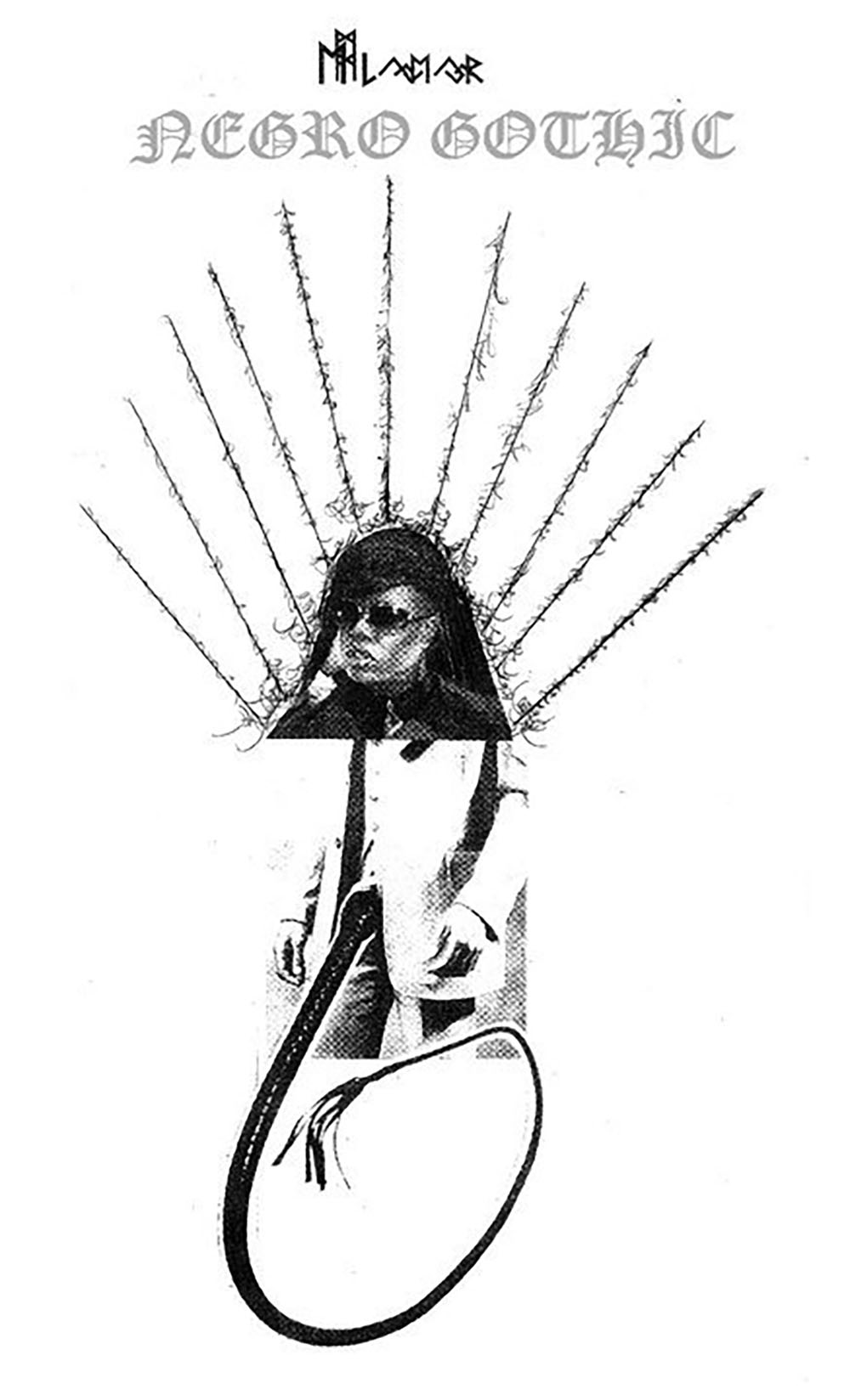
ML I placed my head on top of his collage Man in a Polyester Suit. It’s a decapitated man—the most important thing about that image is it’s decapitation. This was the cover of my 2010 cassette tape, Negro Gothic, and the first time I used a whip. I replaced the penis with a whip, making it a phallic object. I play with the etymology of the word “cracka’,” which comes from “whip-cracker.” I wanted to show how the black penis is a construction of the white imagination. For the record, black penises aren’t any bigger than any other penises. But it’s this power that it’s being given, and so I made it a whip—again this construction that I wanted to give back.

Re-capitation or Re-membering Towards a Negro Cyborg, 2010. Collage.
RP In addition to critical race and queer theory, you’re also talking about punk politics. Punk is about living your politics at every level of life: what you eat or put in your body, non-conforming dress and presentation, staking a position against capitalism and patriarchy and oppression. What was great about show-space was the way that everyone talked about these things. This is an ethos that’s missing these days, instead of all this empty chatter.
ML I was first politically radicalized when I was 15, 16, 17. I would go to punk shows and they would pass out lyrics for songs about being vegan, or the horrible things they do to animals, or patriarchy. That stuff to me was really formative; punk rock shows are so politicized. They’re an on-the-ground kind of activism. Like having lots of straight white men talking about patriarchy in public, asking, “What does sexism look like? What does misogyny look like?” I think it’s more important to talk about these things in groups of men by ourselves instead of only when women are present. It’s like talking about racism only when a black person is present. Patriarchy has no gender, but we can’t only put that onto women, or racism onto black people. It’s not only the job of women or people of color to end this.
RP It’s like you were saying about music being a spiritual force, it can also be a political force.
ML Cornel West recently said that black music is in a state of decline, that hip-hop is brilliant but investing in the charismatic front person as opposed to groups of people harmonizing. What does that mean politically? It supports a certain kind of American individualism versus a collectivity. The operatic diva is a figure I’m invested in as a trope, but she’s the same thing. What’s most compelling to me about Black Lives Matter is that it’s a movement with black women at the forefront, not about a charismatic male leader. There’s no Al Sharpton or Martin Luther King type. It’s a different kind of model, and it’s about a different kind of awakening.
RP Punk is a middle ground between the front man and the harmonizing group. It’s about individuals operating within a group as individuals while thinking about group concerns.
ML I credit my relationship with my boyfriend for turning me away from the need to be a loud, aggressive person fronting the band. A year into the relationship I wanted more intimacy with an audience. I think it was directly related to feeling loved for the first time in my life. In terms of revolutionary possibilities, all the deep people in the tradition of Martin Luther King talk about love as an action that can do—that has the ability to change a life and change political struggle. Love is the most enabling thing in terms of your life. It means you can proceed from a stronger position. I believe deeply in love. I’m a deeply romantic person. But I also believe in justice. Justice and love, what else is there? Vissi d’arte, vissi d’amore is a line from Puccini’s Tosca when she goes to kill Scarpia, the man who raped her, and she asks god, “Why did you allowthese things to happened to me? I’ve lived for art, I’ve lived for love.” I really like this, I’ve lived for art, I’ve lived for love. But for me those things are caught up in questions of justice.  -
Risa Puleohttp://bombmagazine.org/article/0984107/m-lamar

Lamar demands attention in his 2013 video Badass Nigga, the Charlie Looker of Psalm Zero Remix.
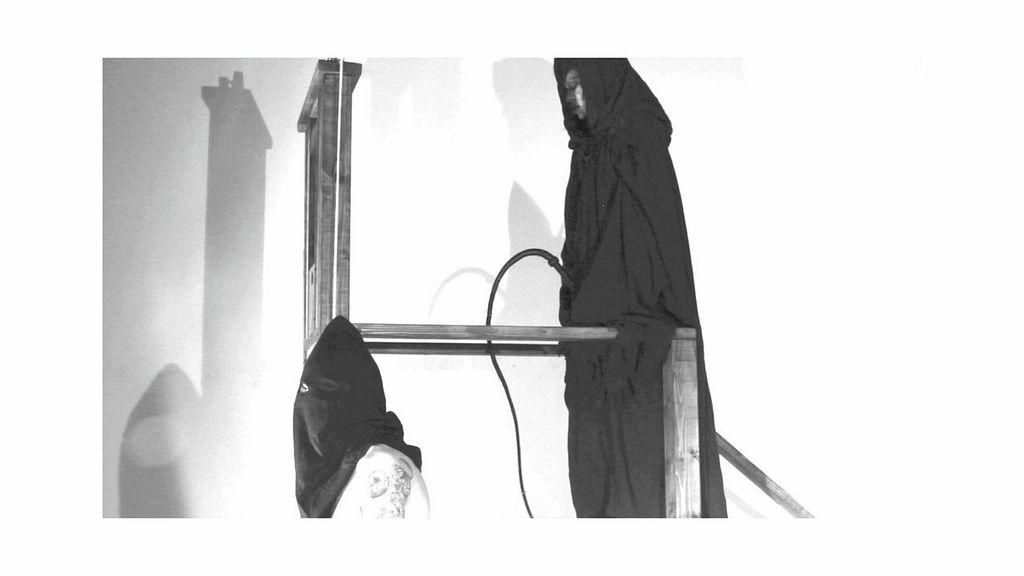
Standing before a 9-foot-tall contraption he calls "The Penis Guillotine," artist M. Lamar raises its blade with a cord, pauses it in the air for dramatic effect, then releases the metal with a sudden exclamation. The sound of steel crashing into wood (thwatt!) echoes around the San Francisco gallery that's exhibiting Lamar's artwork, and he lets out the kind of Oscar Wilde-like comment for which he is known: "I like playing with that."
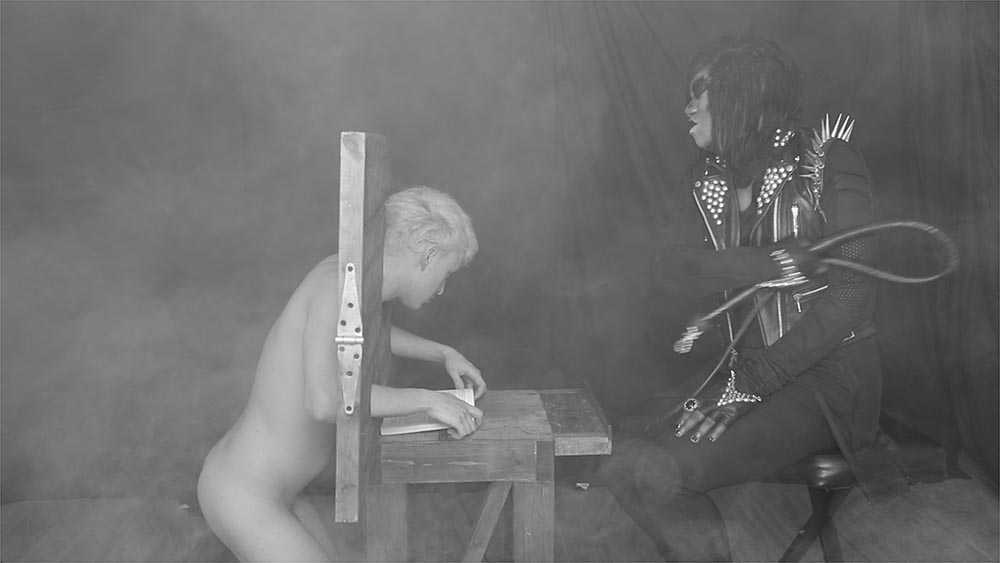
An African-American intellectual, composer, and artistic provocateur who analyzes sex and race in society, Lamar wears spiky leather jackets and gloves, heavy eye shadow and lipstick, and hair that is straight and shoulder-length. Lamar looks, sounds, and acts like few other people in the art world, exemplified by his video Badass Nigga, the Charlie Looker of Psalm Zero Remix. One of Lamar's "fun songs," it opens with Lamar sitting and reading a trio of heavyweight books — The Cornel West Reader, which compiles the writings of the Princeton professor; Beloved, by novelist Toni Morrison; and The Phenomenology of Spirit, the German philosopher Hegel's magnum opus — before Lamar gets up and puts two naked white men into a pillory that clamps their heads and hands. In stylish, smoke-filled black and white footage that is slowed down and sped up in key scenes, Lamar sings in a beautiful falsetto (a la Sylvester) as he forces the men to read his tomes and begins to whip them in the face. "I'm a badass nigga with a badass attitude," Lamar croons, accompanied by piano and dissonant instruments in a song that is catchy, sprawling, and almost unclassifiable. "Fuck you, fuck you, fuck you."
Badass Nigga, the Charlie Looker of Psalm Zero Remix is one of the videos that screens in "Negrogothic," a new exhibit at the San Francisco Art Institute's Walter and McBean Galleries that's a homecoming for Lamar, who got his bachelor's degree at the school about a decade ago before moving to the East Coast to attend Yale's School of Art sculpture program. Lamar won't say what year he graduated from the San Francisco Art Institute. He won't give his exact age. He won't let a visitor take his photo. Lamar dislikes being labeled by others, and he rejects the term "gay" as a personal descriptor. "I don't describe myself as a gay, black man — I describe myself as 'a practicing homosexual.' 'Homosexual' is about the act. 'Gay' is a cultural thing. I'm much more interested in the act than the culture," he says.
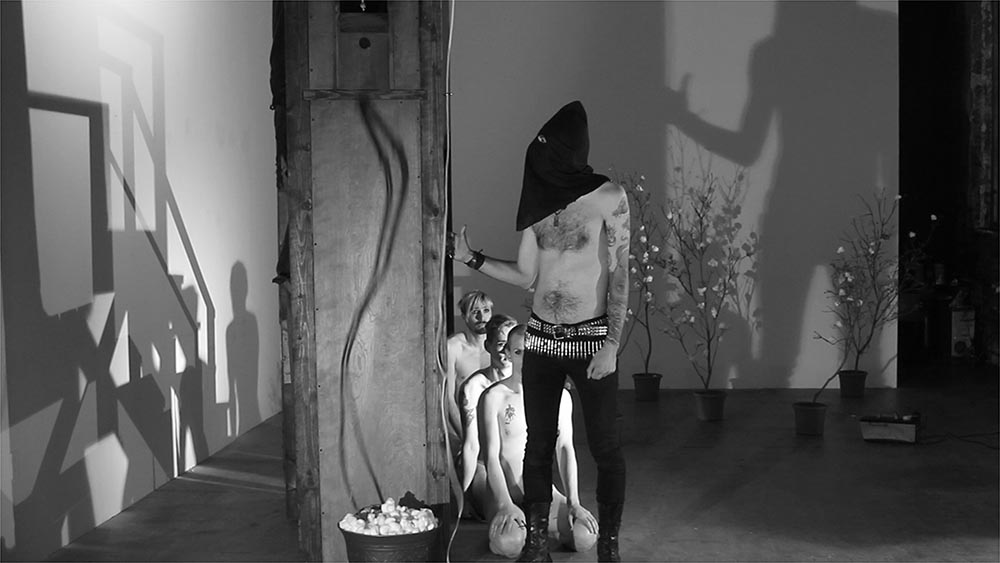
A running motif of "Negrogothic" is the whip and an examination of celebrated photographer Robert Mapplethorpe, whose portfolio included many images of naked black men who were bent over or shown in bondage or posing with their phalluses. Mapplethorpe, Lamar says, stereotyped and misunderstood African-American men — even as Mapplethorpe was heralded as a ground-breaking image-maker. Generations of white society have, consciously and unconsciously, sexualized and objectified the black penis, says Lamar, whose art spotlights that historic fixation by reversing the dominant roles. In stills like Mapplethorpe's Whip VII The Whip Crackers, Lamar wears a dark full-length robe as he inserts a whip into the rectums of white men. Lamar is the overseer. Lamar dictates what goes where with participants who volunteer their bodies to him. There's no coercion in Lamar's artwork, even as he plays with positions of power. Genres of pornography consumed by whites are devoted to black men, which Lamar relates to lynching. Lamar's art, he says, plays off of these market demands.
"Having this black body and my black penis — on one level, I just keep writing songs about my cock," Lamar says, laughing. Turning serious, he says: "This 'Negrogothic' thing is located for me in the schlocky goth thing and in the real-life experience of black people and the horror of it. It's almost like indulging in the horror ... So much a thing of lynching was cutting off black cocks, and [the lynchers] would pickle those cocks. They'd force the lynched man to eat his penis before he died. They'd cut it off, pickle it, photograph it, sell the photographs.
"Black men are dealing with the sexual ramifications of lynching every day. We're living with legacies of lynching on porn sites. If you go to those sites and type in, 'Big, black cock,' or 'My wife fucked a big black man' — there are millions of titles. When I talk about Ferguson and Mike Brown and Trayvon Martin and the ways in which they were shot dead, the flip side of that is this over-sexualization of the black male body on these porn sites. The 'big black cock' mythology is an invention of the white imagination. It's a fantasy. I like the idea, in a surrealist way, of making the whip also this black penis that white people have invented. It's like, 'Here. This is your invention. It's your thing. Have it back.' I try to understand the black body in the white imagination."
Lamar has traipsed through white environments all his life, including at Yale's School of Art sculpture program, which he left early to focus on music. In Surveillance Punishment and the Black Psyche, a sweeping and moody musical theater piece that he's performing at the San Francisco Art Institute on Friday, Feb. 13, Lamar includes video of Jamie Foxx's 2005 Oscar speech, where Foxx thanks his maternal grandmother for raising him with discipline, including whipping him. In Surveillance Punishment and the Black Psyche, Lamar includes a video of Foxx's "whipping" tribute ("when I would act a fool, she would beat me, she would whoop me, and she could get an Oscar for the way she whipped me, because she was great at it"), which inspired widespread laughs at the Oscars but inspires consternation in Lamar, who says Foxx's remarks show how deeply ingrained African-Americans have internalized the kind of violence and racism that was directed at them during slavery and beyond.
"I think a lot of black men have internalized the gaze of whiteness," Lamar says. "Part of the point of Surveillance Punishment and the Black Psyche is to get inside this internalization of white supremacy. We usually refer to it as internalized racism. There's this new documentary on Nat King Cole, and they show him putting light make-up on, and that was required in that point in history to be on television [in the 1950s]. And then we had Michael Jackson, who wasn't being told to become lighter but had got the message that he would be more successful and acceptable if he were lighter."
Inevitably, people ask Lamar about his twin, Laverne Cox, the transgender actress and pop-culture figure who made the cover of Time and plays the character of Sophia Burset on Orange Is the New Black. In 2013, Lamar acted in the series' key flashback episode, portraying the Burset character before she transitioned to a woman. Though Lamar won praise for his performance, he's critical of Orange Is the New Black, which centers on a privileged white character in a prison with many black inmates.
"I've done all sorts of things for money that I'm not proud of, and that would be one of them," says Lamar, who describes himself as "a struggling artist without a trust fund." "I'm very anti-corporate and anti-mainstream media. With any artist, including my sister, I'm always encouraging them to seek other outlets and other milieus for their work. I've always encouraged her to do one-person shows. I don't enjoy Orange Is the New Black. I'm not interested in white people's imaginings of black people.
"Black homosexuality — we really haven't had a big mainstream moment," Lamar adds. "Trans-people are having a moment. And black men and black women are having a moment. But there's a lack of even fictional characters in popular culture. To me, True Blood [the HBO vampire series] is probably the only example of an ongoing series [that had one]. And I guess there's that new show [about a hip-hop company], Empire, which all black people are watching even though it's terrible. I watch it even. Black people are just starved for reflections of themselves."
Talking to Lamar, and taking in "Negrogothic," with its widespread depictions of sex and bondage, is like being inside an experimental Ivy League classroom where the stakes are high, and every student knows it. "Negrogothic" is a tactile, visual, and auditory explosion of important ideas that are usually left to society's margins. Besides "The Penis Guillotine," the exhibit features the pillory that Lamar uses in Badass Nigga, the Charlie Looker of Psalm Zero Remix. Lamar brings the hard edges of the culture into his art, where it can occupy and exalt on center stage exactly like Lamar himself.
-

Harsh light reflects off the pale skin of a naked man kneeling on the floor, his hands and head caught between the wood slats of a pillory. His body is held in torture in a suspended state of grueling physical, psychological and social punishment.
It’s not everyday one encounters public punishment like this, but artist and musician M. Lamar jolts and startles throughout in his solo exhibition Negrogothic, on view in the Walter and McBean Galleries through Feb. 28.
In Discipline 1 (2014), due to the way the pillory constrains his body, the sufferer’s long, dirty blond hair hides his face, making him anonymous all but for his voice — he reads aloud from a stack of texts seminal to a critical race theory class: Cornell West, Toni Morrison and Hegel, which battles in the gallery with Lamar’s chilling countertenor. Lamar’s musical power reverberates throughout the darkened exhibition space; the sounds from other videos create an eerie backdrop for this public sentence. Negrogothic is epic, with videos, still images, sculpture and performance that engage in the way disenfranchised bodies intersect with power, social order and history. And the audience is a participatory spectator.


 Mapplethorpe's Whip, 2014.
“Mapplethorpe’s Whip,” 2014. By M. Lamar (Courtesy of M. Lamar)
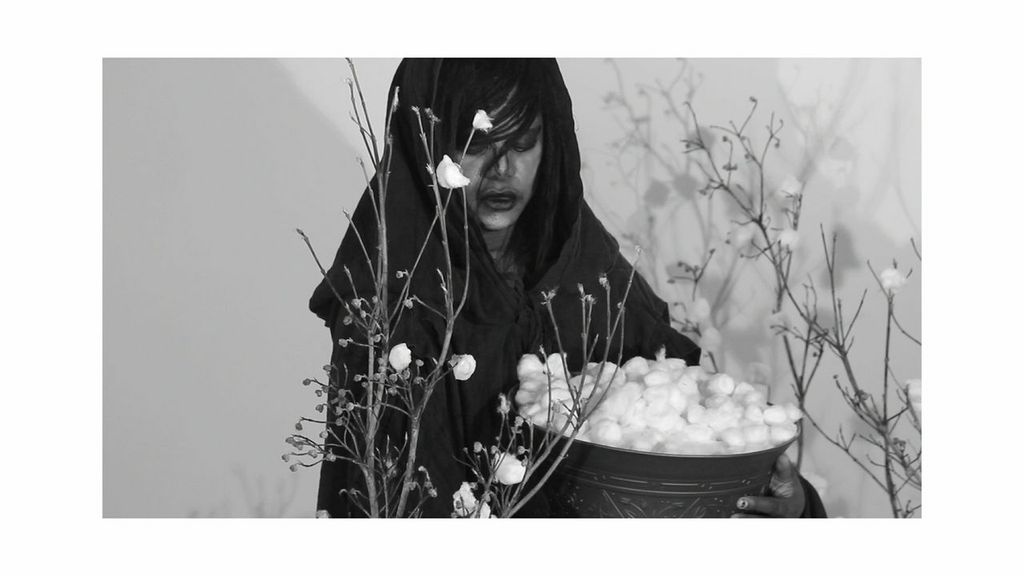
At the heart of the exhibition are the videos presented in black and white, with smoke, dramatic lighting, slow motion, operatic performance and capes to boot. But a somber intensity weighs down any theatrics as the videos center on loaded visual icons that are the unfortunate archetypes of the U.S.’s history of violence against black bodies — whips, ropes, cotton, and even the speculum oris, a device used to pry slaves’ mouths open in order to force-feed them. Lamar takes these historical accouterments and re-contextualizes them for his own strategic social critique.
The exhibition largely revolves around the video Surveillance Punishment and the Black Psyche, Part Two, Overseer (2014). Employing a tragic visual punning, Lamar uses these icons to explore their many possible metaphoric meanings — bait-and-switches that can, at times, be difficult to watch but are nonetheless poignant. The long black whip is a prominent character in Surveillance, presented as a menacing disciplinary tool. When held and carried by a white shirtless man, it carries out its most simple threat, which is to be seen. Like its title suggests, surveillance punishment is enacted not by the man using the whip to whip another body but to induce a visual threat. Order is embedded into the psyche by fear of what could happen, not by what actually does.


Mapplethorpe's Whip 2, Overseer, 2014
“Mapplethorpe’s Whip 2, Overseer,” 2014. By M. Lamar. (Courtesy of M. Lamar)
In other moments in the video, the whip acts as a phallus that is chopped off in an ominous guillotine — the full-scale prop looms in the middle of the gallery space, offering an all-too-tactile emphasis. In another scene, Lamar anally inserts the whip’s handle into three white men who are crouched on all fours. This is not just a reversal of a power dynamic, though many pieces, including the aforementioned Discipline 1, could be quickly read as such. Lamar depicts power as an exchange, of which he is not always in control.
The complicated nature of power is exampled also in the many stills from Lamar’s videos that are displayed throughout the exhibition, but titled into a series all their own. Mapplethorpe’s Whip gestures to famed photographer Robert Mapplethorpe’s controversial image Self Portrait with Whip (1978). This inclusion of Mapplethorpe in a title series not so subtly points to his known, and well-critiqued, fetishizing and objectification of the black male body.
The simultaneous fetishizing and fearing of the black body in U.S. history and culture is a prominent theme in Lamar’s work, but he also explores how those who are disenfranchised negotiate this history of racial trauma. Lamar uses recognizable icons, but confuses time and space. He is neither legibly historicizing nor creating a fantastical future narrative unmoored from the past. It is evidence of a racial trauma that the U.S., as a nation, has not yet come to terms with. Lamar complicates time and space until it begins to crash in on itself. Power dynamics and a linear order of social structure are dismantled and reorganized for the sake of critique.
In a smaller screening room, a collection of four shorter video pieces feel reminiscent of music videos. The music video seems an apt form as Lamar is a musician himself, and although this genre is most definitely a contested site, it is the primary cultural form where black artists have been able to participate in mainstream visual and cultural production. By default this is also a space where the idea of race, particularly notions of blackness, have been constructed, consumed and disseminated throughout popular culture. Lamar’s Goth-postpunk-diva affect is fused with his operatic style to create a mélange that cannot be named. His trans-disciplinary practice—he is an artist, performer, formally trained singer, composer and actor (and brother of Laverne Cox, from Orange is the New Black)—in both form and content transcends and critiques the categorical desire that is key to so much of our current social system.
In Negrogothic, the art viewer studies punishing torture apparatus as sculpture and watches surreal videos that teeter at the intersection of desire, punishment and power, as art video. It is here viewers are reminded that these forms of punishment, at one point and in their day, were intended for an audience—the pillory, the guillotine and lynching. The public and participatory aspect of punishment was embedded in that very system of order and power manifested through visual means.
Lamar conjures historical reminders that intermingle with forms more recognizable today, such as the music video, Goth aesthetics or contemporary writers, and reminds us that while punishment may not appear the same today, order still depends on the cooperation of those being ordered. -


With “Negrogothic, a Manifesto, the Aesthetics of M. Lamar,” the composer M. Lamar offers a bracing alternative to the dispiriting traffic in blandly competent art clogging the New York gallery system these days. Surrealistic, campy and ferociously expressionist, Mr. Lamar’s multimedia work is a heady blend of music, performance, film and political allegory that grapples with the legacy of slavery in America.
The twin brother of Laverne Cox, the transgender actor known for her role in “Orange Is the New Black,” Mr. Lamar gravitated to radical post-punk, goth and heavy metal music scenes while a student at the San Francisco Art Institute. He studied sculpture in Yale’s M.F.A. program before dropping out to concentrate on music and performance.
“Surveillance Punishment and the Black Psyche, Part Two, Overseer,” a 10-minute, black-and-white film is projected on one wall in the darkened gallery. Harking back to the days of early silent movies, the film proceeds in a dreamlike series of vignettes accompanied by the sound of Mr. Lamar singing in a keening, operatic soprano. Playing the role of a mysterious black man called the Overseer, he’s a magnetic, androgynous figure with long, shiny hair, heavy eye makeup and a voluminous, raggedy cloak. In the most extreme scene, he subjects a group of naked young white men to a sadomasochistic ritual based on Robert Mapplethorpe’s famous photograph “Self-Portrait With Bullwhip.”
In a five-minute music video shown on a flat screen, Mr. Lamar directs naked young white men to kneel and put their heads and hands into a pillory, where they are forced to read copies of Toni Morrison’s “Beloved,” Hegel’s “Phenomenology of Spirit” and “The Cornel West Reader.” With these and other works, Mr. Lamar plumbs the depths of all-American trauma with visionary verve. -

subota, 19. rujna 2015.

Stan Neumann - Austerlitz (2015)

austerlitz film


"Ne toliko ekraniziracija Austerlitza, koliko film o knjizi."

ulomak:

www.fondationshoah.org/FMS/Austerlitz-un-film-de-Stan-Neumann


In her essay on the late German author W.G. Sebald, Susan Sontag began with the question: “Is literary greatness still possible?” The answer was undoubtedly yes, and she went on to describe the brilliant way in which Sebald mixed fact and fiction in a series of books that tackled Europe’s destructive past through the melancholic peregrinations of a narrator – often the author himself.
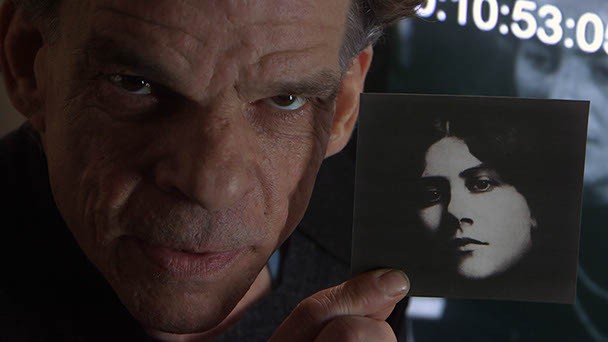
Sebald’s final novel, Austerlitz, which came out the year of his death, is now the subject of a very Sebaldien film adaptation by Paris-based Czech director Stan Neumann, with Leos Carax regular Denis Lavant (Holy Motors) playing the titular hero. Revisiting the book’s portrayal of memory, loss, creation and devastation through narrative techniques – photographs, archives and meta-fictions – that mimic the original text, Neumann crafts a worthy homage to a modern literary giant that should find fest, museum and niche art house play after an opening slot at the Cinema du Reel festival.
Published in 2000, the novel combined many of the author’s favored themes into a single character: Austerlitz (Lavant), a wandering scholar obsessed with 19th century architecture and susceptible to bouts of depression, who gradually uncovers the truth about his past – one that’s inexorably linked to the destruction of World War Two.
Both the novel and the movie take us through Europe’s shattered history, with stops in Brussels, Greenwich, Antwerp, Marienbad, Prague and Paris, though the film takes an additional meta-step by making Sebald himself another subject of the story. Beginning with Neumann describing how he first came upon the novel, and featuring scenes where he dissects the author’s prose (and discovers some heavy borrowing from Marcel Proust, Franz Kafka and Walter Benjamin), Austerlitz is not so much a filmed book as it is a film about a book, breaking down the walls that divide documentary and fiction, just as Sebald blurred the lines between the two in his writing.
It’s an austere technique that may put off viewers who prefer either one genre or the other, but it soon offers its rewards as we follow Austerlitz through his many digressions and obsessions – with train stations, hidden doorways, bricked-up windows and ornate facades – until he arrives at the heart of his tale, and we learn how seemingly intellectual preoccupations would lead him to unearth the dark secrets of his own life. Again one-upping the book, Neumann inserts details of his personal history during these latter sections, blending the film's auteur with the novel's author and character.
Reciting Sebald’s text directly to the camera, Lavant gives one of his typically physical performances, portraying a delirious savant who oscillates between fascination and desperation as he digs up various cultural artifacts that resonate with his past. Neumann inserts lots of the photos featured in the original book – one of the trademarks of Sebald’s style – while adding a few more elements, including footage from a propaganda film made by the Nazis at the Theresienstadt concentration camp.
While the mix of photographs and moving pictures is nothing new (there are moments in Austerlitz that recall the work of Chris Marker), Neumann uses the voice of Sebald to give his imagery a particular weight, even if the HD lensing (by Ned Burgess) can sometimes feel too crisp compared to the rest of the material. The result is perhaps the closest one can get to reading the original text – ever-respectful of the writer’s words while cleverly, and movingly, translating them to the big screen.
- Jordan Mintzer

+
kosmopolis.cccb.org/en/sebaldiana/

petak, 11. rujna 2015.

Phil Minton - A Doughnut’s End (2015)


Ljudski glasovi su najdobronamjerniji izvanzemaljci koje smo dosad otkrili. I boluju od Parkinsonove bolesti.

www.philminton.co.uk/


"Many of the sounds on the album’s 15 short tracks are unpleasant, but they’re all the more powerful for it. This work is in no way deprived of wonder, and you have to marvel at the breadth of what Minton can do. “Breaking News” bleeds from high pitched warbling to multiphonic density, the throat pushed to the weirdest limits of its potential. “There’s A Reason” reprises this sonic field, almost electronic in texture, while “Set In Stone” takes these techniques and flirts with the operatic. “Grandish”, the album’s final track, works through a series of high pitched peeps that could come from an as yet unidentified beast." - Matt Krefting

"Things flap and billow a bit more than they used to, which Minton accentuates in the formation of starker, more striking vocal shapes – unstable vibratos, phlegmy belching baritones. What if it isn’t volume and clear articulation that renders a voice audible amongst the masses, but visceral wordless eccentricity?" - Jack Chuter, ATTN Magazine
~~~
At times barely more than breathing, at others breaking into full-throated song, A Doughnut's End is a highly concentrated sequence of solo improvisations that captures the full range of Minton's vocal powers.
As he says in the accompanying notes, while there is continuity between this record and previous "doughnut" albums, this latest offering is "less optimistic than forty years ago" when he still "thought stuff would get better", an optimism diminished by the continued political dominance of "slush-spraying doughnut-scoffers".
A Doughnut's End is a stark and affecting testament to one man's ongoing exploration of the potential of the human voice.

Phil Minton is best known for his startling vocal improvisations. On his new solo CD, this sensible looking man proffers 37 thin slices of his unfettered soul. Not long ago these croaks, burps, high-pitched exhalations, deep-throated drones and shreds of garbled half-language would have seen Minton either burnt or hailed as an emissary of God. - Stewart Lee

Minton’s range on this disc [A Doughtnut in One Hand] runs from the sounds of a man choking on his own vomit to the sounds that grandpa makes when you finally decide to pull the plug on his respirator. He’s like a little kid who’s contact-miked himself playing yo-yo with his saliva… Minton forces us to ponder the musical qualities of noises that we’d rather not deal with and for that fact alone, makes this an important recording…- Kenneth Goldsmith

There’s a lot to be made of 2015’s crop of vocal music, especially given how widely that descriptor could be applied. From the timbral madness of C. Spencer Yeh’s extended technique all the way through to the auto-tuned euphoria of Sicko Mobb, the voice has been pushed, pulled, and expanded beyond the reaches of human capability, delivering incisive music across a number of genres and disciplines. The abstraction of that most ubiquitous and instinctive of musical instruments has been a pivotal part of what this year has sounded like to these ears: the impossible made possible, the future now, the distinction between man and machine collapsing. To put it in a Baudrillardian sense: “Technology evolves, language changes, the voice breaks, fate overtakes us.”
Phil Minton has been exploring the liminality of the human voice for the best part of four decades, with a series of solo records (the “doughnut” albums) beginning in 1982. He is described as a singer in the biography on his website, but his latest solo work, A Doughnut’s End, bears little semblance to any traditional notion of song. Utilizing a number of unorthodox techniques — utterances, gasps, belches, whistles, etc. — Minton has forged an alternative lexicon, one that seemingly forgoes the constraints of tradition and language. The result is a perverse, evocative set, the kind of performance that forces a reaction and demands attention be paid to it — music that has the power to cause unrest and revulsion in the listener.
It’s a simplistic observation, but what really sets A Doughnut’s End apart from much of the year’s vocal-centric music is the lack of mechanical or scientific enhancements; which is to say, no autotune, no cutting or looping, no overdubs. Therein lies a paradoxically human aspect to the album: Minton’s methods undoubtedly register as anachronistic, and the sheer breadth of sounds produced here — the high-pitched warble of “this is a good place to stay” and the multiphonic gurgling in both “breaking news” and “there’s a reason” are two noteworthy examples — lie firmly outside of the typical functions of the throat and mouth. And yet, the lone voice placed front and center offer a vulnerability that manifests itself in the numerous imperfections with the recording itself (pauses for breath, audible straining to reach notes at both extremities). An air of fragility lingers throughout, a reminder that even Minton’s finely honed, idiosyncratic delivery is all too susceptible to the inevitable pitfalls of existence.
The “doughnut” records were never merely concerned with physical limitations, however. For all the vocal acrobatics and constant striving to take the voice into uncharted territory, there has been an emotional core in each successive album — namely, one that animates inward feelings of disgust and contempt. In the accompanying notes to A Doughnut’s End, Minton talks of the thread that ties his experimental tendencies to the world around him:
On some tracks I use voice placings and constraints for improvising that I’ve been involved with since A Doughnut in Both Hands[…] but less optimistic than forty years ago. Then I thought stuff would get better. I’m writing this a few days after a bunch of slush-spraying doughnut-scoffers got to run the UK for another five years.”
A Doughnut’s End, then, captures an ineffable resentment, albeit with an obliquely humorous edge. Maybe Minton’s native tongue fails to fully conceive of this. But then again, this is the same man who has a track called “i have given this much more thought than blair did before he decided to invade iraq.” The primal outpouring of A Doughnut’s End is all-consuming, and without language to dirty the proceedings, it is as much a personal meditation as it is a display of pure virtuosity. - Soe Jherwood


O HOW WE  Listen on Bandcamp


“Joyous and jubilant, now I go better on my way”
The Feral Choir project is a series of vocal workshops with non-professionals, leading up to performances. It originated in the late 1980′s when I was asked to do some workshops with ‘non-singers’ in the Musik Centrum Stockholm. The success of these led me to develop the idea further. The choir consists of a three day workshop and performance, not only for singers but for anyone who takes a delight in the freedom to experiment. I encourage participants to take a vocal leap and explore all vocal possibilities through exercises and improvisations, over the workshop period, leading to a concert.
Feral Choir workshops and performances have subsequently been held in many different places around the world including Berlin, Centre for Performance Research Cardiff, Musickzentrum Munich, Tokyo, Angelica Bologna, City Festival Lausanne, Institute for Living Voice Antwerp, Baltimore, Nante, Brest, Oxford, Paris, Oakland, Melbourne, St. Paulo, Rio de Janeiro, Bristol, Pau, Florence, Le Man, Trondheim, Rotterdam, Ghent, Zurich, Nancy Vandoeuvre, Poitiers, London, Amsterdam, Warsaw, Brugge, Strasbourg, and Aberystwyth.
Some of the choirs have been made up of professionals, sometimes actors and musicians, but many have been amateur groups with no previous musical interest or experience. These have been particularly rewarding, as has the work with teenagers in Belgium and Holland, and the responses from the participants have been overwhelmingly positive.
My recent experience of working with singers, many of whom think they cannot sing, has strengthened my conviction that the human voice is capable of so much more than is generally understood. In the workshops I have encouraged participants to realise that anyone who can breathe, is capable of producing sounds that give a positive aesthetic contribution to the human condition and many of these contributions are without any cultural influences or references.
The workshops normally begin with laughter, a non-verbal ‘vocal technique’ which uses the voice in spontaneous, inventive and sometimes very extreme way. I know that these workshops have a very positive impact on the participants, and I spend enough time with each group to be able to leave a lasting ‘legacy’ and hopefully a structure in which the resulting choir can continue after I have left.
Some of the comments from previous Feral Choir participants are as follows:
  • “You have let the sun enter into my head”
  • “Thank you for the most fantastic experience to let us express ourselves in this way”.
  • “A new heart in my voice”.
  • “You and your work brings happiness (and other great things) to people”
“After singing with the feral choir I felt elated and alive. My voice felt bigger afterwards, and I find myself still appreciating how much it can do.”
I hope that the workshops and performances will offer a similar experience to the many often ‘voiceless’ people who participate.
http://www.pointofdeparture.org/PoD40/PoD40Ezz-thetics.html


One of the greatest pleasures of the album [Glad Day] is the opportunity it brings to once again hear the remarkable vocalist Phil Minton. Minton is the most thrilling singer we have, with a messianic passion so fierce that his performances glow as brightly as Blake’s own tyger. - Phil Johnson


  • sr310

    By the Stream

    Phil Minton / Audrey Chen
    Listen Online 
  • anicca

    Anicca

    2011
    Dancing Wayang Records
    Okkyng Lee & Phil Minton
  • ndih

    No Doughnuts in Hand

    2007
    Emanem records
    Phil Minton
  • alived

    Alive at sonorités with Daunik Lazro

    2007
    émouvance
    Phil Minton: Voice Daunik Lazro: Saxophone
  • tasting

    Tasting with Sophie Agnel

    2006
    Another Timbre
    Phil Minton: Voice, Sophie Agnel: Piano
  • wow

    Ways Out East – Ways Out West with Veryan Weston

    2005
    Intakt records
    Phil Minton: Voice, Veryan Weston: Piano, Organ, Voice
  • slur

    Slur

    2006
    Emanem records
    Phil Minton Quartet – Phil Minton, Roger Turner, John Butcher, Veryan Weston
  • ammo

    Ammo

    1998 Re release 2006
    Leo records
    Phil Minton, Roger Turner
  •  1.0.3

    Phil Minton Quartet with Lars Göran Ulander

    1969
    Blue Tower Records
    Phil Minton (trumpet & voice), Lars Lars Göran Ulander (altosax), Lars Gunnar Gunnarson (bass), Sten Oberg (drums)
    Track #1 – Day


    A clip from Track #2 – Blue Reading 1

  • moe

    Mouthful of Ectasy

    1998
    Victo records
    Phil Minton Quartet – Phil Minton, Roger Turner, John Butcher, Veryan Weston
  • doughnuts

    A Doughnut in one hand

    FMP Online
    Phil Minton
  • dadadas

    Dada Da

    1993
    Leo records
    Phil Minton / Roger Turner
  • sfpd

    Songs From A Prison Diary

    1993
    Leo records
    Phil Minton and Veryan Weston
    A clip from Track #10 Noon
  • drainage

    Drainage

    1993
    Emanem records
    Phil Minton voice / Roger Turner percussion
  • dbh

    Doughnut in Both Hands

    1975 – 1982
    Emanem records
    Phil Minton Solo Singing
  • 15230

    Phil Minton/Dylan Nyoukis Live in Athens

    2011
    Recorded live at Knot Gallery, Athens, Greece in November 26, 2011.
  • spukhaftefernwirkung

    fORCH / Furt ‎– Spukhafte Fernwirkung

    2014
    Recorded At – Sporthalle Der Gewerblichen Schulen, Donaueschingen, Donaueschinger Musiktage, SWF-Studio Schloßbergsaal, Freiburg
  • a2597297314_10

    The Knowledge Of Its Own Making

    2014
    Phil Minton: voice
    Simon H. Fell: double bass
    Huddersfield Contemporary Records 2014
  • skaermbillede-2014-09-05-kl.-13.00.50

    What Rivers Is This: Lotte Anker

    2014
    Lotte Anker, Phil Minton, Anna Klett, Garth Knox, Jesper Egelund, Fred Frith, Ikue Mori, Chris Cutler.