utorak, 20. listopada 2015.

Peter Hutton - Three Landscapes (2011)


Noć je emulzija za snimanje svjetla. Nitko ne zna što snima priroda.


Many narrative filmmakers have recognized the expressive power of landscape as a time-based element. But most would acknowledge that two markedly different avant-gardists have taken the medium further than anyone else: James Benning, a Wavelengths regular, is one; Peter Hutton is the other. While Benning’s work tends to systematically organize the living environment (13 Lakes, Ten Skies), Hutton’s films are about the ineluctable drift of things. His films get out on a river (Time And Tide), or set up along the side of a hill (Skagafjordur), and patiently observe as nature unfolds in its own sweet time.
Hutton, whose 47-minute “Three Landscapes” debuts this year, is a longtime filmmaking professor at Bard College in New York, and he’s drawn extensive inspiration over the years from both the Hudson River and the school of painters associated with that region, Thomas Cole in particular. Accordingly, Hutton’s work has explored land and water as phenomena of light, capturing their luminosity in misty, diffuse circumstances as well as in piercing direct sunstream. His films rely on the character of 16mm celluloid; most are black and white, all are silent. Hutton employs the diffusion of swirling film grain to replicate the atmospheric specificity of environmental light. He’s filmed throughout the world, from China to Iceland and beyond, emphasizing the absolute qualities of light in different places. Hutton’s latest returns to the Hudson while also examining northeastern Ethiopia and his troubled hometown of Detroit. - Michael Sicinski 

threelandscapes_01
By Max Goldberg
One of several triptychs showing in this year’s Wavelengths program, Peter Hutton’s Three Landscapes zeroes in on the industrial terrain ringing Detroit (where he grew up), the bucolic pastures of the Hudson River Valley (where he now lives), and Ethiopian salt flats (where he travelled under Robert Gardner’s sponsorship). The most obvious link between the three is labour, but the film functions less as a thesis statement than a poetic meditation, a haiku-like attempt to distill the landscape using a few sparing, echoing graphic forms. The Detroit sequence is the most immediately arresting, its subdued colour palette and precise graphic calculations of grass, clouds, sky, smoke, and industrial architecture leading to a dramatic chain of images of two men inching across a high ladder—a vision of meditative calm in struggle. Workers and clouds are combined to more expressly lyrical effect in a superimposition punctuating the Hudson River Valley sequence, a marvelous bit of photochemical guesswork (albeit one now rendered in DCP projection). If the Ethiopia sequence seems comparatively uncertain about itself, its final long take of a line of camels stilled by distance and heat closes the film with an eloquent appeal to the necessity of limits. After the screening Hutton remarked that he takes special pleasure in those landscapes in which you see clouds moving faster than the workers, a point of view that goes a long way towards restoring the link between the documentary and spiritual connotations of this word “observe.”
cinema-scope.com/cinema-scope-online/tiff-2013-three-landscapes-peter-hutton-us-wavelengths/

img-home
Peter Hutton, 3 Landscapes, 2011
Courtesy: the artist

Lived Experience

Luke Fowler and Peter Hutton have their own particular lines of research that have at times led to synergies, but which above all share precise affinities, starting with the anthropological and historical intent of their films—which explore geographical places and human movements with a poetic impulse—to achieve the attitude of the true explorer, the artist who crosses localities and boldly roams in search of stories. As readers, we can let ourselves be wafted along on their conversation, in pursuit of carovans of camels crossing the horizon, observing salt mines and peasants at work...


Luke Fowler: I understand you are filming your next project in three places: Detroit, Michigan; Mekelle, Ethiopia; and the Hudson River Valley in New York State. What drew you to these locations?

Peter Hutton: The new film is tentatively titled Three Landscapes. The first section was shot near Detroit, where I grew up. I worked as a merchant seaman on the Great Lakes during the 1960s (I continued to work on ships throughout the early 1970s) and my union hall was in River Rouge, a heavily industrial area. I spent a few weeks there again three years ago, documenting a steel plant called Zug Island, which is still functioning. It was a security nightmare to film. Another steel mill, an abandoned one, became a source of some additional images.

I traveled along West Jefferson Avenue nearby, and recorded whatever appealed to me. It culminated in a study of two men walking up the suspension cable of the Ambassador Bridge, which connects Detroit with Windsor, Canada. All the material feels like a dream, which is appropriate, since so much of the landscape surrounding Detroit is dead.

The Hudson River Valley is my home. In the summertime I’m always amazed at how beautiful the landscape is. The dry green meadows, where the hay bales cast long shadows at that magical hour of the day. The clouds rolling above the Catskill mountains—huge thunderheads—are stunning, evoking dreams. I remember reading an account of Henry Hudson’s voyage up the Hudson River, and how fragrant the land was to the sailors on board his ship; they could smell the abundant fruit trees. From the dispiriting climates of Western Europe they thought they had arrived in paradise.

The final landscape I will shoot is Ethiopia. In 1968 the filmmaker Robert Gardner went to the Dallol Depression and made a very short film about the Afar camel herders who harvest salt there. It’s the lowest spot in Africa, which is essentially a vast salt deposit. It’s also one of the hottest places on Earth. In 2010 we showed his film as part of a retrospective of his work at Bard College, where I have been teaching since 1984. Gardner asked me then if I would be interested in going to Dallol to expand on what he did in 1968. His film is quite beautiful but also very short. I agreed.

So, last year I went to Ethiopia with my wife and a cinematographer friend, Mott Hupfel. We planned to camp out in the area for five days. The day before we were to depart to Mekelle from Addis Ababa, a group of rebels from Eritrea came across the border, murdered six European tourists, and kidnapped two German citizens. As a result, the Ethiopian government shut down foreign travel to that region.

Now it’s a year later and I’m preparing to go back and try again. One of the most haunting images from Gardner’s footage is a distant shot of a camel caravan crossing the horizon. Because of the intense heat waves, the landscape seems to be melting. One is not sure if it is real or a hallucination. I am haunted by that image—it is like something you might see right before death, an ancient memory about traveling.

This, I hope, will be the focus of my film. What exactly this has to do with my material of Detroit, or for that matter the Hudson River Valley, I’m not entirely sure. There is some irony, however, in the fact that I shot a huge pile of salt in Detroit three years ago. There is a vast salt mine under that area of the city. I actually tried to go into the mine and shoot in the 1960s but was denied permission at that time. What a metaphor for Detroit!


Luke Fowler, A Grammar of Moving, 2010
Courtesy: the artist; The Modern Institute/Toby Webster Ltd, Glasgow; Galerie Gisela Capitain, Cologne


LF: You spend so much time studying the movement of people, work, and the environment. Do you see your work as having an intrinsic anthropological and historical value? I do see my work in that way.

PH: Well, for instance, the slow processes of humans engaged in agriculture in the Hudson River Valley are quite remarkable to watch, and I believe that it is necessary to record that agrarian sense of time. All the figures working: farmers plowing the rich black soil and cutting the hay, planting and harvesting crops. They are young and old, from different parts of the world, all moving very slowly across the land. Often I’ll watch a group crouched over pulling weeds for hours in the blazing sun, just inching along. Time almost stops. It’s an activity that seems more suitable to painting; often the clouds are moving faster than the workers. Is this cinematic? The slowness seems to me a revelation of sorts. These people are undoubtedly going to heaven in my world; they belong there after bending down all day in the summer heat.

There are also, of course, machines, like the tractors that rumble along cutting hay; they look as though they are swimming through the long grass. The funny hay baling machines look like large mechanical bugs shitting out very large, round turds that roll along the ground with steam rising, which is actually hay dust. How biomorphic and allegorical it looks to me.

LF: Your films often remind me of Raymond Williams’s book The Country and the City, where he talks about the false dichotomy between those two geographies. For example how people from the city view the country with romantic whimsy, though in reality the country is a place of work that interconnects with the city in vital lines of communication, industry, and politics.

Do you remember the quote I used in our film The Poor Stockinger, where Williams talks about the idea in painting of “the prospect”:

The signs of people working in the landscape are often seen as obtrusive of spoiling the landscape... There is a sense that when you’re looking at a picture, you want to control and compose the elements, you want in a sense to put a frame around them, as people still do in photography. Too much movement, too much life is going to contradict what you are looking for.

I think the idea in the 18th century of “the prospect,” where you found yourself a commanding point of view and looked over some tract of the country, which was increasingly often like landscape pictures that you’d seen... that [practice] does involve separation from the country as a place of life and work.

How do these ideas relate to your work?

PH: I have traditionally bounced back and forth between city and country projects and definitely feel they are connected in many ways. It’s very ironic in today’s crumbling urban spaces—Detroit, for example—where the city is being encroached upon by the country by way of “urban gardens” and “country” markets, the “green belts” and the strong importance of “open spaces.” I always thought the experience of being at sea gave me a greater awareness of urban spaces in that it made me acutely aware of nature’s influence on the city environment.

I remember once reading an account by the painter Albert Pinkham Ryder. There was a parade in Greenwich Village and he was sitting on the curb watching clouds overhead. I’ve always loved the seascapes he painted of New Bedford, Massachusetts. I was a painter when I was young, and painting remains a primary influence on my filmmaking.

There is a lot of self-referencing in many of your recent films, very much like a diary. Why is that?

LF: It’s pure narcissism! Ha, just kidding. I think there are many reasons. One is a reaction against the spurious notion of objectivity in nonfiction film—that somehow these films are impartial or objective and do not encode the beliefs and opinions of the makers. I remember watching documentaries on the BBC when I was growing up and the end credits would list no director, only a producer. Which confused me, as quite often there would be the most overpowering “voice of God” narrator over the top of the imagery.

Sometimes it can be simply a pragmatic reason, you know, to bring a figure into the frame. I have also filmed people I’ve worked with or lived with: Lee Patterson, Eric La Casa, Toshiya Tsunoda, my mother. I believe you and George are on that list now too.


Peter Hutton, Boston Fire, 1979
Courtesy: the artist


PH: Can you talk about your desire to create alternative histories regarding characters from social history: R. D. Laing, Raymond Williams, et cetera? What feeds your urge, as an artist, to revisit history?

LF: Of course we both know that history is constructed, researched, edited, and structured (often around narratives). I am inclined to reject the simple motives that narrative or documentary film often provides us with. Instead I adopt, as you do, an open, observational tendency, with a preference toward the polyvalent.

You mention Raymond Williams, who I have not ever devoted a film to, and perhaps I should. I find his work important in that it attempted to expand into sociology and literature in the late 1950s the notion of a “common culture” and the importance of “lived experience.”

R. D. Laing, in whom we share a mutual interest, also put emphasis on the experiences of the people he worked for and broke bread with. He wanted to understand the thoughts and utterances of those who conventional psychiatry had cast off as unintelligible, illogical, mad. His manner was personal as opposed to diagnostic; he avoided categorizing and schematizing human experience. He was prescient in stating that madness was often a political issue with strong social, environmental, and interpersonal dimensions.

In short, I believe in what E. P. Thompson hoped to achieve in those North Yorkshire WEA night classes: the need to create more revolutionaries. He wanted to reconnect working people with a history of dissent and struggle, to show them they had the agency to shape their own history. If history is a construct, it’s a construct that is owned by the victors. I hope to return history to the voices that in those struggles have become marginalized.
We have in the past discussed our mutual admiration for the work of your peers James Benning and Nathaniel Dorsky, and yet you seem equally close, personally and professionally, to the anthropological filmmaking of Robert Gardner. Do you think your work somehow bridges the different values of these two distinct worlds? Or perhaps they are not as distinct as I perceive them.

PH: When I started making films in the 1960s, I thought all I really needed to do was live an interesting life and continue to travel, and things would take care of themselves. I’ve always admired artists who lived in the world. Gardner did just that. Ben Rivers, whom I greatly admire, does that too. I think it’s got a lot to do with the idea that “truth is stranger than fiction.” I’ve always felt that there is an amazing film going on all day, every day, right in front of us.

When I was young in the 1950s my father often took me and my brother to see travelogues screened at the Detroit Art Institute. These were wonderful amateur movies made by a wide variety of people who loved traveling. They ranged from trips to Yellowstone National Park in the U.S. to more exotic fare, films made in Europe and Asia. Some were quite cleverly shot on Bolex; others were more direct, with heavy-handed use of voice-over. My father loved these films. He had made his own photographic records of his travels as a merchant seaman when he was young. His photo album greatly affected me as a child. I remember going to see Mondo Cane with him when it played in a theater in Detroit. In the early 1960s he created a film society with a friend, and they screened films by Jacques Tati, among others. He once got a letter from Tati thanking him for showing Mr. Hulot’s Holiday so often!

These influences seeped into my rather naive brain. I always wanted to be an artist but never imagined I would end up making movies. Then in the mid-1960s I picked up an 8-millimeter camera and began documenting performances that I had created as a sculpture student at the San Francisco Art Institute. The films abstracted the performance and were far more interesting for me. It was at this time that I began considering film a suitable medium for my creative yearnings.

I sometimes think that I’ll someday end up painting again. The demise of film is helping hasten that. Why do we make films, anyway? We both share a love of film and creating records of our lives directly on film.

LF: When I am making a film I am often motivated by the idea that I feel comfortable inhabiting the world of my subject for a long period of time. During this period I throw out, usually quite quickly, any idea of a thesis, script, or preconceived notion in order to drift between intuition, experience, and research. Its not that I am afraid of committing to an idea or making a statement; I am just resistant to a positivist procedure that forecloses on experience, on being able to react to the shifting realizations and circumstances that inevitably come about during the process of making.

I learn, in the broadest terms, through the making. In return, I feel I have a duty to offer something back to the public that honestly reflects my process and method. Although I realize that (as with your films, which are all silent) some of what I am trying to do may be lost on people who are used to channel surfing, or constantly scouring the Internet.


moussemagazine.it/articolo.mm?id=945


Figures, landscapes & time  by Peter Hutton

'Three Landscapes', 2013 exhibition view of 'Figures, Landscapes & Time' by Peter Hutton, La Loge, Brussels 2013


The collection of seven films presented in the exhibition at La Loge represents over three decades of work by American independent filmmaker Peter Hutton. The exhibition features a number of early works including Boston Fire (1979) and Landscape (for Manon) (1986-87) and traces the artist's oeuvre through to the present. The main highlight of the exhibition is the debut of Hutton's latest films, Three Landscapes (2013) and At Sea (2004-2007) in the form of an installation.
Throughout his career, Hutton has used film to capture subtle moments in time in a way that reflects a powerful, contemplative method of viewing the world. In each of his films, he positions himself as a witness; he uses the camera to make a record of chosen landscapes filmed from a distance. Therefore, a tangible line can be felt in his films, separating the filmmaker from the reality that he is filming. His entire body of work results from patient observation as opposed to constructing a manipulated or staged reality.
Before becoming a filmmaker, Hutton spent a decade living and working on large merchant ships. He paid his way through art school with the money he earned at sea. The experience of witnessing the world by boat undeniably forged the artist’s sense of looking as a means of experiencing time and reality with a more intense focus on the subtleties of vision. The artist explains that, “there’s a kind of culture of survival when you’re out at sea, where you have to develop a kind of visual acuity to know where you are going and what’s happening.” Another defining aspect of Hutton’s work is his early artistic career as a painter. Though the artist abandoned painting for film in the mid-1970s, his films convey a visual connection to the methodologies of painting. As Hutton describes, film is “about painting with the language of cinema.”
Born in Detroit and a current resident of the Hudson River Valley, Hutton’s personal connection to specific places is evident in his work. His long appreciation for the beauty of the Hudson River Valley is expressed in a number of his films including Landscape (for Manon), Study for a River and Three Landscapes. His cinematic treatment of this area has been linked to the mid-19th century painting of the Hudson River School, an American art movement known for romantic depictions of the natural landscape surrounding the Hudson River. Often using his daily life as inspiration, Hutton believes in the adage that truth is stranger than fiction.
Hutton’s oeuvre consists of a rich collection of over twenty films that portray a sense of meditative timelessness. The seamless movement of man and nature appear as continuous forces untouched by time. - www.la-loge.be/project/figures-landscapes-time
In the 1990s and 2000s, when celluloid film was being eclipsed by digital technology, there was an efflorescence of 16-millimeter film installations, with loud projectors and richly colored images, and a revival of interest in deceased pioneers like Paul Sharits and Hollis Frampton. One thing curiously absent — at least in galleries — was work by living artists revealing how they had (or hadn’t) made the switch from film to video.
This show addresses that with three slow, beautiful installations of moving images by James Benning and Peter Hutton. Mr. Benning’s “Tulare Road” (2010) was shot digitally but includes repeating segments, the kind of structural elements determined in the past by looping film stock, but added here in post-production.
Both an extension of, and a follow-up to, works like “The United States of America” (1975), made with Bette Gordon, in which the filmmakers shot through the windshield of a moving car, “Tulare Road” captures a quiet stretch of California highway shot under different conditions: fog, overcast, clear.
Mr. Hutton’s three-channel installations were shot on 16-millimeter film and transferred to video. Deep-hued and expertly composed, the films are also subtle commentaries on labor and globalization.
On Eldridge Street, shipping is the common theme. “At Sea” (2004-07) has footage of a ship being constructed in Korea; images taken from a ship at sea; and film of workers demolishing freighters in Bangladesh, which switches at one point to black and white.
On Orchard Street, Mr. Hutton’s “Three Landscapes” (2013) depicts different forms of industry: salt miners in arid Ethiopia, farmers in the verdant Hudson Valley and repairmen in a familiarly bleak Detroit.
Mr. Benning’s work is formally lean and austerely poetic; Mr. Hutton’s more humanistic, poignant and political. All three exhibit a mastery of the moving picture that is arresting, instructive and impressive.


Peter Hutton’s installation “Three Landscapes." Credit Courtesy the artist and Miguel Abreu Gallery, New York


James Benning and Peter Hutton
NATURE IS A DISCIPLINE

It is difficult to overstate the influence of Peter Hutton and James Benning, two towering figures in American avant-garde cinema and the standard bearers for a deeply attentive approach to landscape. Putting their work side by side in a gallery, as curator Ed Halter has done at Miguel Abreu’s two locations on the Lower East Side, is sure to turn a few heads. Yet while pairing these two lions of experimental cinema may seem faintly gimmicky, Halter convincingly presents them as filmmakers with a similar story. Not only do they share a deep commitment to blurring the lines between natural and industrial landscapes, but both have also moved cautiously in recent years from 16mm to digital formats.
The exhibition presents three multi-channel video installations, two by Hutton and one by Benning. The latter’s Tulare Road (2010), the only piece with sound, consists of three similarly framed images of a stretch of highway in California’s Central Valley: in dense fog, in thick cloud cover, and in mostly blue skies. We observe the comings and goings of cars and trucks while looking for subtle differences in the landscape—the quality of the light, but also the patterns of tire tracks on the side of the road or the clarity of the mountains silhouetted along the horizon.
In a compact 18 minutes, Tulare Road demonstrates how a single place can look and feel entirely different. Yet seeing all three images side by side also emphasizes some minor asymmetries in Benning’s framings—the side of the road meets the lower left corner of the frame differently in each take. Presumably, this subtle difference could have been corrected in post-production, but Benning leaves it intact, underscoring his willingness to be imprecise. It’s a reminder that while Benning often sets strict rules for himself, he also feels free to break them.
Next door, Hutton’s 2007 film At Sea, a portrait of global cargo shipping, is transformed from three sequential chapters into three adjacent channels. Whereas the theatrical version tells a linear story, the installation emphasizes simultaneity: ship assembly in South Korea, the passage of cargo across the North Atlantic, and shipbreaking on a beach in Bangladesh proceed all at once.
The installation’s multiplying effect, however, is not merely temporal. It also emphasizes At Sea’s iconographic dimensions, breaking the film into photographic tropes that cross-reference a range of related films. The voyage at sea and its colorful containers photographed from the ship’s bridge, for example, invoke Allan Sekula and Noël Burch’s The Forgotten Space (2010). The shipbreaking recalls Michael Glawogger’s strikingly similar scene in Workingman’s Death (2005). And the shipbuilding passage invokes Kelvin Kyung Kun Park’s A Dream of Iron (2014), which was perhaps an explicit homage to Hutton (and Benning and Sekula) to begin with. In the cinema, At Sea emphasizes atmosphere and wonderment, downplaying these intertextual notes. But in three channels, the film becomes ripe for typologizing. We contemplate not just the circulation of cargo, but the circulation of cargo shipping’s cinematic representations as well.
In reference to Benning, Hutton, and others, Scott MacDonald famously wrote that their use of long duration and clinically precise framings seeks to “retrain perception” of space, time, and the environment. Surely, these filmmakers have inspired legions of like-minded artists to slow down and look exhaustively at one thing at a time. So what does it mean to take such a concentrated, deliberative focus and to split it up? Does Nature is a Discipline mark an acquiescence by the filmmakers, a reluctant embrace of digitally-fueled divided attention?
The most convincing argument against such a reading is Hutton’s Three Landscapes (2013). Here,repeating structures and rhyming visual elements draw the viewer into the three screens as a kind of aggregate landscape. Salt mining in Ethiopia is combined with farmworkers in New York’s Hudson Valley and bridge repairmen in Detroit. During much of the 47-minute loop, the landscapes are contrasted—the bridge repairmen are abstracted as faceless, silhouetted lemmings while the salt miners and their camels are depicted in intimate bodily proximity. At other times, however, all three scenes line up perfectly, with workers traversing the horizon in a kind of cosmic unison. The images often repeat and move from screen to screen. Hutton’s orchestration is precise, imaginative, and revealing.
Benning and Hutton often traffic in bits of American iconography that can feel decidedly nostalgic—nondescript roads, agricultural fields, smokestacks—and this show is no exception. This makes it all the more jarring to see their work at Abreu Gallery, where the bookshelves are lined with the “non-philosophy” of François Laruelle and manifestos on “accelerationist aesthetics,” emphatic signifiers of stylish avant-garde leftism. Perhaps this collision was the point all along. If the distracted viewing of the gallery has the effect of speeding up Benning and Hutton’s work, perhaps the accelerationists are also forced to spend more time staring at the surrounding landscape in return. Halter seems to imply that any leftist discourse investigating planetary industrialization or the material traces of global capitalism should include Benning, Hutton, and the tradition of observational landscape cinema. Here, there can be no argument.


Peter Hutton received his BFA and MFA from the San Francisco Art Institute. Hutton has taught at CalArts, Hampshire College and Harvard University. He currently teaches at Bard College. In 2008, his work was the subject of a retrospective at MoMA. His films have been featured in a number of international film festivals including New York, Vienna, Rotterdam, London and Toronto. His work has also been exhibited at the Whitney Biennial (1985, 1991, 1995, 2004), George Eastman House, Museum of Contemporary Art Oslo, among others. He is the recipient of a Guggenheim Fellowship and has received grants from the National Endowment for the Arts, DAAD/Berliner Künstlerprogramm, Rockefeller Foundation, etc. His work can be found in the collection of many museums including MoMA, Centre Pompidou and the Austrian Film Museum.

Minóy - Plain Wrap Purgatory


Apstraktne emocije iz kamenog doba snimljene zvukom.

   Minóy or Stanley Keith Bowsza (October 30, 1951 - March 19, 2010) was a prolificAmerican  DIY sound artist, a home taper active in mail-art. He has created numerous releases on cassettes and gained a high rank position in cassette culture spheres. If you are still not familiar with this unique persona I suggest you to read this and this articles. Or get a fresh book/cassette/cd here.
Since I heard The Dying Man, a collaboration release made by David Prescott and himself, I got hooked and after a quite of time that passed - I'm still under the spell of the magician of his own, the spell that holds me with empathy identified with endless embracing.
Plain Wrap Purgatory is a droning sound collage with eerie vocals, typical Minoy-ish. Intense, licentious, emotional, abstract... He is sharing with us his darkest secrets but he is so cold, so indifferent.
What is he doing? Is this real? It seems he is so into his musical rite, he transforms his creature to some unknown far above dimensions... stahlfabrik.blogspot.hr/2014/08/minoy-plain-wrap-purgatory-sound-of-pig.html

DOWNLOAD.   


Minóy  edited by Joseph Nechvatal
download book

Minóy is a rescue operation with several life rafts. Minóy-the-book provides an introduction and overview to the important noise music artist Minóy — the pseudonym of American electronic art musician and sound artist Stanley Keith Bowsza (1951-2010). Minóy’s audio compositions, often conjuring up an enigmatic world of almost dreadful depth, earned him a key position in the homemade independent cassette culture scene of the 1980s.

Minóy-the-CD+cassette+mp3s (available HERE) makes available nine of Minóy’s audio compositions that span the years 1985 to 1993. These were drawn from recently discovered archival material and selected by the editor and artistic director of the project, Joseph Nechvatal, in collaboration with composer Phillip B. Klingler (PBK). Klingler (co-producer and sound engineer) houses the Minóy archive and has re-mastered the tracks, most of which have never been heard before (it was thought that Minóy stopped recording in 1992).

Minóy-the-book contains two written monograms of Minóy, one by close friend Amber Sabri and one by artist and art theoretician Joseph Nechvatal. There are three additional essays by Nechvatal, the first of which, “The Obscurity of Minóy,” recounts the history of the recovery of the audio material from obscurity. In the subsequent essays (“The Aesthetics of an Obscure Monster Sacré” and “Hyper Noise Aesthetics”), Nechvatal reflects on the artistic benefits of obscurity and situates Minóy’s deep droning palimpsest soundscapes within an original aesthetic-theoretical context of an obscure monster sacré, and also examines Minóy’s legacy in terms of current aesthetic responses to the surveillance state, couching Minóy’s mysterious and excessive compositions in terms of a general art of noise. In total, Minóy’s work undergoes a critical intricacy in terms of a contemporary art practice engaged in the fragile balance between production of, and resistance to, perceptibility. Nechvatal brings a subversive reading to Minóy’s work by presenting it as a form of hyper-noise artistic gazing, based in the flipping of figure and ground. The book also contains sixty black and white portrait images from the Minóy as Haint as King Lear series that photographer Maya Eidolon (Amber Sabri) created before his death in collaboration with Minóy (then known as Haint) and Stuart Hass (Minóy’s lifetime partner).

  • Listen to a selection of Minoy tapes and hear a special spoken response by Minoy to his favorite piece of equipment ( thanks to Tom Furgas and Greg Mathieson).
    Hear more Minoy material at the downloads in the sidebar ( grey box ) below.

    Minoy often recorded his powerful electronic sounds during the middle of the night.
    Minoy often recorded his powerful electronic sounds during the middle of the night.
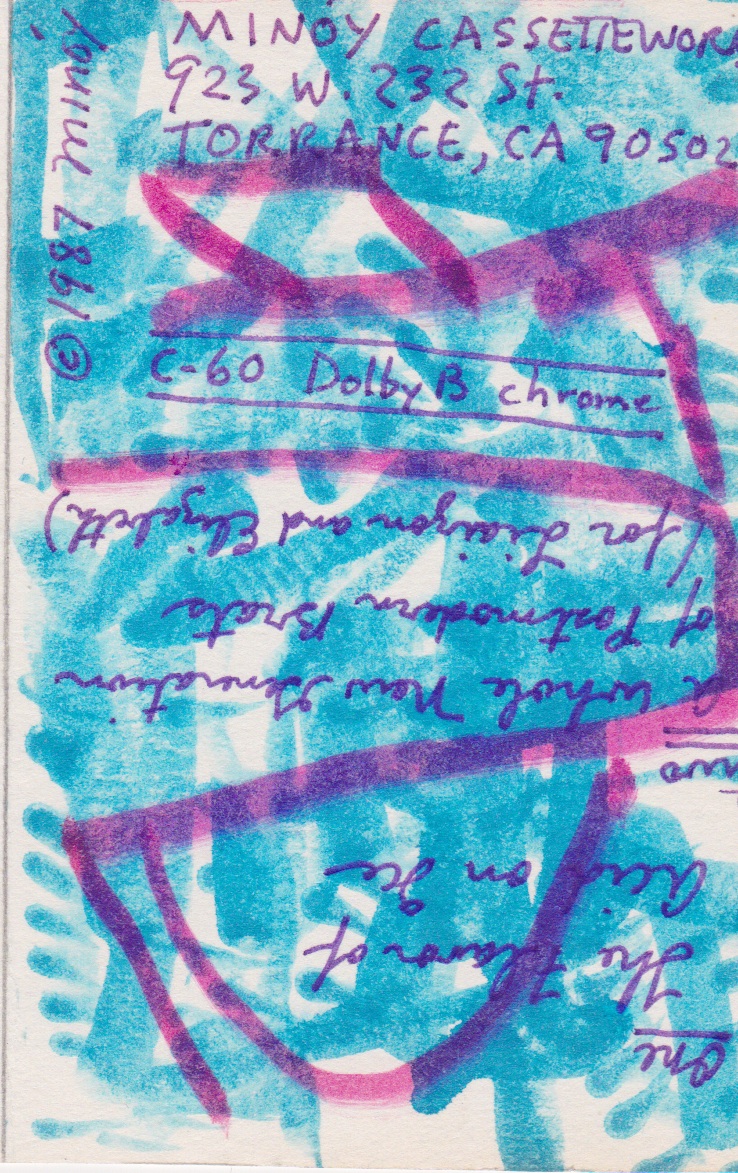
    The inner cover to "The Flavor Of Acid On Ice"
    The inner cover to “The Flavor Of Acid On Ice”
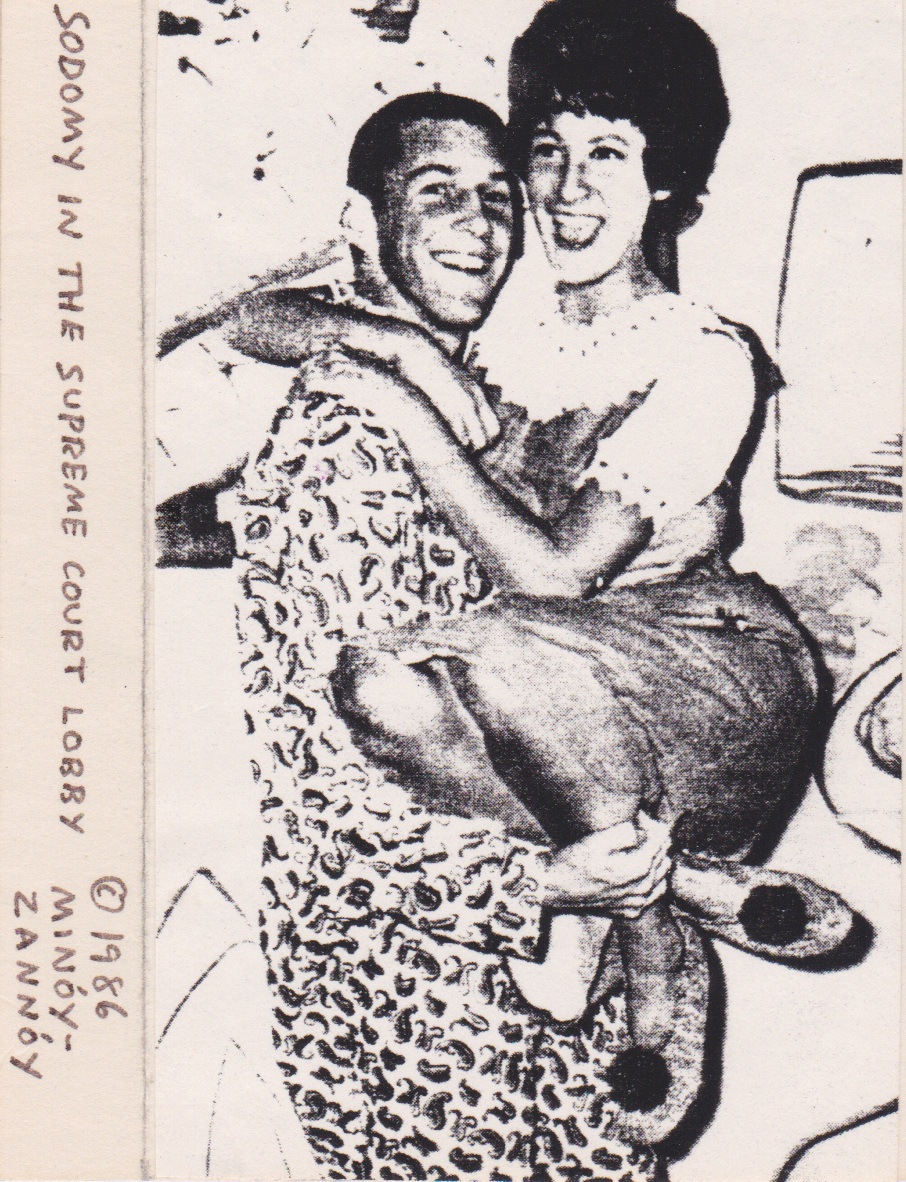
    The first tape I ever received from Minoy, "Sodomy In The Supreme Court Lobby". Released in 1986.
    The first tape I ever received from Minoy, “Sodomy In The Supreme Court Lobby”. Released in 1986.
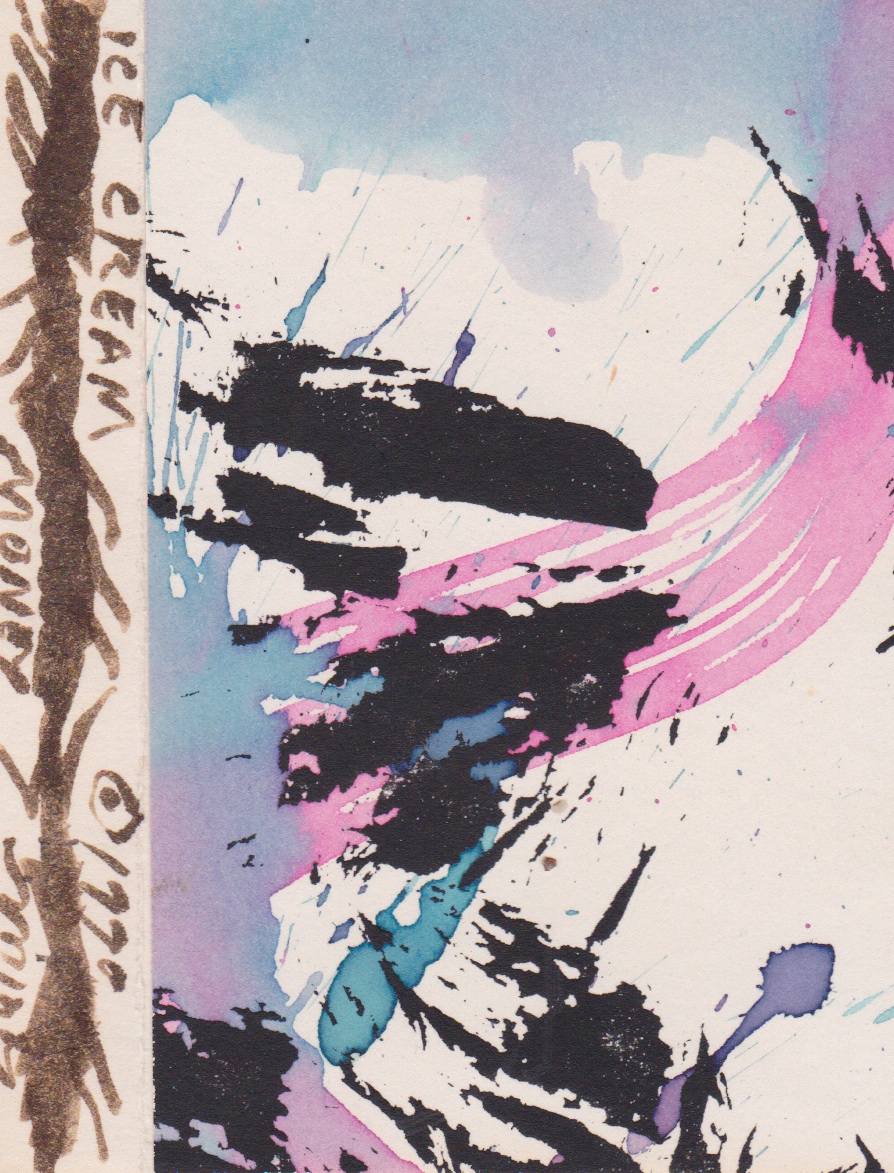
    The hand written inner cover to "Ice Cream Money".
    The hand written inner cover to “Ice Cream Money”.
    "Ice Cream Money" released in 1990.
    “Ice Cream Money” released in 1990.
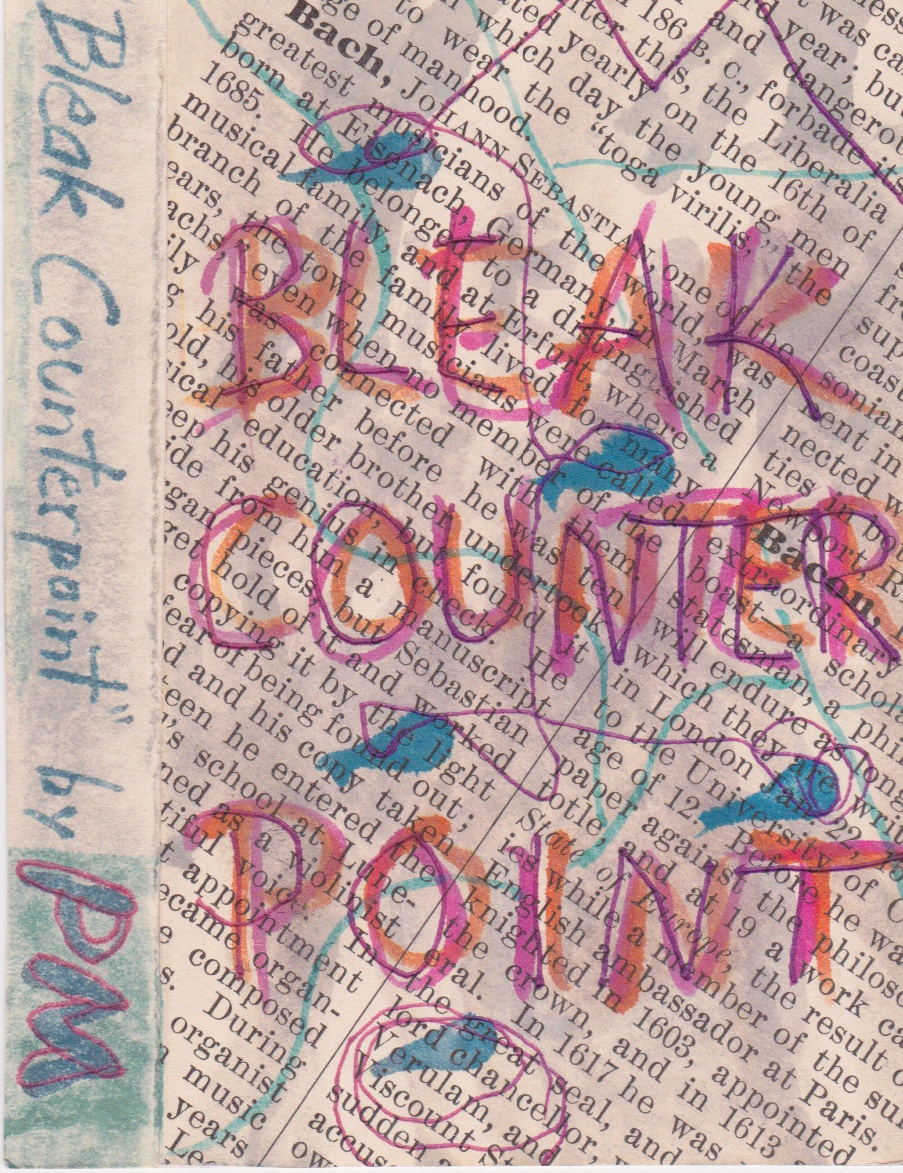
    The inner cover for "Bleak Counterpoint".
    The inner cover for “Bleak Counterpoint”.
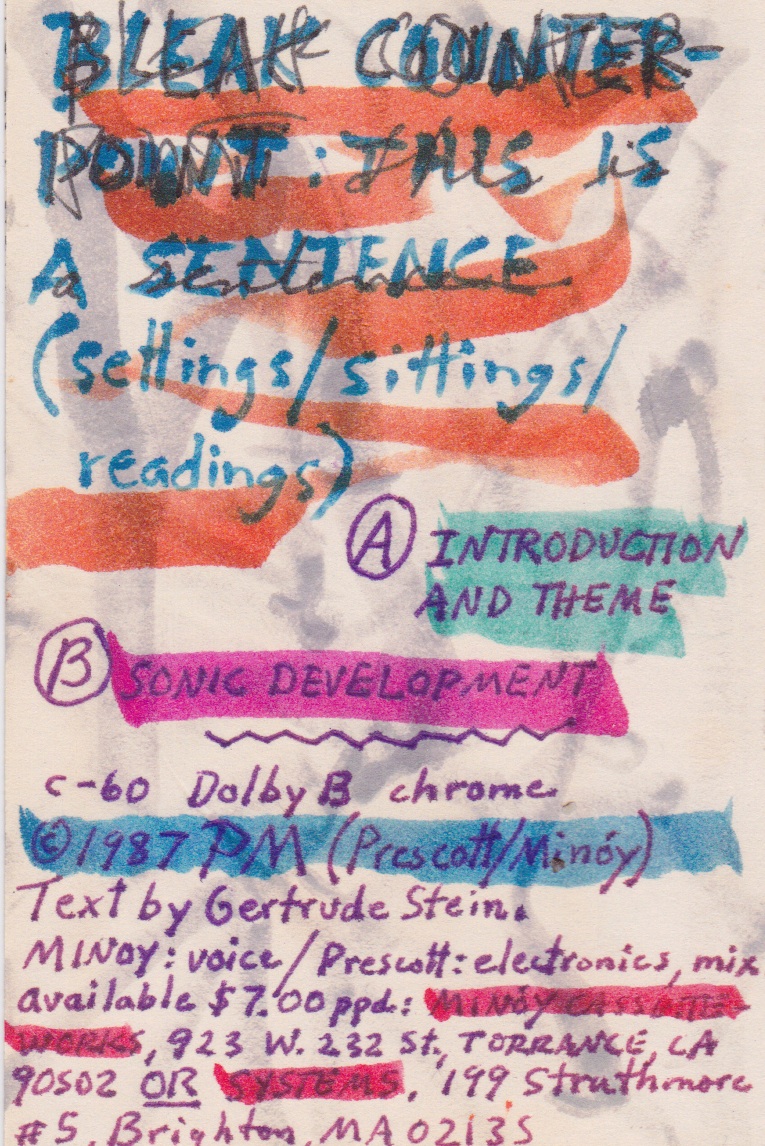
    "Bleak Counterpoint" was a collaboration between Minoy and east coast electronics musician David Prescott. This one came out in 1987.
    “Bleak Counterpoint” was a collaboration between Minoy and east coast electronics musician David Prescott. This one came out in 1987.
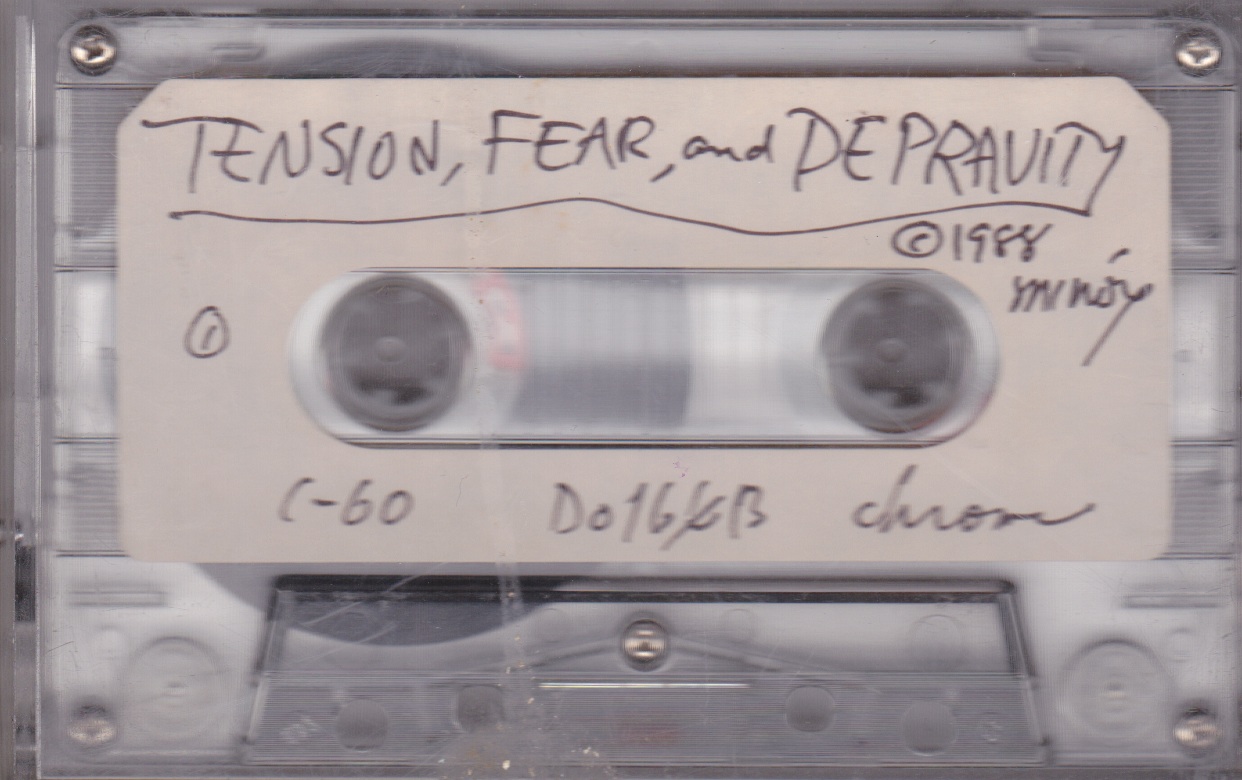
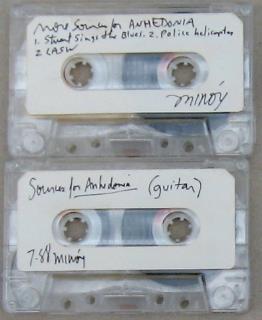
    Most of the tapes I received from Minoy did not feature paper covers but were simply hand inscribed in their plastic shells.
    Most of the tapes I received from Minoy did not feature paper covers but were simply hand inscribed in their plastic shells.
    Photos used in Electronic Cottage article.
    Photos used in Electronic Cottage article.
    I have no mouth and I must scream...Minoy.
    I have no mouth and I must scream…Minoy.
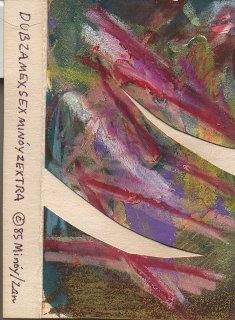
    A Minoy/ Zan Hoffman collaboration from Mike Honeycut's collection.
    A Minoy/ Zan Hoffman collaboration from Mike Honeycut’s collection.
    A couple of Minoy tapes from Mike Honeycut's collection.
    A couple of Minoy tapes from Mike Honeycut’s collection.
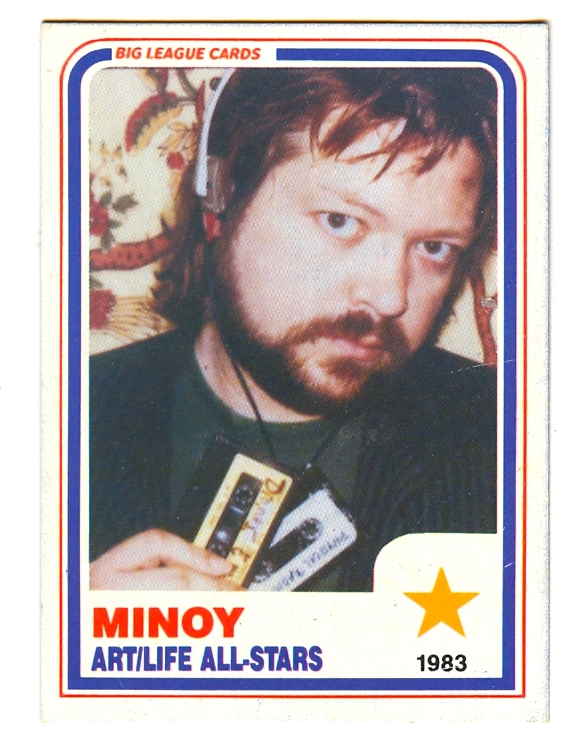
    Minoy's baseball card. Courtesy of Hal McGee.
    Minoy’s baseball card. Courtesy of Hal McGee.
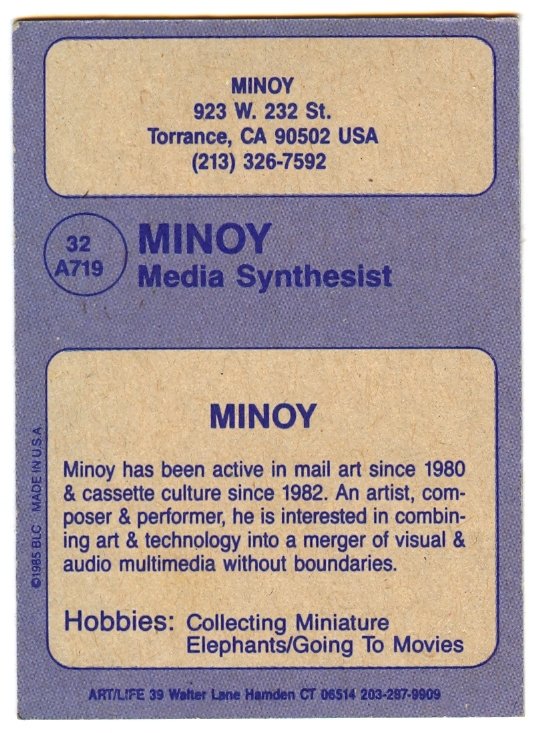
    The back of the Minoy baseball card. Courtesy of Hal McGee.
    The back of the Minoy baseball card. Courtesy of Hal McGee.
    Minoy poster on Philip B. Klingler's wall.
    Minoy poster on Philip B. Klingler’s wall.
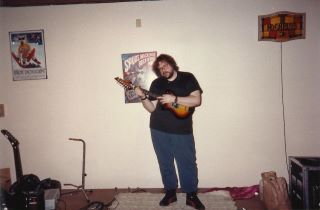
    Minoy with guitar.
    Minoy with guitar.
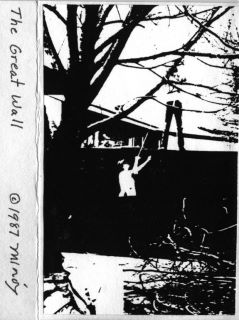
    "The Great Wall" by Minoy 1987. From the collection of Mike Honeycut.
    “The Great Wall” by Minoy 1987. From the collection of Mike Honeycut.
     To the left above, the cover  for "The Flavor Of Acid On Ice" and to the right, the plastic shell which had been coated with an odd resin of adhesive material that was hand colored. 1987. That was a gift to me from Jack Jordan back then.
    To the left above, the cover for “The Flavor Of Acid On Ice” and to the right, the plastic shell which had been coated with an odd resin of adhesive material that was hand colored. 1987. That was a gift to me from Jack Jordan back then.

    Business card tucked into my copy of Sodomy In The Supreme Court Lobby"
    Business card tucked into my copy of Sodomy In The Supreme Court Lobby”

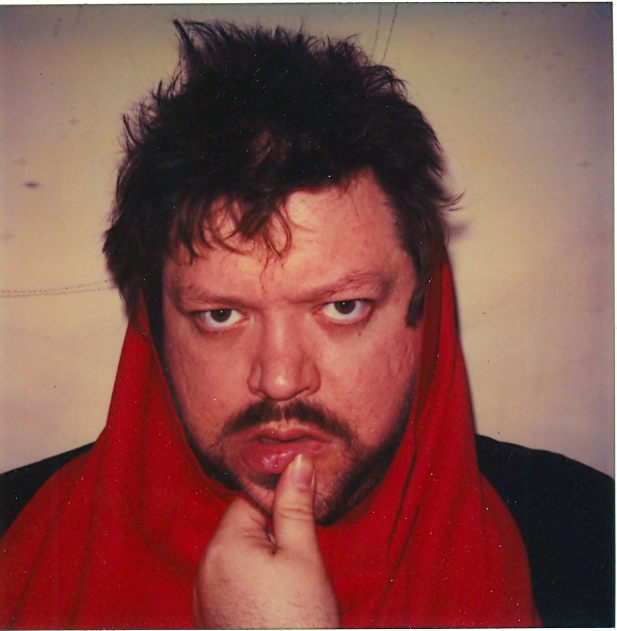
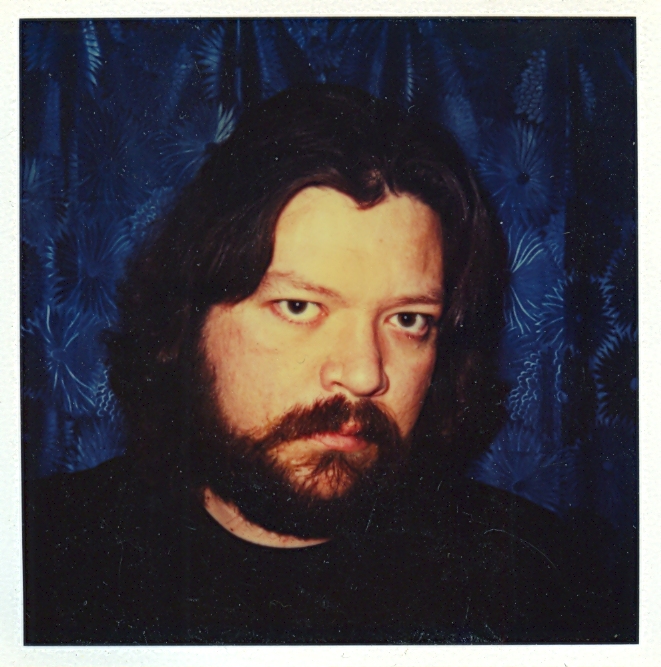
    The artist known as Minoy.
    The artist known as Minoy.

    Stanley Keith Bowsza, also known as Minoy died in 2010. I just found this out recently when notified by Philip B. Klingler on facebook Here was the info
    The information also got posted by his long time partner, Stuart, here
    The name Minoy is supposed the have an accent above the “O”. You will see it in the photos of the tapes. I could not get my text program to do it though.
    I tried to remember when I first heard of Minoy. I thought it had been 1986 but it was actually later, probably early in 1988, maybe 1987. He had blindly sent a copy of “Sodomy In The Supreme Court Lobby” to KKUP for my radio show. No letter, no accompanying info that I recall. I think there was some handwritten communications on the tape cover itself or on a small piece of paper tucked into the plastic cassette shell.
    I don’t think I played it on the show that same day because I was afraid there might be obscenity or foolish, meaningless noise. But not long after I immersed myself in his strange world of sound and came to see how unique it was.Now, by 1988 there had been a lot of noise, electronics, industrial and more in the home recording underground but here was something a little different and certainly as challenging as anything I’d come across in my aural travels.
    My friend Jack Jordan exposed me to many Minoy tapes in about 1988 and we even did a radio show together where we mixed about 60 of his tapes into a long set. Jack was a huge fan and champion of Minoy right from the start. Hear the show here
    Not long after, I wrote Minoy and we started trading tapes and he would send his latest work. I never even knew his name then.The period in the late 1980s seemed the most productive from where I sat and the legend of Minoy grew. To look at, he seemed rather scary or maybe angry. To communicate with though he was anything but. He was always a gentleman to me and although I wouldn’t call him a prolific letter writer he would jot a sentence or two in a communique and add a tape or two.
    I didn’t like all the Minoy I heard. I wasn’t big on the growling, meandering vocals he did. It was uncomfortable to me. His best work to me was the droning collage electronics that would sometimes abruptly stop, poke around in some weird found sound space and then continue on. One of my favorite tapes was “Tennessee Dance Mix” an all out noise attack of torrential waves of sound. I once sat transfixed in my car for almost a half an hour after I got home because I could simply not leave my car until it was over.

    Even in his most outward days he still seemed reclusive though. When he made the front cover of Hal McGee’s Electronic Cottage Magazine I was sort of shocked. You mean, he actually responded to an interview? He didn’t bite somebody’s head off? He sat still for this? At one point in this article he even talked about people he wanted to collaborate with. And one of them was me! Ah, but we never did.
    That ranks up there with not going to see The Beatles at Candlestick Park in 1966, or Hendrix and The Doors in San Jose in 1968 as lifetime regrets.

    When I began The Living Archive in 2009 I knew I wanted Minoy to be the first Artist Spotlight. He is an iconic figure to me…and maybe larger than life because I didn’t meet him in person. I had hoped somehow that he would see the article, the tribute to him, and come forward from the shadows. Maybe he had a bunch of recordings that he had done in the interim that would come to light now.
    But no. He died in 2010 leaving a large legacy of material for us to go through and cherish.
    If you haven’t heard his sounds I hope you download or stream some of what is offered here and at least give them a bit of a listen. It isn’t for everyone. But the power of his music is hard to deny.

    I would like to thank all of the people who helped with this tribute page to Stanley Keith Bowsza aka Minoy: Hal McGee, Damian Bisciglia, Philip B. Klingler, Jack Jordan, Tom Furgas, Greg Mathieson, Mike Honeycutt and everyone who wrote comments. Thanks and condolences also to his long time partner, Stuart for letting the world know about his passing.
    Minoy was certainly one of the legends of the sociological/musical period we call Cassette Culture. Mail artist, noise maker, digital visual artist and enigma.
    My 2009 Artist Spotlight on Minoy here

    Bret Hart
    I reviewed several Minoy releases during the 80’s. I was impressed by the startling sonic violence on the works I heard. The man sounded as angry as his cassette images suggested he might be. There was a depth of tone and texture that was, at the time, nearly unmatched. Disturbing and evocative, like much in the electronic realm can be. He was one of a kind.
    Zan Hoffman
    Don’t wanna “like” this but I must say for those of you who only hear but never wrote Mr. M – he was a gigantic personality! He was keenly aware of modern & contemporary arts and was wildly artistic himself. His audio arts were obnoxiously ahead of there time & it took years for all this to make sense. Surely someone should polish a Wikipedia entry for the boy!
    Tom Furgas
    As an avid home-taper and trader back in the ’80’s I was naturally inclined to network with just about anyone who was interested in trading tapes and exchanging information.  So it was natural that I would hear from one of the greats of home-taping; Minoy.  He and I traded tapes and letters for a short while in the late ’80’s, and I even telephoned him once.  (I specifically remember one statement he made; “Minoy is a myth!”)  His music had (and still has) the power and originality of the greatest electronic composers of the 20th century; I would rank him with such luminaries as Stockhausen and Xenakis!  And this was done with very minimal equipment, I am given to understand.  Just a Sony Walkman recorder, shortwave radio, echo unit, and a few other bits of equipment.  Minoy was never one to be discouraged because he didn’t have access to state-of-the-art equipment.  Many of his works are 30-minute aural workouts, but always continually absorbing and never repetitious or boring.  He didn’t believe in making a lot of obnoxious noise; his music was indeed “music”, but challenging and original.  He had a lot of personal demons and physical illness that often made life sheer Hell for him, but he still created brilliant music and shared it with the listeners and home-tapers who were lucky enough to get to know him.  His taped music is his legacy, and we are fortunate to have it to listen to now that he is gone.
    Al Margolis

    Well serious bummer about Minoy, who i never met and had not been in contact with for many years – i would often here from Zan or Jack Jordan about him or be asked about him – but i no longer knew nothing. And to be honest i cannot remember exactly what i first heard of Minoy’s. looking at an old SOP catalog i see i had a Minoy tack on SOP 15 – Scary World compilation. Which means we must have been in touch by 1985 at the latest. SOP released about 15 of his tapes – as Minoy or as his various collaborations. I think perhaps my favorite Minoy tape is Spaceshot – by PM – Minoy and Dave Prescott – the beginning in fact is brilliant – just Minoy speaking and Dave’s synth..utterly great. And i heard Minoy’s work before i had ever heard Stockhausen’s Hymnen – so that my take on hearing Hymnen was that it fit in this continuum …not the other way around!!!
    And i have some very cool Minoy drawings hanging in our house…we’ll miss ya….

    Bryan Baker
    I only have a few tapes and I’m not sure exactly what. I’ve come across “that which momentously declares itself not to be I and yet must be. It could be nothing else.” It has an art collage of print clippings, foil, and string stuck with melted plastic on the front of the case.
    Roger Moneymaker
    All I can do is shake my head at the passage of time an friends. MINOY was the MAD MONSTA, the Woolly Brain, one of a kind- and a fellow tennesseean! In these end times art is lost in the storm of information. Minoy was a storm of tireless creation. As an artist he found no peace in rest…….now may he Rest in peace. Om nama shivaya.
    Jack Jordan
    Minoy – a legend lost too soon. But you will continue to be emphatically and vigorously alive each time I play your music – which will live on indefinitely and be revered by those adventurous musical souls yet to discover your genius.
    Philip B. Klingler
    I contacted Minoy because of some reviews I’d read of his tapes in Option Magazine. I purchased some of them from him in 1987, sent him a money order. Even though I considered myself to be knowledgeable in music, I had a huge collection of albums, nothing quite prepared me for the unique sound world of Minoy. While living in California I would go record hunting in L.A. and one day I found Ron Lessard’s Due Process “RRRadio Six” album, that LP turned my head around, and then to follow it up with Minoy it was easy to see two distinctly different approaches to abstract sound. Where Ron’s work was playful and dadaist, Minoy’s bedroom isolationist approach produced something that seemed otherworldly, spiritual and more like paintings, which was my own background. I took Minoy’s approach as my own model.
    Collaborating with him was an overwhelming experience, but I don’t think he trusted me at first, he asked to keep our first collaborations anonymous and we created together a “hoax” project called Disco Splendor. The aesthetic that we determined for this project, that of repetitious, banal, meaningless noise was a kind of quest to find out just what “flew” in the cassette underground, what would be denounced as ridiculous or dreadful in this new world? In those days there was no blueprint for what any of us were doing, there had certainly been assimilations in rock music of the experiments of Stockhausen, Pierre Henry, or John Cage, and we knew of those things, but what we were doing with noise had not been tried to such an extreme. There was no internet and it was very difficult to find out what others were doing concurrently that might be similar to our own. (and when I say “we” I am talking about a number of artists, a certain zeitgeist happening simultaneously in different parts of the world) Ultimately, Disco Splendor proved nothing if not that the ears and minds of the artists and fans of experimental music were wide open to new possibilities, and even the most excessive sorts of approaches. So, the project was put behind us and we worked from then on as Minoy/PBK.
    There is a photo from 1988 of my studio wall in California where I have a cork board attached, and pinned on it are pictures of some of my heroes, there’s Jiddu Krishnamurti, Charlie Parker, Max Beckmann, William S. Burroughs… and Minoy. That is how highly I thought of him.
    Minoy had the largest collection of homemade experimental tapes I have ever seen, this was in 1987. It was immense, he had shelves covering the walls of his room. When he showed the tape collection to me on a couple of occasions, I glanced about and noticed his messy bed with blank tapes and papers strewn about, a tape recorder with hand-held microphone. He told me he did most of his soundwork late at night in his bed.
    During a fevered six year period, between 1986 and 1992, Minoy created hundreds of unique audio works. He defined the “mail collaborator”, which suited his personality and phobias- he was an agoraphobic and didn’t like to travel, could not drive a car. He was addicted to his mailbox and would receive stacks of mail. On the days that I spent with him the mail carrier would bring his mail bound in twine there was so much of it. He adopted the name “No Mail On Sundays” for his sound project with Damian Bisciglia, a reference to his postal addiction.
    We performed at the University of California, San Bernardino, the now infamous “Devil Music” concert, and I had assured Minoy before that everything would be fine, coaxed him to do it, told him people would dig it. In retrospect, I think that performance took a toll on him. Even for all the validation Minoy did receive, it was events like this that made him acutely aware of how unacceptable and misunderstood his creative works were to society at large. He was a non-conformist who wanted love.
    Throughout the 2000’s we kept waiting for him to surface, thought to ourselves he is somewhere out there observing all that’s going on, maybe he’s working under a pseudonym. But the truth is very far from that: he quit making music. Nevertheless, the things he did record represent, to me, a pinnacle, they are some of the most remarkably beautiful and imaginative work-of-art albums released on cassette in the 1980’s. We will save what of it we can and I hope it inspires future generations as much as it did me.
    Little Fyodor
    I am very saddened to hear of Minoy’s passing.  I very much admired him for the distinctive quality of the sound of his labyrinthian and highly textured personal brand of “noise”.  Lots of people made experimental and ambient noise back in the cassette days – and still do! – but I don’t know if I’ve ever heard anyone else approach the type of distinctive sound that Minoy made his signature, which I consider a great and wonderful feat of his.  My most direct interaction with him was via his involvement with the Walls Of Genius compilation tape, Madness Lives.  His contribution was called “Guadalajara Dry Heaves”, which, for most its 4 1/2 minutes paired his usual unique soundscape with intermittent interruptions from seemingly random sounds and voices.  Right when one of the voices says “Guadalajara”, the soundscape quickly fades away to be replaced by – you guessed it – the sound of someone suffering through the throes of the remainder of the piece’s title!  This, in turn (before, thankfully, too long!) , is replaced by the sound of a media talking head announcing the release of “We Are the World”!  On which note the piece abruptly ends.  Yes, we got it!  It was a perfect contribution for Madness Lives since WoG’s twofold goal for the comp was to simultaneously represent a genuine cross section of the cassette “scene” as it were while simultaneously bringing out the more, ahem, wacky, you might say, side of said scene, since, after all, that’s what WE were into.  Minoy did a fabulous job of being Minoy yet fulfilling the theme of the comp as well!  Ah well, it’s but a small data point of an interesting person and life amidst a vast sea of earthly culture amidst of much vaster and quite spacious universe.  Death, as the idly swimming fish near the beginning Monty Python’s “Meaning of Life” noted, makes you think.  My hats off to you Minoy, and my condolences to all who knew him a whole lot better than did I.  - livingarchive.doncampau.com/lost_and_forgotten/minoy-the-passing-of-a-legend


Jairus Victor Grove - Something Darkly This Way Comes: The Horror of Plasticity in an Age of Control


Izvrstan novi teoretičar - geopolitika, antropocen, ratovi, nevidljivo nasilje...

jairusgrove.squarespace.com


The Horror of Security
DESCRIPTION
Contemporary geopolitics as curated by the United States is in a permanent beta phase. Neuro-torture, algorithmic warfare, drones strikes, cybernetic nation-building are not means or ends but tests. Can a polis be engineered? Can the human operating system be reformatted? Can violence be modulated until legally invisible while all the more lethal? Each incursion, each new actor or actant, new terrains from brains to transatlantic cables, all find themselves part of a grand experiment. Over the course of this seminar we will explore how classically Realist concepts of order and national interest have been subtly displaced by subterranean violence entrepreneurs that populate the transversal battlefield of security politics. Doomsayers like Paul Virilio, Lewis Mumford, and Martin Heidegger who foretold a kind of terminal and self-annihilating velocity of security's technological saturation are today being shown to have been optimists. Security doesn’t know totality or finality: it bleeds, mutates, and reforms. Furthermore the peril of biopolitics seems now almost romantic. The care and concern for life’s productivity is increasingly subsumed by plasticity—forming and reforming without regard to the telos of productivity, division, or normative order. There are of course orders in our geoplastic age but they are almost unrecognizable as such when so many are directly invested in the intensifying failure of publically-stated strategic ends. In an attempt to confront the particular differences that mark our historical moment we will explore thinkers and practices that organize violence and pain beyond the limits of identity and mortality. We are witnessing creative and horrifying experiments in the affirmative production of dying that also deprive those targeted, in some cases whole population, from the relief of death. The horror of security politics is not tragic. Tragedy redeems. The horror of contemporary security politics is precisely that there is no relief, no reason, no victory, no defeats, no exit. Throughout this seminar, therefore, we will explore the problem of life and identity in the age of sustainable warfare.

Dangerous Algorithms: The Weaponization of Drones, bots, and Informatics


Thinking Like a Bomb: An Ecology of Global Warfare


Horizontalizing Quantum Thinking: World War I and the Aleatoric Cosmologies of Whitehead, Duchamp, Keynes, Goldman, JFC Fuller, and Plank.
The talk begins at 28:16 http://projectqsydney.com/portfolio/q2-war-memorial-transformational-and-gendered-panel/
A Recenty Apocalyptic Tone in Everything: The Anthropocene or Peak Humanity?
A condensed article version of a book chapter by the same name. Part of a special issue on William E. Connolly's new book the Fragility of Things.
  
Something Darkly This Way Comes: The Horror of Plasticity in an Age of Control [Do Not Cite Without Permission]

The Blood of Geopolitics
Must We Persist to Continue


srijeda, 14. listopada 2015.

M. Lamar - Negrogothic: Surveillance Punishment and the Black Psyche (2013)


Negrogotika = romantizam + nadrealizam + horror + pornografija + gospel + metal + rani nijemi film.

www.mlamar.com/


Brandon Peter Masterman: In the Belly of the ShipParaontological Blackness and Sonic Abjection in the Music of M. Lamar

http://www.vice.com/read/the-plantation-is-still-here-inside-m-lamars-negrogothic-a-manifesto-exhibition?utm_source=vicetwitterus


M. Lamar is an artist whose work in music and performance straddles the genres of gospel, opera, punk, goth, and metal and blues traditions. While these sources may seem broad-ranging and disparate, Lamar has found a way to synthesize them into a cohesive musical, political and aesthetic statement. Connecting the virtuosity of operatic voice to that of the gospel soloist, goth’s dark theatricality to operatic grandeur, the mournfulness of the blues to punk’s political agendas, Lamar seeks to understand how colonial and plantation narratives about gender and race underlie daily life in the US.

The result of this fusion is vocals that haunt, lyrics that expose endemic problems, and performances of baroque grandiosity that point to capitalist excesses. Through an exhibition at PARTICIPANT INC last summer and a recent performance at Issue Project Room last month, Lamar has produced a series of short videos, prints, and sculpture to accompany his songs, with the videos to be consolidated into a longer film tentatively called Surveillance, Punishment and the Black Psyche, currently in production.
Risa Puleo How are you?
M. Lamar I’m frustrated. How are you?
RP I’m upset. I just came from a conversation about how people living with HIV are criminalized. Michael Johnson, a young man in Missouri, was recently sentenced to 30.5 years in prison for allegedly transmitting and “exposing” others to HIV, though there is no evidence to prove this.
ML How do they justify that? It’s not legal!
RP If your jury includes a group of conservative people who think the only acceptable sex is missionary within the confines of marriage, then a sex life filled with other kinds of sex acts with multiple partners is constructed as evidence of irresponsibility. This is how he was constructed as a threat to public safety.
ML But it’s a fiction though! Related to the imagined over-sexualization of the black man since plantation times.
RP Since the medieval ages, at least! When Christians defined themselves against Jews and Muslims by projecting sodomitical sex acts.
So now that we’re both upset… this is a great segue into your work, because self-making and world-making against fictions of black masculinity and sexuality are really important aspects of what you do.
ML It is. The only way you can create different kinds of possibilities within this current political and cultural context is to imagine them. The question is how we imagine. In my process there has to be an acknowledgment of what has happened to people—black people, in my case. One can’t be delusional. Many people walk around in a haze believing that horrible stuff isn’t happening all the time. We still have very serious situations in prisons, with poverty. I think fully acknowledging that and trying to make a fully emancipated self—who is aware of the past but is also trying to make a difference in the present and future—is important. I find a lot of solace in my own practice; it enables me to go on. It’s a question of survival for me, this world-making, imagining the possibilities for a different kind of self and fighting for that, too.
We can just stop there in a way. This is what I’m trying to do.
I mean, I’m frustrated. As I enter a kind of public sphere, people are wanting to put me in an identity box.
RP What are the words you get tagged with?
ML I get invited to show a lot with transgender people, and I am not transgender. I’ve never said that I am. It’s confusing to me as someone who is trying desperately to liberate himself from all these forces. The difficulty of stepping outside the status quo is that your life is more difficult. Transgender identities are mainstream right now, but I think in terms of representation, people don’t seem to be stepping outside of a binary presentation. I just don’t think that that’s liberatory. Even as we push against all these hegemonic forces, there still seems to be a status quo that reinserts itself, because under capitalism you need a new take on something. So the new take on femininity is trans femininity. The new take on masculinity is trans masculinity, but the hegemony is still in place, nothing has been dismantled. On one level if we acknowledge that transness is inherently hegemonic, maybe we can get to something truly radical and challenge these kinds of constructions.
RP What are the words that you prefer?
ML I consistently describe myself as a “NEGROGOTHIC devil-worshipping free black man in the blues tradition.” I’ve been really loud about that, but people want to understand my identity by some preexisting script. I’m trying to write my own script. That’s where the frustration comes from, where you’re constantly trying to construct yourself and people are pushing you back. We were saying this yesterday: liberation isn’t something you do and you’re done. It’s a constant fight.
But I also reject notions of fixity. I am an artist. I am a NEGROGOTHIC, devil worshipping, free black man in the blues tradition. Those are the things I am now. I have this trouble with identity as a noun—even the notion of sexual orientation. The idea that there is one is a fallacy. Our sexual orientation changes and mutates throughout our lives. I use the term “practicing homosexual,” and I reject the notion of being gay. It’s all very bourgeois and white. I like the idea of being queer, or queerness as a verb rather than as a noun. Sex and sexuality is a thing that you do, not who you are—it’s not ontology. But fucking, I do that. So what? It’s a very reductive thing, to define people according to sexuality. It’s a very Western, scientific thing, the desire to name something and put it in a box. I just reject the names that aren’t my own, the names I haven’t given to myself.
RP You’ve also been making a lot of work recently that defies identifiers: music that crosses blues, opera, goth, punk, metal, and gospel traditions; performances on stage and for videos and still images.


Surveillance Punishment and the Black Psyche, Part Two, Overseer, 2014. HD video, 05:00 minutes.
ML I feel lucky that I’ve amassed a significant body of work. At PARTICIPANT, I showed the first part of a film that will be a feature, tentatively called Surveillance, Punishment and the Black Psyche. There’s a book coming out of the PARTICIPANT show called NEGROGOTHIC. It will have librettos for Negro Antichrist and Surveillance, Punishment and the Black Psyche, text from my Lynching Song Cycles and The Speculum Orum Requiem, and essays by lots of awesome people that I can’t say by name right now.The book is made possible through PARTICIPANT, the Harpo Foundation, and the Walter McBean Galleries of the San Francisco Art Institute. I’m pretty excited about the work that’s coming: a new recording with Mivos Quartet with Charlie Looker doing the string arrangements for the feature film. This project is supported by The One Archive and USC, and I’m doing a big performance and exhibition there in April. And I have a new piece at PS1, called Tree of Blood, that’s connecting this new revolutionary energy generating out of justice movements like Black Lives Matter with my research and past work on lynching.
RP Can you tell me more about Tree of Blood?
ML There’s lots of imagery about the dead rising up. I don’t want to be done with the dead. There is a finality—especially if you’re not a Christian—with death. The Christian tradition invests in an afterlife. The African tradition does too. A lot of spiritual music is about death, meaning that you’re going to die at some point, so this will be over. Really, my investment in this NEGROGOTHIC, devil-worshipping, free black man blues tradition is about a rejection of that. The blues began to form out of emancipation. It was a rejection of the enforced Christianity that was a part of slavery.
RP What dead do you want to speak to?
ML I particularly want to have a conversation with those we have lost in struggle. Sandra Bland, the black woman stopped by the police for some routine traffic violation in Texas who died in jail three days later, is a freedom fighter and a revolutionary. To me, the video of her not cow-towing to the police—being very defiant, knowing that she was involved in Black Lives Matter, knowing that she could die—is so moving. It’s like a Biggie Smalls “ready to die” moment. I don’t want to accept that she isn’t always going to be speaking to those of us who are lovers of justice. Or that Martin Luther King or Trayvon Martin or Mike Brown or Emmett Till or Emmett Till’s mother won’t always be the legacies.
RP On one hand you’re talking about memorialization, but really you’re talking about conjuring, incantation, spirit-to-spirit communication between the embodied and disembodied souls.
ML I’m very interested in ideas of possession, of being a vessel. I think the best singers, dancers and actors are the people who become conduits for spirits, energy channeling. Channeling and possession can’t be done when the ego is in the way. You have to let that go for stuff to move through you. I really believe that. Anthony Paul Farley has been writing about zombies relative to race. The dead can’t sing, but we know that the dead are singing to us all the time through spirituals and black music. If the dead can’t sing then maybe they’re just asleep, is what Farley says. And if they’re sleeping there’s always the possibility of awakening. A lot of Black Lives Matter, Ferguson, Baltimore, Oakland, is about a certain kind of awakening. It’s very exciting. Even if it’s squashed, and all evidence suggests that it will be extinguished as a movement, at least we’re going to go out fighting.
RP Grief is an enormous political force motivating action right now. And there is a renegotiation of how people are reacting to fear, not being terrorized into submission.


Discipline VI, 2014. Archival pigment print on canvas.
ML The song that I wrote, “They Hung Her on the Deck” in Speculum Orum, is about the whipping of a black woman on a slave ship to install fear. It’s connected to a famous illustration. It’s a profoundly liberating moment to not be a afraid. I’ve been stopped by the police many times. I have been very much afraid. I haven’t been ready to die like Sandra was or Biggie, although I don’t think Biggie was ready then to die. I’ve been very afraid, and I think a moment in emancipation was about not being afraid. Marcus Garvey’s people would march with signs that said, “We are not afraid.” Malcolm X would talk about not being afraid. That’s one of the ways black people have been terrorized, with lynching. Lynching was about creating fear to keep the rest of the Negroes in line. In that Nina Simone documentary on Netflix, someone asks her, “What does freedom mean to you?” And she says, “No fear.” That sentiment means so much to me.
There’s always this mourning happening in my work. How do you grapple with profound loss and profound devastation? But in this new phase in my work, I’m trying to create a revolutionary impulse, what Cornel West calls “a black prophetic fire.” It’s about a longing to connect deeply with those we’ve lost. It’s a longing to remake the world anew. Really this new show at PS1 is about trying to put yourself back together. I’m in pieces.
RP This is kind of the opposite impulse of your song, “I’m Trying To Leave My Body,” which is about dissociation. You’re speaking about reintegration spiritually and physically.
ML If a body’s been traumatized, one has to go some place else. “I’m just trying to put myself back together, I’m walking around in pieces.” Many of us are walking around fragmented or dismembered. Parts of our spirits, our psyches, our bodies, are hanging off, barely there. Many of us are walking around decapitated, not whole selves. There is also a very literal meaning of “being in pieces.” I was reading the story of this one man who survived lynching. He had been castrated, and he continued to live in this dismembered state.
RP This relates to the story Willie Francis in the narrative for Surveillance, Punishment and the Black Psyche, about another man who survived an execution.
ML Surveillance, Punishment and the Black Psyche is loosely based on the story of Willie Francis. I say loosely because I had to make up a lot of facts, because much of his story is unknown. What we do know is that they attempted to execute him in 1946 and it didn’t work, because the electric chair was installed improperly. Then the NAACP descended upon St. Martinville, Louisiana. He was allegedly having a sexual relationship with the man he was accused of killing, a 53-year old pharmacist, a white man. Willie Francis would have been 14 or 15 years old at the time. I was trying to imagine what interracial homosexual dynamics look like in plantation times or under Jim Crow. What did their relationship look like? There are always questions of consent when someone is underage, or in bondage in slavery, but he didn’t seem coerced. Maybe he was manipulated. Maybe he was paid. We just don’t know. I was trying to understand what the dynamic must have been when someone in bondage desires the touch of a white man.

Mapplethorpe’s Whip V The Trophy Collectors, 2014. Archival pigment print on canvas.
RP The way you reconfigure Mapplethorpe’s image (Self-portrait with Whip) in the video made me think about how BDSM allows people to recreate these same master-slave scenarios with awareness and consent. It’s the other side of the possible dynamic you’re describing, where the power inequity between a black boy and white man in Louisiana of the 1940s is so pronounced. For instance, in the film The Night Porter, the relationship that happens between a SS officer and a Jewish woman in a concentration camp, when recreated by the same officer and same woman outside the camp after the war, carries all the traumatic weight of their shared history.
ML Mapplethorpe was obsessed with black men, and that’s no secret. We seem to be some symbol of his transgression, as if he was a radical, white male artist because he was daring to be fucked by “big, black cock.” He’s reenacting a white supremacist fantasy, what I call plantation fantasy, imagining black people as overly-sexualized with enormous genitalia—black women and men. White people have this incredible fantasy world around the sexuality of black people. By casting Mapplethorpe as plantation master, I’m trying to give back this construction of the white supremacist imagination. It’s yours, you made it, here it is. I don’t want this anymore. I’m trying not to be didactic in the work, but I don’t want this. I don’t want this thing placed on my body.
RP Thinking about Michael Johnson’s case in Missouri; he was a wrestler using the name “Tiger Mandingo,” referring to the West African people imported to the American South as slaves, whose name has become an equivalent for “big, black cock.” This image, which he participated in constructing, worked in the minds of the people he hooked up with and against him in court.
ML We’ve all internalized white supremacy. Even if you’re a black person only engaging in sex with black people you still deal with this, because we all have that stuff going on. Black masculinity gets constructed in very particular ways, and many men like playing that role. There can be something enjoyable about that for sure, but we won’t be truly liberated until we can move into a different place and embrace different parts of black masculinity. That’s why I get really frustrated when people want to say that I’m transgender, and I say: No, I’m a black man, and black men look all kinds of ways and exist in all kinds of different spheres. I want to proclaim that proudly and also claim these different kinds of ways of existing as a black man.
RP Your images don’t look like Mapplethorpe’s images of black men though. There’s not a lot of variation in how he wants them to look.
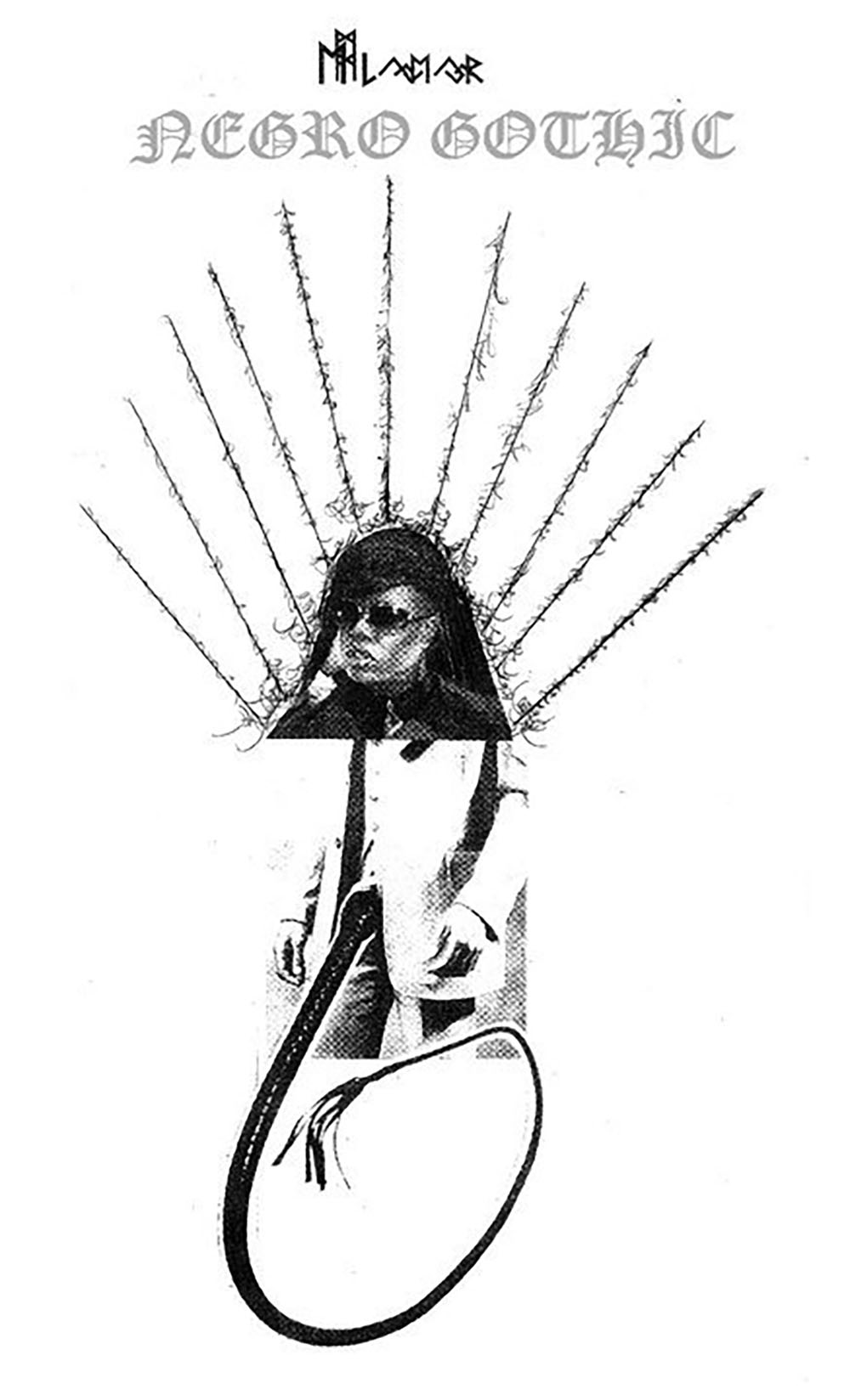
ML I placed my head on top of his collage Man in a Polyester Suit. It’s a decapitated man—the most important thing about that image is it’s decapitation. This was the cover of my 2010 cassette tape, Negro Gothic, and the first time I used a whip. I replaced the penis with a whip, making it a phallic object. I play with the etymology of the word “cracka’,” which comes from “whip-cracker.” I wanted to show how the black penis is a construction of the white imagination. For the record, black penises aren’t any bigger than any other penises. But it’s this power that it’s being given, and so I made it a whip—again this construction that I wanted to give back.

Re-capitation or Re-membering Towards a Negro Cyborg, 2010. Collage.
RP In addition to critical race and queer theory, you’re also talking about punk politics. Punk is about living your politics at every level of life: what you eat or put in your body, non-conforming dress and presentation, staking a position against capitalism and patriarchy and oppression. What was great about show-space was the way that everyone talked about these things. This is an ethos that’s missing these days, instead of all this empty chatter.
ML I was first politically radicalized when I was 15, 16, 17. I would go to punk shows and they would pass out lyrics for songs about being vegan, or the horrible things they do to animals, or patriarchy. That stuff to me was really formative; punk rock shows are so politicized. They’re an on-the-ground kind of activism. Like having lots of straight white men talking about patriarchy in public, asking, “What does sexism look like? What does misogyny look like?” I think it’s more important to talk about these things in groups of men by ourselves instead of only when women are present. It’s like talking about racism only when a black person is present. Patriarchy has no gender, but we can’t only put that onto women, or racism onto black people. It’s not only the job of women or people of color to end this.
RP It’s like you were saying about music being a spiritual force, it can also be a political force.
ML Cornel West recently said that black music is in a state of decline, that hip-hop is brilliant but investing in the charismatic front person as opposed to groups of people harmonizing. What does that mean politically? It supports a certain kind of American individualism versus a collectivity. The operatic diva is a figure I’m invested in as a trope, but she’s the same thing. What’s most compelling to me about Black Lives Matter is that it’s a movement with black women at the forefront, not about a charismatic male leader. There’s no Al Sharpton or Martin Luther King type. It’s a different kind of model, and it’s about a different kind of awakening.
RP Punk is a middle ground between the front man and the harmonizing group. It’s about individuals operating within a group as individuals while thinking about group concerns.
ML I credit my relationship with my boyfriend for turning me away from the need to be a loud, aggressive person fronting the band. A year into the relationship I wanted more intimacy with an audience. I think it was directly related to feeling loved for the first time in my life. In terms of revolutionary possibilities, all the deep people in the tradition of Martin Luther King talk about love as an action that can do—that has the ability to change a life and change political struggle. Love is the most enabling thing in terms of your life. It means you can proceed from a stronger position. I believe deeply in love. I’m a deeply romantic person. But I also believe in justice. Justice and love, what else is there? Vissi d’arte, vissi d’amore is a line from Puccini’s Tosca when she goes to kill Scarpia, the man who raped her, and she asks god, “Why did you allowthese things to happened to me? I’ve lived for art, I’ve lived for love.” I really like this, I’ve lived for art, I’ve lived for love. But for me those things are caught up in questions of justice.  -
Risa Puleohttp://bombmagazine.org/article/0984107/m-lamar

Lamar demands attention in his 2013 video Badass Nigga, the Charlie Looker of Psalm Zero Remix.
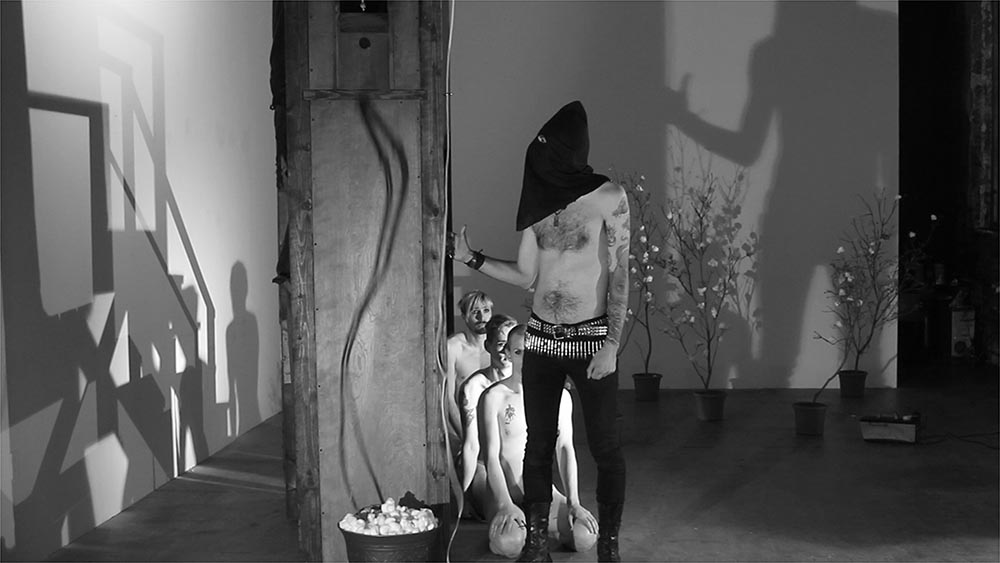
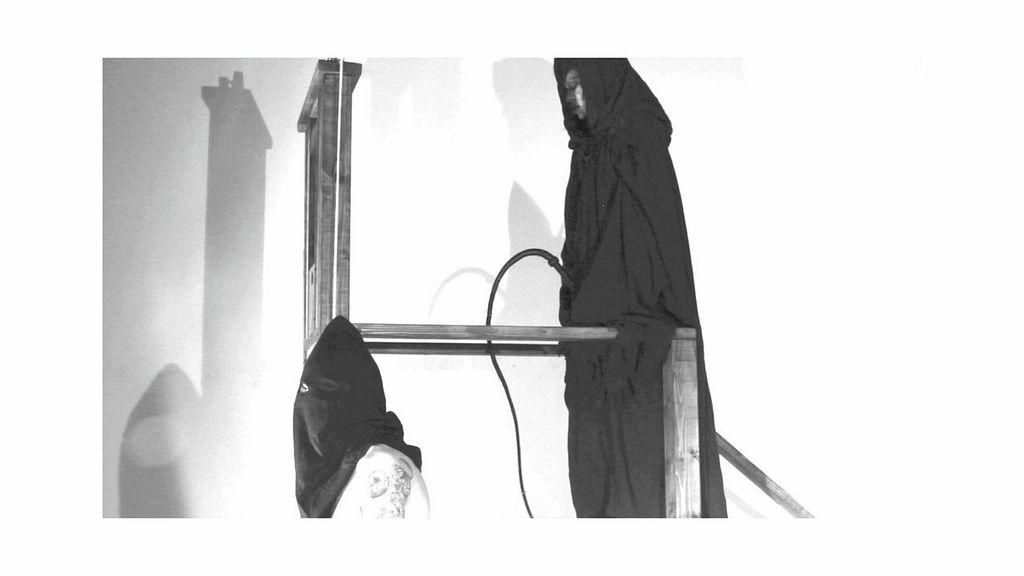
Standing before a 9-foot-tall contraption he calls "The Penis Guillotine," artist M. Lamar raises its blade with a cord, pauses it in the air for dramatic effect, then releases the metal with a sudden exclamation. The sound of steel crashing into wood (thwatt!) echoes around the San Francisco gallery that's exhibiting Lamar's artwork, and he lets out the kind of Oscar Wilde-like comment for which he is known: "I like playing with that."
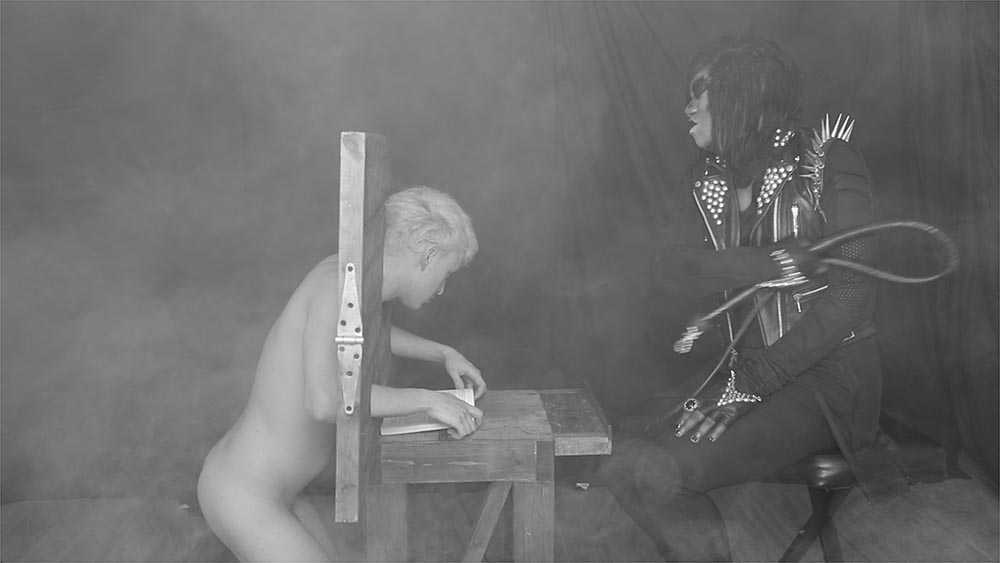
An African-American intellectual, composer, and artistic provocateur who analyzes sex and race in society, Lamar wears spiky leather jackets and gloves, heavy eye shadow and lipstick, and hair that is straight and shoulder-length. Lamar looks, sounds, and acts like few other people in the art world, exemplified by his video Badass Nigga, the Charlie Looker of Psalm Zero Remix. One of Lamar's "fun songs," it opens with Lamar sitting and reading a trio of heavyweight books — The Cornel West Reader, which compiles the writings of the Princeton professor; Beloved, by novelist Toni Morrison; and The Phenomenology of Spirit, the German philosopher Hegel's magnum opus — before Lamar gets up and puts two naked white men into a pillory that clamps their heads and hands. In stylish, smoke-filled black and white footage that is slowed down and sped up in key scenes, Lamar sings in a beautiful falsetto (a la Sylvester) as he forces the men to read his tomes and begins to whip them in the face. "I'm a badass nigga with a badass attitude," Lamar croons, accompanied by piano and dissonant instruments in a song that is catchy, sprawling, and almost unclassifiable. "Fuck you, fuck you, fuck you."
Badass Nigga, the Charlie Looker of Psalm Zero Remix is one of the videos that screens in "Negrogothic," a new exhibit at the San Francisco Art Institute's Walter and McBean Galleries that's a homecoming for Lamar, who got his bachelor's degree at the school about a decade ago before moving to the East Coast to attend Yale's School of Art sculpture program. Lamar won't say what year he graduated from the San Francisco Art Institute. He won't give his exact age. He won't let a visitor take his photo. Lamar dislikes being labeled by others, and he rejects the term "gay" as a personal descriptor. "I don't describe myself as a gay, black man — I describe myself as 'a practicing homosexual.' 'Homosexual' is about the act. 'Gay' is a cultural thing. I'm much more interested in the act than the culture," he says.
A running motif of "Negrogothic" is the whip and an examination of celebrated photographer Robert Mapplethorpe, whose portfolio included many images of naked black men who were bent over or shown in bondage or posing with their phalluses. Mapplethorpe, Lamar says, stereotyped and misunderstood African-American men — even as Mapplethorpe was heralded as a ground-breaking image-maker. Generations of white society have, consciously and unconsciously, sexualized and objectified the black penis, says Lamar, whose art spotlights that historic fixation by reversing the dominant roles. In stills like Mapplethorpe's Whip VII The Whip Crackers, Lamar wears a dark full-length robe as he inserts a whip into the rectums of white men. Lamar is the overseer. Lamar dictates what goes where with participants who volunteer their bodies to him. There's no coercion in Lamar's artwork, even as he plays with positions of power. Genres of pornography consumed by whites are devoted to black men, which Lamar relates to lynching. Lamar's art, he says, plays off of these market demands.
"Having this black body and my black penis — on one level, I just keep writing songs about my cock," Lamar says, laughing. Turning serious, he says: "This 'Negrogothic' thing is located for me in the schlocky goth thing and in the real-life experience of black people and the horror of it. It's almost like indulging in the horror ... So much a thing of lynching was cutting off black cocks, and [the lynchers] would pickle those cocks. They'd force the lynched man to eat his penis before he died. They'd cut it off, pickle it, photograph it, sell the photographs.
"Black men are dealing with the sexual ramifications of lynching every day. We're living with legacies of lynching on porn sites. If you go to those sites and type in, 'Big, black cock,' or 'My wife fucked a big black man' — there are millions of titles. When I talk about Ferguson and Mike Brown and Trayvon Martin and the ways in which they were shot dead, the flip side of that is this over-sexualization of the black male body on these porn sites. The 'big black cock' mythology is an invention of the white imagination. It's a fantasy. I like the idea, in a surrealist way, of making the whip also this black penis that white people have invented. It's like, 'Here. This is your invention. It's your thing. Have it back.' I try to understand the black body in the white imagination."
Lamar has traipsed through white environments all his life, including at Yale's School of Art sculpture program, which he left early to focus on music. In Surveillance Punishment and the Black Psyche, a sweeping and moody musical theater piece that he's performing at the San Francisco Art Institute on Friday, Feb. 13, Lamar includes video of Jamie Foxx's 2005 Oscar speech, where Foxx thanks his maternal grandmother for raising him with discipline, including whipping him. In Surveillance Punishment and the Black Psyche, Lamar includes a video of Foxx's "whipping" tribute ("when I would act a fool, she would beat me, she would whoop me, and she could get an Oscar for the way she whipped me, because she was great at it"), which inspired widespread laughs at the Oscars but inspires consternation in Lamar, who says Foxx's remarks show how deeply ingrained African-Americans have internalized the kind of violence and racism that was directed at them during slavery and beyond.
"I think a lot of black men have internalized the gaze of whiteness," Lamar says. "Part of the point of Surveillance Punishment and the Black Psyche is to get inside this internalization of white supremacy. We usually refer to it as internalized racism. There's this new documentary on Nat King Cole, and they show him putting light make-up on, and that was required in that point in history to be on television [in the 1950s]. And then we had Michael Jackson, who wasn't being told to become lighter but had got the message that he would be more successful and acceptable if he were lighter."
Inevitably, people ask Lamar about his twin, Laverne Cox, the transgender actress and pop-culture figure who made the cover of Time and plays the character of Sophia Burset on Orange Is the New Black. In 2013, Lamar acted in the series' key flashback episode, portraying the Burset character before she transitioned to a woman. Though Lamar won praise for his performance, he's critical of Orange Is the New Black, which centers on a privileged white character in a prison with many black inmates.
"I've done all sorts of things for money that I'm not proud of, and that would be one of them," says Lamar, who describes himself as "a struggling artist without a trust fund." "I'm very anti-corporate and anti-mainstream media. With any artist, including my sister, I'm always encouraging them to seek other outlets and other milieus for their work. I've always encouraged her to do one-person shows. I don't enjoy Orange Is the New Black. I'm not interested in white people's imaginings of black people.
"Black homosexuality — we really haven't had a big mainstream moment," Lamar adds. "Trans-people are having a moment. And black men and black women are having a moment. But there's a lack of even fictional characters in popular culture. To me, True Blood [the HBO vampire series] is probably the only example of an ongoing series [that had one]. And I guess there's that new show [about a hip-hop company], Empire, which all black people are watching even though it's terrible. I watch it even. Black people are just starved for reflections of themselves."
Talking to Lamar, and taking in "Negrogothic," with its widespread depictions of sex and bondage, is like being inside an experimental Ivy League classroom where the stakes are high, and every student knows it. "Negrogothic" is a tactile, visual, and auditory explosion of important ideas that are usually left to society's margins. Besides "The Penis Guillotine," the exhibit features the pillory that Lamar uses in Badass Nigga, the Charlie Looker of Psalm Zero Remix. Lamar brings the hard edges of the culture into his art, where it can occupy and exalt on center stage exactly like Lamar himself.
-

Harsh light reflects off the pale skin of a naked man kneeling on the floor, his hands and head caught between the wood slats of a pillory. His body is held in torture in a suspended state of grueling physical, psychological and social punishment.
It’s not everyday one encounters public punishment like this, but artist and musician M. Lamar jolts and startles throughout in his solo exhibition Negrogothic, on view in the Walter and McBean Galleries through Feb. 28.
In Discipline 1 (2014), due to the way the pillory constrains his body, the sufferer’s long, dirty blond hair hides his face, making him anonymous all but for his voice — he reads aloud from a stack of texts seminal to a critical race theory class: Cornell West, Toni Morrison and Hegel, which battles in the gallery with Lamar’s chilling countertenor. Lamar’s musical power reverberates throughout the darkened exhibition space; the sounds from other videos create an eerie backdrop for this public sentence. Negrogothic is epic, with videos, still images, sculpture and performance that engage in the way disenfranchised bodies intersect with power, social order and history. And the audience is a participatory spectator.


 Mapplethorpe's Whip, 2014.
“Mapplethorpe’s Whip,” 2014. By M. Lamar (Courtesy of M. Lamar)
At the heart of the exhibition are the videos presented in black and white, with smoke, dramatic lighting, slow motion, operatic performance and capes to boot. But a somber intensity weighs down any theatrics as the videos center on loaded visual icons that are the unfortunate archetypes of the U.S.’s history of violence against black bodies — whips, ropes, cotton, and even the speculum oris, a device used to pry slaves’ mouths open in order to force-feed them. Lamar takes these historical accouterments and re-contextualizes them for his own strategic social critique.
The exhibition largely revolves around the video Surveillance Punishment and the Black Psyche, Part Two, Overseer (2014). Employing a tragic visual punning, Lamar uses these icons to explore their many possible metaphoric meanings — bait-and-switches that can, at times, be difficult to watch but are nonetheless poignant. The long black whip is a prominent character in Surveillance, presented as a menacing disciplinary tool. When held and carried by a white shirtless man, it carries out its most simple threat, which is to be seen. Like its title suggests, surveillance punishment is enacted not by the man using the whip to whip another body but to induce a visual threat. Order is embedded into the psyche by fear of what could happen, not by what actually does.


Mapplethorpe's Whip 2, Overseer, 2014
“Mapplethorpe’s Whip 2, Overseer,” 2014. By M. Lamar. (Courtesy of M. Lamar)
In other moments in the video, the whip acts as a phallus that is chopped off in an ominous guillotine — the full-scale prop looms in the middle of the gallery space, offering an all-too-tactile emphasis. In another scene, Lamar anally inserts the whip’s handle into three white men who are crouched on all fours. This is not just a reversal of a power dynamic, though many pieces, including the aforementioned Discipline 1, could be quickly read as such. Lamar depicts power as an exchange, of which he is not always in control.
The complicated nature of power is exampled also in the many stills from Lamar’s videos that are displayed throughout the exhibition, but titled into a series all their own. Mapplethorpe’s Whip gestures to famed photographer Robert Mapplethorpe’s controversial image Self Portrait with Whip (1978). This inclusion of Mapplethorpe in a title series not so subtly points to his known, and well-critiqued, fetishizing and objectification of the black male body.
The simultaneous fetishizing and fearing of the black body in U.S. history and culture is a prominent theme in Lamar’s work, but he also explores how those who are disenfranchised negotiate this history of racial trauma. Lamar uses recognizable icons, but confuses time and space. He is neither legibly historicizing nor creating a fantastical future narrative unmoored from the past. It is evidence of a racial trauma that the U.S., as a nation, has not yet come to terms with. Lamar complicates time and space until it begins to crash in on itself. Power dynamics and a linear order of social structure are dismantled and reorganized for the sake of critique.
In a smaller screening room, a collection of four shorter video pieces feel reminiscent of music videos. The music video seems an apt form as Lamar is a musician himself, and although this genre is most definitely a contested site, it is the primary cultural form where black artists have been able to participate in mainstream visual and cultural production. By default this is also a space where the idea of race, particularly notions of blackness, have been constructed, consumed and disseminated throughout popular culture. Lamar’s Goth-postpunk-diva affect is fused with his operatic style to create a mélange that cannot be named. His trans-disciplinary practice—he is an artist, performer, formally trained singer, composer and actor (and brother of Laverne Cox, from Orange is the New Black)—in both form and content transcends and critiques the categorical desire that is key to so much of our current social system.
In Negrogothic, the art viewer studies punishing torture apparatus as sculpture and watches surreal videos that teeter at the intersection of desire, punishment and power, as art video. It is here viewers are reminded that these forms of punishment, at one point and in their day, were intended for an audience—the pillory, the guillotine and lynching. The public and participatory aspect of punishment was embedded in that very system of order and power manifested through visual means.
Lamar conjures historical reminders that intermingle with forms more recognizable today, such as the music video, Goth aesthetics or contemporary writers, and reminds us that while punishment may not appear the same today, order still depends on the cooperation of those being ordered. -


With “Negrogothic, a Manifesto, the Aesthetics of M. Lamar,” the composer M. Lamar offers a bracing alternative to the dispiriting traffic in blandly competent art clogging the New York gallery system these days. Surrealistic, campy and ferociously expressionist, Mr. Lamar’s multimedia work is a heady blend of music, performance, film and political allegory that grapples with the legacy of slavery in America.
The twin brother of Laverne Cox, the transgender actor known for her role in “Orange Is the New Black,” Mr. Lamar gravitated to radical post-punk, goth and heavy metal music scenes while a student at the San Francisco Art Institute. He studied sculpture in Yale’s M.F.A. program before dropping out to concentrate on music and performance.
“Surveillance Punishment and the Black Psyche, Part Two, Overseer,” a 10-minute, black-and-white film is projected on one wall in the darkened gallery. Harking back to the days of early silent movies, the film proceeds in a dreamlike series of vignettes accompanied by the sound of Mr. Lamar singing in a keening, operatic soprano. Playing the role of a mysterious black man called the Overseer, he’s a magnetic, androgynous figure with long, shiny hair, heavy eye makeup and a voluminous, raggedy cloak. In the most extreme scene, he subjects a group of naked young white men to a sadomasochistic ritual based on Robert Mapplethorpe’s famous photograph “Self-Portrait With Bullwhip.”
In a five-minute music video shown on a flat screen, Mr. Lamar directs naked young white men to kneel and put their heads and hands into a pillory, where they are forced to read copies of Toni Morrison’s “Beloved,” Hegel’s “Phenomenology of Spirit” and “The Cornel West Reader.” With these and other works, Mr. Lamar plumbs the depths of all-American trauma with visionary verve. -