Povijest se u raspada već na početku, a ne tek s protokom vremena.
A film constructed using the opposition of what a huge collection of recently discovered glass-plate photographs from the 30's and 40's tell us about Romania and what they do not show.
Radu Jude's documentary on anti-semitism in 1930s-1940s Romania featured in the edgy Signs of Life section of the Swiss festival.
There are currently few more unpredictable careers in European cinema than that of Romania's Radu Jude, who takes a quietly stunning segue into non-fiction territory with his fifth feature-length work, The Dead Nation (TaraMoarta). An essayistic juxtaposition of historical materials from Jude's native land during the turbulent and bloody period from 1937 to 1946, it premiered at home in June before bowing internationally in the Signs of Life sidebar at the Locarno Film Festival. Dealing in an intelligent and original manner with anti-semitism and nationalistic propaganda in the context of "ordinary" folks' lives, it deserves wide exposure at documentary-oriented festivals and far beyond.
Best known for the multi-award-winning short The Tube With a Hat (2006) plus well-received period-set features Aferim! (2015) and Scarred Hearts (2016), Jude again draws on Romania's problematic, persecution-blighted past with The Dead Nation, subtitled Fragments of Parallel Lives.
As assembled by Jude's regular editor Catalin Cristutiu over a brisk, lean 83 minutes, the film's structure sensitively interweaves three main strands. The visuals are drawn from a cache of some 8,600 photographs taken at a professional studio in the town of Slobozia, in the country's southeast corner.
Costica Acsinte's 'Foto Splendid' company was evidently patronized primarily by the ordinary folk of this rural district, who pose in their workaday dress (farmers are often snapped in the company of their prized livestock) or strut in military uniforms.
Jude makes a superb, illuminating selection from this treasure trove. The limpid clarity of the glass-plate monochrome portraits, teeming with detail, contrasts with some ragged edges and other manifestations of historical wear-and-tear. During particularly fraught passages of Dorian's text Jude includes photographs which have decayed into eerie abstraction; showing appropriate restraint, he "illustrates" a section about the gassing of Jews with an interlude of uninterrupted blackness.
The soundtrack, meanwhile, features extracts from radio broadcasts and rabble-rousing patriotic anthems as Romania steadily tumbles into the Fascist abyss after Octavian Goga's rise to power in late 1937. We also hear — via Jude's own narration — extended quotations from the diaries of Dr. Emil Dorian, a Jewish doctor in Bucharest whose Romanian-language Jurnal was partially translated into English as The Quality of Witness.
The chronicles of Dorian (emphatically not to be confused with the better-known poet Emil Cioran) provide an eloquent eyewitness account of the daily reality for the capital's Jewish citizens. The net of oppression closes in; deportations to distant death-camps commence; the horrors of genocide gradually become apparent. Striking in its aesthetic purity, with beautiful images placed in the context of scarcely conceivable horrors, the film is a multi-dimensional snapshot of history. It offers an intense, sometimes poetic engagement with found materials, arranged in a manner which invites multiple interpretations.
"Human cruelty has never been so ferocious," opines Dorian, his mood oscillating between grim stoicism and suicidal despair as he copes with "an endless season whose days are gray, cold and bloodstained." The doctor's testimony is, as he puts it, "torn between poetry and reality," and while the English-language subtitles on the DCP shown at Locarno provided an approximate precis of his harrowing prose, it was apparent even to non-Romanian-speakers that much was being elided.
It is to be hoped that a more exhaustive subtitle file will be provided for the film's subsequent screenings. And there will surely be many. The Dead Nation is a disarmingly simple idea, executed with a bold artistic flair that straddles experimental and more traditional documentary techniques; Jude has pulled off that rare feat of crafting a highly accessible but complex, ambiguous and significant work of cinematic art. - Neil Young -www.hollywoodreporter.com/review/dead-nation-tara-moarta-1027947
Stockhausen je za mene najvažniji muzički stroj 20. stoljeća. Ako ga danas moraju oživljavati trulo bogati Švicarci, neka bude. Četvrtak iz svjetla.
Introduction On June 25th, 2016, a new production of Stockhausen's first opera, DONNERSTAG AUS LICHT (Thursday from Light) premiered at the Basel Theatre in Switzerland, with stage direction by the American-born, Europe-based Lydia Steier (with sets designed by Barbara Ehnes, costumes by Ursula Kudrna, and video effects by Chris Kondek). This opera, the first in Stockhausen's LICHT opera cycle, originally premiered at La Scala, Milan in 1981, and was last staged in 1985 at Covent Garden in London. For this third production, the opera received a fairly dramatic "makeover" in it's scenic design, setting, choreography and costuming. The original score for DONNERSTAG includes very detailed instructions for many elements of the stage production, and this kind of control is a hallmark of Stockhausen's compositional oeuvre, almost from the start of his career. In this way, he manages to coordinate (or "harmonize") the music with the visual presentation of his works. Stockhausen's designs for DONNERSTAG are detailed in this site's entries below:
Original Synopsis In short, the first Act, Scene 1, KINDHEIT, describes the youth of the main character MICHAEL as he is torn between the conflicting emotional and intellectual desires of his mother EVA and his father LUCIMON (this scene notably features many elements which reflect Stockhausen's own childhood). Scene 2, MONDEVA, describes MICHAEL's encounter with a musical space creature named MONDEVA (Moon-Eve), and their attempts to communicate and learn from each other through melody. In a tandem setting, Michael's mother and father are killed by euthanasia and war, respectively. Scene 3 is an examination setting where MICHAEL explains his past experiences to a panel of four judges in order to "graduate" to his next state.
In Act 2, MICHAEL pops in and out of different regions of a giant globe of the Earth, in effect "traveling" through 7 global regions and portraying MICHAEL's experience as a human being on Earth. Near the 7th Station, MICHAEL hears the basset horn call of EVA, an incarnation of MONDEVA, who he'd met in the 1st Act. MICHAEL leaves the globe to pursue EVA, as a pair of mischievous wind players appear (but which are soon reprimanded and "crucified" by somber brass). At the end, MICHAEL reappears with EVE and they play intertwining melodies as they "ascend" together.
In the 3rd Act, MICHAEL has returned to a heavenly plane where he is welcomes by yet another incarnation of EVA. The first part of the Act, FESTIVAL, presents highly ritualized sequences involving lighted gifts and images and other heavenly phenomena. At one point a small globe-shaped gift opens to expel a devil-like incarnation of LUCIFER, and the MICHAEL-dancer is forced to battle this disruptive force. After the devil has been defeated, yet another incarnation of LUCIFER appears at a balcony box and taunts MICHAEL and EVA. In Scene 2, VISION, MICHAEL (still in his 3 incarnations of tenor, trumpet and dancer-mime) explains LUCIFER's origins in a musical-choreographic soliloquy. He then explains why he took on a human form and experienced the pain and joy of growing as a human. Seven visions ("shadowplays") are projected on a screen which act as "time-windows" into his Earthly existence and subsequent return to the Heavens. He ends DONNERSTAG AUS LICHT by proclaiming his love for Mankind.
Overall, this opera has a premise which begins on a relatively mundane and localized premise (family/education), moves to a global setting (a semi-symbolic journey around the Earth), and then ends in a "cosmic" homecoming, with a few somewhat slapstick-ey moments thrown in to keep things from becoming too overly pompous (MICHAEL defeats the dragon-devil with the help of the orchestra conductor's baton stick, for example). The Basel 2016 Production
The 2016 Steier production essentially revamps/remixes most of the elements of the opera except for the musical score itself. In other words, everything that was not anchored with a treble or bass clef symbol was deemed open to revision. Steier's team apparently felt that Stockhausen's original stage premise would need major alterations in order to make the opera more palatable to "contemporary audiences", and thus gave the visual narrative a much more cynical, self-parodying flavor, reducing much of the cosmic symbolism in the original staging to a more traditional opera narrative with a decidedly more "Earthly" through-line. The story begins the same, with Michael's dysfunctional childhood, but the euthanasia of Michael's mother becomes a more pivotal flash-point which is revisited in each of the subsequent Acts. The stress of Michael's childhood causes him to have an apparent mental breakdown, during which he has an Oedipal fantasy (the father repeatedly shoots down auditioning Eve's in various states of moral undress, much to Michael's chagrin). In the second Act, after admittance to a mental hospital, Michael travels not around the world, but only within the confines of the patient rec-room, and has video-projected hallucinations (partially induced through chemical means) about imaginary adventures in various global locales, . The third Act finds a grown-up Michael (as a Christ-like, Stockhausen-circa-1977 figure) becoming a kind of enlightened "guru" in a celestial church, and administering to a somewhat insouciant choir of "space children" acolytes. Additionally, the dragon-devil figure which Michael fights in FESTIVAL takes on the post-modern costuming of a drag-queen, and in the end Michael becomes disillusioned with the dogmatic restrictions of his own church. The final Vision scene features a 5-way soliloquy between the 5 incarnations of Michael characters from all 3 Acts, but with a curtailed selection of "mime-plays" concentrating on his relationship with his mother. A more detailed comparison between Stockhausen's original staging instructions and the Steier team's alterations follows http://stockhausenspace.blogspot.hr/2016/07/donnerstag-aus-licht-basel-2016.html In the world of contemporary music, there are still few compositions that are more formidable, challenging and controversial as those of Karlheinz Stockhausen. Whether it's his 'Helicopter String Quartet' to be played by four musicians on separate helicopters, 'Gruppen', his work for three orchestras or his various experiments and innovations with tape recordings and electronics, there are few modern composers who have stretched musical boundaries quite so far. It's not surprising then that Stockhausen's major opera work Licht, written between 1977 and 2003, is also one that pushes the art form to its limits. A series of seven operas, one for each day of the week, adding up to about 29 hours of music, it's not surprising that Licht (Light) isn't performed more often, even in its individual day components. It's a major event then when a segment of Licht is performed and Theater Basel's production of Donnerstag aus Licht (Thursday from Light), first performed at La Scala in Milan in 1981, is the only full performance there has been of this work in the last 30 years. It's no easy matter then to summarise what Licht, or even Donnerstag aus Licht is all about. It's certainly possible to describe what takes place inDonnerstag on a narrative level, but the musical element (which is far from conventional), the autobiographical elements (which appear strange and eccentric to say the least), and the spiritual element (which is a level that is intended to run through everything else, musical, narrative and autobiographical), are all wrapped up in religious symbolism and a great deal of narrative and musical symbolism that Stockhausen has developed for himself.
To try and describe it as simply as possible however, Donnerstag aus Lichtdescribes the early childhood of Michael, a spiritual being or angel who has been born in the body of a man with the intention of growing up to be the saviour of mankind. That salvation will be through the gift of music. As the final lines of Donnerstag describe it, Michael says his purpose is "to bring celestial music to humans and human music to the celestial beings, so that humanity may listen to GOD and GOD may hear his children." Michael's ascension to this messianic role is however not an easy one and he is tormented in his progress by Lucifer, who despises mankind and is full of disgust that Michael has taken on the form of one of these low creatures. Michael's troubled childhood in Act I is not that far removed from Stockhausen's own, his mother - who takes on a symbolic form as Moon-Eve, while his father is to some extent aligned with Lucifer - is incarcerated in an institution for mental illness after her husband accuses her of having an affair. Confined to an asylum himself, Michael however receives a vision that tells him he is a celestial being who is to be the saviour of mankind, providing spiritual nourishment through his music (a belief that would come to be another part of Stockhausen's increasingly eccentric personality in later life). In the entirely musical Act II of Donnerstag aus Licht, Michael assumes his role of saviour in a three-form incarnation, one as a tenor singer (Peter Tantsits), one as a trumpeter (who does all the 'singing' for this Act), one as a dancer (there are three-part Evas and three-part Lucifers as well). He undertakes visitations to major centres around the Earth; to Cologne, to New York, Japan, Bali, India, Central Africa and Jerusalem. His appearances heralding his Mission are followed with his trials of Mockery, Crucifixion and ultimately Ascension. Act III sees Michael's homecoming, a return to his celestial residence. Worshipped by choirs and greeted by Eve, Michael performs a ritual of Light with plants. It's here that Lucifer makes his strongest play to turn Michael away from his mission in a fight and a bitter exchange, but Michael resists.
Quite how seriously you are supposed to take this is not really open to question; you're supposed to take it very seriously indeed. Theater Basel were even obliged to publish a statement from the Stockhausen Institute that largely approved of the performance of this major work by the composer, but expressed grave reservations that the tone was darker than the composer would have liked, that it was too earth-bound with not enough emphasis on the 'light' that embodies the spiritual side of the work. It's a very stiff and humourless statement and unnecessarily restrictive and intolerant of any idea of interpretation. Lydia Steier's direction for Theater Basel does however stick closely to the detailed descriptions and copious notes that Stockhausen lays out for the presentation of Donnerstag aus Licht, as well as for the musical delivery, complete with its precise indications and enumeration of noises, clicks, syllables, symbols and gestures that are as significant a part of the score and the singing as any conventional instrumentation. The production even opens with a Thursday Greeting in the lobby of the Theater Basel before the start of the main performance, humorously performed here with Titus Engel and a small band dressed in 70s' outfits and wigs puffing away on cigarettes between, and it closes outside the theatre with a Trumpet Farewell after the performance. Steier takes much of the actual opera at face value, although she does attempt to tie it to a more conventional reality than the high-flown ideals of the Stockhausen Institute might have liked. Michael's journey around the globe in Act II seems to take place here from within his own mind while in the asylum, his mission an attempt to re-establish contact with his catatonic mother. There's a bit of humour as the trumpeter Michael destroys Godzilla at the second station in Japan, but apparently there's little room for either interpretation or humour in Stockhausen's self-important vision of himself as a cosmic musical saviour. All the grandeur of the piece is there however, particularly in Act III's choirs and battle with Lucifer.
What the Basel production does manage to achieve then is the sense of Lichtas a real operatic event. Evidently the streamed version is a very different experience to being present at the actual event, but the sense of this being an opportunity to experience a rare work of genuine interest and significance, and share it with the world is commendable. Barbara Ehnes's set design is impressive in its efforts to make the complex musical lines, vocal lines, and multiple levels of Donnerstag aus Licht easy to follow. A rotating stage allows the work to flow beautifully around a tower that is used for back projections and as a window into Michael's mind and scenes from his childhood. Whatever the merits of Stockhausen's epic work, at the very least you have the opportunity to see that vision staged and it's hard not to be impressed either with the ambition of the work or its execution here. http://operajournal.blogspot.hr/2016/10/stockhausen-donnerstag-aus-licht-basel.html
"Film o luđacima koji i sam mora izgledati kao da su ga napravili luđaci."
This film is often classified as the first South African cult movie, an insane asylum-set satire that remains an arrestingly bizarre spectacle, outdoing similarly themed films like THE NINTH CONFIGURATION and KING OF HEARTS in provocation and sheer weirdness. The Package To fully understand this movie requires at least a smidgen of knowledge of South Africa’s apartheid era, which writer-director Jans Rautenbach was satirizing. His previous effort, 1969’s KATRINA, has been called the most controversial film ever made in South Africa due to its questioning of apartheid-instituted racism, and FAREWELL JOHNNY furthers those concerns, albeit in a more symbolic and abstract form. For whatever reason, FAREWELL JOHNNY (JANNIE TOTSIENS; 1970) is little known outside South Africa, despite its exalted reputation therein--it’s been called the “CITIZEN KANE of South African films,” a claim that may well be accurate. The Story Johnny, a catatonic college professor, is brought by his parents to a strangely gothic, cat-filled insane asylum. Its inmates include Franz, a military man who thinks he’s still at war; Linda, a grown woman who behaves like a little girl; and Aunty, a witchy middle-aged lady. There’s also a one-armed painter, an elderly judge, a black servant who serves as a receptacle for the inmates’ racism, and an absurdly straight-laced psychiatrist who oversees the asylum, and is as nutty in his own way as his patients. In this atmosphere of unfettered madness Johnny emerges from his shell somewhat, although when his mother visits he retreats back into catatonia. He starts up a tentative romance with Linda, who identifies him as “the man in the moon.” The other inmates oppose the relationship, not least because one of them, the schizophrenic English gal Liz, is in love with Johnny herself. Auntie especially disapproves, believing Johnny is “Satan.” Aunty and Franz gang up on Johnny and drop him into the asylum basement, where he’s attacked by cats. He manages to escape, only to confront a much greater horror: the asylum director wants to have Johnny discharged. He, however, wants nothing more than to stay put, as he’s “learned how to love” in the asylum. During a new year’s eve party the director announces that he’s going to discontinue psychoanalyzing his patients in favor of a more impersonal drug regime. The following morning Liz is found dead, having committed suicide because of her thwarted love for Johnny. A mock trial by Auntie, Franz and the judge is held against Johnny, who’s found guilty of having caused Liz’s death, and given a mighty stiff sentence… The Direction Highly fragmentary and episodic in nature, FAREWELL JOHNNY is anything but predictable. In place of a linear narrative, writer-director Jans Rautenbach lavishes copious amounts of screen time on individual characters and their delusions, which are depicted more often than not via off-screen sound effects (a la THE NOAH). Each character represents an aspect of South African society in the 1960s (while the titular Johnny allegedly represents Jans Rautenbach), and all are extremely well cast. The dialogue could admittedly have used some work (example: “my love is stronger than your pills!”), but otherwise FAREWELL JOHNNY is an impeccable depiction of insanity both personal and societal. The proceedings are marked by stark, noirish photography that places great emphasis on light and shadow. Typical are shots through stairway columns and lamps, with various objects occupying, and often obscuring, the foreground. The art direction is also integral to the overall effect. The bleak, claustrophobic interior where most of the film takes place rivals most movie haunted houses in its overtly gothic architecture, and there’s a stained glass window whose multi-hued illumination enhances the insane atmosphere. For good measure, a wealth of phallic balloons and creepy marionettes are also present, and generously displayed throughout (particularly during the peerlessly creepy opening credits sequence). It makes sense that a movie about lunatics should itself appear to have been made by crazy people, and that’s definitely the case with FAREWELL JOHNNY. - http://www.fright.com/edge/FarewellJohnny.htm
WHY IT DESERVES TO MAKE THE LIST: Jannie Totsiens is rather like Milos Forman’s One Flew Over The Cuckoo’s Nest, only far, far more weird, disturbing and funny than that Oscar winning film. Jans Rautenbach’s film is a microcosmic view of South Africa circa 1970 and an indictment of the blinkered Afrikaner Nationalist enforced attitudes and very dubious morals of the time. COMMENTS: Allegedly autobiographical in tone, this was South Africa’s first film in the avant-garde genre, one of its very few horror films, and also its first black comedy. It is now known to be an allegory about the South African situation in 1970 – showing said situation and the country’s inhabitants in the milieu of a home for the insane whose inmates’ lives are flipped by the arrival of a catatonic, mute mathematics professor, the “angel of discord”, as he is referred to by one of the loonies. Among this merry little band, we find a jilted bride (Hermien Dommisse) whose wedding portrait depicts her holding the hand of a faceless man who locked her up in this house until she went insane, a knife wielding nymphomaniac with Bible thumping parents (Katinka Heyns), an ex Ossewabrandwag soldier with an uncanny resemblance to John Vorster (Don Leonard), a judge (Jacques Loots) who went mad (and consequently hangs up the plants in the asylum’s hothouse in a makeshift gallows) after his daughter’s killer was let off scot free, and a psychotic, lovesick woman (Jill Kirkland) who continuously writes unsent letters to her dead daughter. Other characters include the sane, disabled artist Frans (Phillip Swanepoel) whose parents locked him up in the asylum because they were ashamed of him, and the Director of the asylum (Lourens Schultz), a weak-willed, gambling, drinking good-for-nothing, almost as mad as those he cares for, whose only purpose in life is to give injections and make his inmates swallow pills. The seemingly mad and mother-fixated Jannie Pienaar was supposedly based both on director Jans Rautenbach’s treatment by the critics and some of the more sensitive sections of the South African community, and Rautenbach’s experiences as a clinical psychologist. He finds himself restored to life because of two major factors: a love triangle which involves him and two of the inmates and the horrific finale when, on the suicide of one of those inmates, Jannie is condemned to death by hanging. For real. Not by his neck, but by his feet.
One would have to go very far back or far forward into the future of the South African film industry’s history to find a film as horrific, comic (yes, it is very funny in parts) and perfect as this, with brooding photography (courtesy David Dunn Yarker and Koos Roets, ACS ), an eerie credits puppet show in which the spectre of death intrudes and is frightened away, haunting music by Sam Sklair and oppressive, claustrophobic set and art design. To unsuspecting first time viewers, this film’s impact is still felt months and years later. Judging by its’ initial reception in 1970, it is clear that the movie going public in South Africa did not know that they were actually looking into a mirror with themselves as the subjects, notwithstanding the fact that each viewer of this film feels like they have just been dinged on the head with a very large, heavy board when the film ends.
Bruce Lee says in Enter The Dragon, “Boards….. don’t hit back.” This one does.- http://366weirdmovies.com/recommended-as-weird-jannie-totsiens-johnny-farewell-1970/
Evgenii Iufit, Aleynikov brothers, Boris Youkhananov, Debil Kondratiev
It’s almost a buzz to type something into Wikipedia these days and find that your search yields no information whatsoever, bar a slightly bewildered auto-reply: Did you mean neorealism? No, not quite: necrorealism.
The slightly grandiose, academic name belies the fact that the movement was actually a small group of experimental-artists from Leningrad (now St Petersburg) who emerged in the 80s under the leadership of the artist/experimental filmmaker, Evgeny Yufit.
Having got their hands on a lavishly illustrated forensic pathology textbook for inspiration, their initial output was comprised of photos of themselves in zombiesque make-up. Then followed performances – recreations of violent deaths using a crash test dummy, a series of brutal-looking staged fights and sadistic torture scenes in suburban forests, abandoned construction sites and in the carriages of suburban trains – events that passersby or passengers were guaranteed to observe with horror. Later they began to use film as medium, and established an underground film studio.
Necrorealism was born out of social protest, a love of excess and black humor. The idea behind it was an interrogation of social beliefs and the glorified Soviet notion of a heroic ultimate sacrifice – ‘death in the name of the Motherland’ – they aimed to subvert the state ideology, and the deification of public figures (just think of Lenin’s embalmed corpse). Instead, they tried to present death in all its horror, absurdity and baseness.
Under perestroika in the 1990s, some necrorealist works were shown in the West. More recently, the majority of these works were shown in London. Now all four floors of the Moscow Museum of Contemporary Art in Ermolayevsky Lane have been devoted to a necrorealist retrospective as part of the fourth Moscow Biennale of Contemporary Art.
The stairways of the museum are adorned with vivid, enlarged pictures from the same pathology textbook that so inspired the group. Stylistically, the work and individual approaches are quite disparate. There is a mix of meticulous charts and diagrams explaining the precepts of necrorealism, then large format photographs, some installations, plus a lot of hulking, expressive paintings rendered in a naive or ‘outsider’ style. There are copious quantities of swords, spears and lots of flesh being pierced. It’s almost like looking at the margin in some 14 year old boy’s textbook. Then there are also Yufit’s b&w films, which are projected onto the walls. - http://nonewenemies.net/2011/10/19/necroreality-and-the-eternal-death/
A half naked man builds a wooden swinging hammock and tethers it under tension to a tree. He lies down on it and cuts the tethering rope. The hammock hurtles towards a tree trunk. His head is smashed.
A young boy runs through woodland to a corpse that is half lying in a lake, the boy pushes the corpse in fully and only the boy's head can be seen.
A woman walks slowly through the woodland swinging a pail of water in her wake. Her feet become trapped in a scrambled mass of wire, and she falls. Her head smashes against a rock and a blood curdling clanging of a bell is heard. Wanton cruelty and murder
These are scenes from a series of films by Russian necrorealist film maker, Evgenii Iufit's. Necrorealism was founded in Leningrad, now St Petersburg, in the 1980s. At this time, Iufit was a student at a Leningrad technical institute and had begun to develop an interest in art and cinema. But film making was controlled by the state via the official cinema organisation, Goskino, and made no room for alternative styles--thus necrorealism was born as an underground movement.
The filmmakers had no money and had to improvise by using crude equipment, despite this, they became united in their stride to create a new genre of film. The ethos of the movement has been described as "an exploration of the liminal state between life and death, in which crazed zombies wander apocalyptic landscapes and commit acts of wanton cruelty, homosexual violence, and murder."1 Iufit's work in particular is characterised by homoeroticism and a blend of black humour and slapstick comedy. - Iles, Andrew.
Germinal Death or the Mistmare.
Such an epidemic plague infesting and totally anonymizing death is one of the main traces investigated by the contemporary Russian necrorealist cinema known as Chernukha (blackness), mainly founded by the directors such as Evgenii Iufit, the Aleynikov brothers, Boris Youkhananov, Debil Kondratiev, et al. A radical movement started in Leningrad mainly with an inclination primarily toward the underground counter-culture of the mid 80s in Russia. The desolated landscapes of economic meltdown, lack of horror cinema or a science-fictional future in the collapsing Soviet Union and the Post-Soviet era, intense strife between the necroeconomic terror of survival economy and horror of life, collapse of thermoeconomical markets, and finally, cold-melt process of the necrocratic institutions, all have composed a web of netting heterogeneities, unnatural, unlocalizable and chronologically discontemporized to all politico-economic terrors in recent decades or a dystopian future; in one word, rendering a chaotic geography so terminal that any occidental / oriental discontaminating cultural, economic or social solution has been proved both inapplicable and dangerous not for Russian anonymous labyrinths but for the Eastern and Western countries themselves. Encountered with such an ample pestilential opportunity, the Russian artists started to investigate how the necrocratic regimes rot and their power formations are ungrounded within the shell of institutions, architectonic solids and political survivals but in fact exterior to them; how solidity is not wiped out and sucked into Zero but necrotized and softened to no end, shatters on the virtual surfaces of Zero without being sucked by its vortices, making its own economic grund, a (un)grund whose tectonic expansion is the Zero itself (p/0); and how masculinity does not take the voyage of becoming-woman as its space of becoming but bites itself, appearing as the extreme homophobic/erotic irony of the impossibility of any final deliverance one can anticipate as the satisfying end of masculinity; however, considering and charting all these not as the illustrations of life emptiness (a survivalist or absurdist approach) or mortification as a collective response to social disorders and the problem of subjectivity (a crisis-based reaction), but affirmation (acting as companion) of a non-survival-supporting life whose tentacles crack death open merely as a collective perversion, a philia, which progressively disterminalizes as the end of all becomings or the terminus ad quem of becomings; and is transmuted to a collapsing expanse exhumed, deflowered and scavenged by life (non-survivalist life: unlife), its netting, mazing and bonding philia: a space of becomings, so contagious and epidemic, which as Nick Land puts it, is a "Pest" [9], a "meltdown plague" [10] (similar to Chernobyl Chinese syndrome) which does not serve the fluxional faith of the flux (becoming as fluvius) or pseudo-theological becoming (an unconventionally reductionist and characteristic, Eigentümlichkeit, becoming that is pregnant of some kind of stealth negativity) which Catherine Malabou suspects about Deleuzian becoming [11], but a terminal multiplicity in the form of evaporation, a GAS-becoming where molecules do not play the role of constituting or designing agents of flux-movements any longer; they become the pestilential ungrounding forces, the surface-consuming plagues; whatever they do is ungrounding (exhumation: ex + humus: ground), irreparable and undoable; each molecule becomes a miniature of a mazing earthquake. Such evaporations (Gas-becomings) and ungrounding / anonymizing becomings do not depict a "pure insertion into the cycle of metamorphoses" [12] that rummages through the stealth circulations of pseudo-flux (where flow is appropriated by grund) to locate its temporary (transient) and dynamically appropriated Utopias (the stages or expressions of metamorphing process); for meta-morphosis expresses a movement which, temporarily and dynamically, is appropriated by the ground it traverses to generate a fully dynamic and somehow unlocalizable formation; a non-institutionalized movement but a messenger of grund, a movement forced to transport a form-ation (morphosis), to express the ground dynamically, to disseminate the regulations of ground like fluvial / alluvial processes, irrigation systems fertilizing the ground and hydraulic architectures (as the State war-machines) which Wittfogel investigated in his Oriental Despotism: a Comparative Study of Total Power (1963). In Chernukha, as through the anonymous and undomesticated horizon of Russia with its vertiginous simplicity (or as Sergei Medvedev suggests The North or The_Blank_Space[13]), death as a terminal expanse of coldness and a part of desiring-machine is messed up through the pestilential and wasteful (exorbitant) bonds of epidemic life (philia) which frantically composes new strategies of 'openness to everything' -- by means of its ungrounding strategies, bonds of philia and affirmation -- not merely openness as the plane of being open but rather being lacerated, cracked, butchered and laid open ... then, sewing and scavenging what have been opened through the bonds of philia and the interphyletic labyrinths of life through which becoming runs as a vermiculating, mazing machine or an engineer of labyrinthine inter-dimensionalities. Once death is infected (and infested) by the true satanic horror of life and its opening / affirming strategies or epidemic bonds of philia -- triggered by the auto-collapse of all survival economies and necrocratic regimes -- opening and being opened gruesomely is inexorable; the exhumed and scavenged death is sewn together as the lines of a new becoming (anonymous-until-now) trapped in the interphyletic and pestilential bonds of philia and life; it becomes a germinal death or a becoming(s), disloyal to Zero. To call it germinal death is because it has a germinal intensity within itself; it has been infected and infested with a germinality which can only be diagramed and perceived through the inter-dimensionality and the fathomless epidemic of philia and its openness and not life alone since this germinality which death has been infected with is not the Deleuzian movement from an organized body to 'the body without organs', the vortex of zero or death, for death itself has been laid open (infected, contaminated and butchered) and disterminalized (brought to an ultimate openness) under the constant and progressive ungrounding processes unleashed by the desiring machines or the epidemic / plaguing agents of philia; this germinality is a total and dangerously epidemic Openness, it is not movement but pure openness (in the sense of epidemic), it does not move since it is an absolute ungrounding process of ground or a horizon which makes all lines of tactics (movements) and at the same time, their domestication possible (movements, fluxes or tactical lines can only run and flow in the presence of dimensions, surfaces and other attributes of grund[14]), an openness which infects and attracts, merely radiating openness, its war against closure is purely strategic and not tactical [15] which needs ground as its horizon. However, what makes this germinality, germinal and not something else is that it is a space of becomings and heterogeneities giving rise to the new things (modes of power, entities, etc.) like the germinality that Deleuze diagrams; however the lines of these ungrounded becomings (of this ungrounded germinality) do not envelope a becoming-death as their zero-intensity (extinguishable intensity) or final silence [16] any longer, for, once again, death has been disterminalized, infested and cracked open. Openness bites into death, chews and liquidates it by its enzymes. Germinal death is death transmuted to a new becoming or rather a space of becomings through which death surpasses itself through a brutal opening process; death itself is disterminalized by transmuting to a becoming that is anonymous (and imperceptible) even to zero but not external to it. Death actually happens but merely as a collective perversion (an infested practice with its own anonymous and contaminated intensities) through the epidemic bonds and the interphyletic labyrinths of philia. This is why Russian psychoanalyst Victor Mazin considers Chernukha and necrorealism as the anonymous landscapes of "the mutual contamination of life and death" [17]; or as previously discussed, base-necrophilia. Where even death is infested, then, survival economy (and the necessity of surviving for the organic body) as the base-ground of necrocracy loses all its politico-economic conservatism, mutates into a virulent strategy augmenting the collapse of any stratification process on its holy ground, acts as a camouflaged ungrounding process: solidity becomes virulent and messy; institutions become deterritorializing machines (as in the Post-Soviet space). This is where necrophilia (Chernukha) unleashes itself as a brutal schizotrategy working at the heart of paranoia as an ungrounding force. Through germinal death, the survivalist subject or the avatar of solidity does not try to survive but to soften itself progressively, to become an avatar of the ultimate softness; however, it does not choose or follow the liquidation that flux or conventional destratification processes use to mollify solidity; it installs decay (what is supposed to be a characteristic process of the regime of doom and destruction and the Oedipus race as Deleuze warns) as its softening machine, as a way of replacing surviving with eternal decomposition and rotting processes not on the plane of paranoia but schizotrategy and anti-solidity. Decomposition and decay stop because of the limits that death (or the great void) draws; in germinal death, however, they progress and persist endlessly. Decay appears as a strategic anti-rigidity process working through paranoia, using a brutal and fanatic destratification which is utterly dangerous and somehow disloyal to both schizophrenia and paranoia; what it only cares about is delirial softening. To this extent, desire for germinal death is not geminated on the great silence or the cosmic tides of entropy, but as Nick Land suggests, "Pest." In a transcendental interrogation, if becoming-death is the zero-collapse of all becomings, then what is that Becoming which infects death, demonically possesses it, pervades and infiltrates it, and in a turbulent motion ungrounds death through the epidemic openness of life through which everything is scavenged as an interphyletic wreckage or a maze of the affirming bonds? What is the becoming-infected death (germinal death) which loses its terminality, crosses itself as a becoming and becomes anonymous even to Zero but not external to it, a death cracked open by the affirming strategies of the satanic chemistry of life which allows the survival economies to be grounded as part of mess engineering and its grand strategic design for universal ungrounding? Is it Anonymous-until-Now (incognitum hactenus)? Or a lie or as the ancient Zoroastrians called it, Druj-, the feminine blackening upheaval, a universal ungrounding force or the Mother of Abominations -- Druj- means lie or strategy, the Mother of Abominations (Mistmare) or the life-satan according to Vendidad or the Zoroastrian Anti-Druj Laws -- by whose ungrounding forces, survival is rendered a catastrophic blindness through the dark chemistry of life? Chernobog, Chernobyl, Chernukha. Call it Chernukha cinema, contemporary Russia, the Mistmare (Mother of Abominations) or germinal death; it ungrounds death to the point that it (death) cannot be charted on the logic and the plane of the Outside; and the Outside as a horizon which renders the outlines of our thoughts, politics and economies and finally horror loses its creative and significant existence. We come to an expanse of juxtaposed death (Non esse apud se) or a dimensional wreckage (a terminal intimacy as in demonic possession) in which death is extra-proximal, assuming a germinal process of its own through life. Death itself becomes a germinal unlife. In such a non-judgmental upheaval, death cannot serve the outside any longer or the other way around; horror leaves the Outside or Baudrillardian Double as its fungal oceans and becomes a cryptogenic process which rises everywhere that philia germinates. The Bataillean eye, the eye of the Outside, is turned inside out; becomes an evaporative eye. The cult of the Eye must be the cult of philia, the Mother of Abominations, Chernukha and the germinal death. Chernukha does not insinuate death as an outsider or the death-outsider as the principle of its horror but frenziedly tries to explore the space in which death is always beside one in a diabolic intimacy of zero-distance and multiplying closeness or more accurately the level of possession (possessing and being possessed: ungrounded), for possession (or demonic infestation) is always the closeness in the absence of measures, scales and judgments (metron), a molecular closeness. This extra-proximal death ('death-beside ...') instead of the death-outsider has been disseminated as the imminent horror of a life whose necrocratic regimes and survival economies are progressively ungrounded, a life rabidly radiating its contagious lines, turning necrocracy to base-necrophilia, transmuting any communication to a strategic affirmation leading to a gruesome and inevitable openness (not 'being open to' as the liberalist and absolutely economical approach to openness but being lacerated, cracked and laid open). The entities, the inter-dimensional entities of this germinal death have already swarmed our popular culture, horror genre, video games, literature, the internet and everyday life, triggered the rise of new cryptogenic (ungrounded) entities and networks of power, disloyal to any grounded(ing) approach or procedure. Chernukha is not noir; it is a creative blackness inviting blindness as its only way of experience. It is beyond judgment. - Reza Negarestanihttp://www.ctheory.net/articles.aspx?id=396
Još 1960.: zasićen fiktivnim svijetom lik bježi u stvarni svijet kako bi otkrio da je stvarnost nadrealna.
“I'm a walking television show. I can't get away from them. Big Brother is watching me, and Big Dad and Big Mum. The whole family's watching me. I'm like a goldfish in a bowl...”
Dissatisfied with his role in a stereotypical television sitcom, Gurney Slade decides to take matters into his own hands: walking off-set and out into the real world, he meets all sorts of strange and interesting people, animals and inanimate objects, each with a life all of their own. But are Gurney’s experiences real, or are they just in his mind..? - www.clivebanks.co.uk/Gurney%20Slade%20Intro.htm
One of television's genuine oddities, The Strange World of Gurney Slade was a whimsical 'comedy of thought' following one ex- (or so he thinks) actor's meandering journey through a fantasy world. On the back of a burgeoning pop career, Anthony Newley was offered free reign to create of a six-part comedy series in collaboration with comedy scriptwriters Sid Green and Dick Hills (who would later write for Morecambe and Wise). The result, to the bemusement of ATV's Lew Grade, was not a series of pop shows, but an off-beat, stream-of-consciousness comedy.
Unusually, the series was shot on film, marking it out from the largely studio-bound, live, theatrical drama of its time. The first episode sees actor Gurney Slade, in protest against a hackneyed sitcom script, abandoning the studio set for the streets of London. What follows is a fantastical journey unlike anything on television by 1960: Lewis Carroll-style linguistic invention, conversations with dustbins and dances with Hoovers, culminating in Gurney's entering a home to find an average TV viewing family (his former acting colleagues) watching his show.
Gurney Slade displays the irreverence to authority - Gurney witnesses a politician desert his duty for a buxom mistress, and reacts with petty acts of rebellion when bothered by a policeman - that would become the province of the youth movements later in the decade. At the same time, it captured the 1960s' youthful spirit, combining images of everyday contemporary life (London street, and the shortie raincoated Gurney himself) with sped-up fantasy sequences consisting of romps in parks with girls, as well as songs - anticipating The Beatles films A Hard Day's Night and Help! (d. Richard Lester, 1964 and 1965). But the series' most lasting legacy remains its theme tune, written by Max Harris; Newley's contemporaneous cover of 'Strawberry Fair' was also a Top-10 hit.
The series is often described as ahead of its time (although for Lew Grade, this might represent an attempt to excuse its sizeable budget and poor reception), and likened to the surrealist comedy of the late-1960s - notably Monty Python's Flying Circus (1969-74) and Marty Feldman's Marty (1968-69). It also captured the kind of surreal kitsch take on conspiracy drama evoked by The Prisoner (ITV), admittedly more glamorously, in 1967. The first episode provoked enough complaints (and newspaper headlines) to see the series moved from its initial primetime Saturday evening slot to a late night one arguably better suited a younger, more responsive audience.
Catriona Wright
The Strange World of Anthony Newley
“From a certain angle it’s tempting to regard Newley as a rather cheesy showbizzy figure… But look deeper and you’ll discover a genuinely gifted, restlessly creative man who often brought something unexpected into the mainstream.”
It’s September 1963. On a dark street, a smartly-dressed young man stands with a panting sheepdog, peering at a tattered advertising hoarding for a TV show. Addressing the figure pictured on the hoarding, the man says, “Well, it was a noble effort, wasn’t it? You tried. I give you that, you tried. But the public is no man’s fool, you know. The public knows what it wants, and you had no right to even try and suggest something different. Anyway, the public doesn’t like anything… suggestive.”
The man nods down towards the sheepdog. “He thinks you were before your time. Personally, I don’t think we’re ever going to reach the time that you’re in.”
The chap in question is writer/singer/performer Anthony Newley, and the picture he’s addressing is of Gurney Slade, the main character from a 1960 TV show played by, um, Anthony Newley. The above speech is the opening to a special trailer shot to mark a repeat showing of The Strange World of Gurney Slade, which was every bit as left-field and idiosyncratic as the show itself.
From a certain angle it’s tempting to regard Newley as a rather cheesy showbizzy figure, all Las Vegas residencies, guest appearances on Miss World and The Royal Variety Performance and Being Married to Joan Collins. But look deeper and you’ll discover a genuinely gifted, restlessly creative man who often brought something unexpected into the mainstream, an admirable inclination of which Gurney Slade is a fine example.
Born in Hackney in 1931, by the age of 17 Newley was already a star, playing the Artful Dodger to Alec Guinness’ Fagin in David Lean’s 1948 film version of Oliver Twist (with an almond up one nostril, he later claimed, in order to subtly misshape his face). By his late 20s, rather than having befallen the standard obscure fate of the child actor, Newley was still starring in a string of hit films, including Idle on Parade and No Time to Die.
Simultaneously, he’d managed to launch a hugely successful singing career. By 1959 he’d notched up 31 consecutive weeks on the British singles charts and become something of a fixture on television entertainment shows such as ITV’s Saturday Spectacular. One of Newley’s sketches for that particular programme, written by comedy kings Sid Green and Dick Hills, seemed to strike a chord for all concerned. It showed Newley making awkward small-talk with other characters, but with his unguarded private thoughts piped in as a voice-over. Perhaps there was something in this, they thought. The Strange World of Gurney Slade, first broadcast in late 1960, was the end result, written by Hills and Green in close collaboration with Newley, who effectively co-directed the show with credited producer Alan Tarrant. The first episode opens with Newley sitting in a family kitchen setting, failing to engage with the banter of those around him. In fact, it becomes obvious that he’s missing his cues for lines. Eventually, he grabs his coat and, with a smirk and a small shake of his head, he walks off the set – because a set is what it is. He leaves the studio and starts parading around London with his every unspoken thought heard loud and clear by the viewer. Sometimes his thoughtful flights of fancy are seen to intrude into the real world, too.
Just think of it: Newley had just turned 29 at the time and had proven himself to be a very popular, multi-talented light entertainer. Given the chance to have his own TV show, he plumped for something so unconventional that is still feels genuinely left-field almost sixty years later. What young celebrity would do the same today? That opening scene alone is pretty much a perfect deconstruction of the sitcom genre – which, let’s not forget, was still in its infancy at the time. It’s heady stuff, so was Gurney Slade some act of career hara-kiri, or was Newley a genuinely bold, brave creative figure?
Undoubtedly it’s the latter, as everyone involved in the show seems to have had high hopes for it. But it wasn’t to be. Gurney Slade was probably just too out-there for early-evening ITV viewers in 1960, and Newley’s established fan base didn’t take to it. After the first two episodes, it was shunted unceremoniously from prime time – 8.35pm on Saturday night – into a late-night time slot.
In fact, the series falls into two distinctive halves. The first three episodes are filmed on location and play out on suburban streets, an abandoned airfield and a farm. The latter three are studio-bound and see Gurney Slade interacting with a variety of bizarre characters, ultimately having to stand trial for lacking a sense of humour. The studio episodes are more self-conscious and not quite so satisfying, but they’re never less than unique. At times, it’s far closer to pure stream of consciousness than to your standard TV comedy show. Perhaps the closest frame of reference would be a leading light entertainer experiencing his own personal take on Alice’s Adventures in Wonderland. In truth, the show does teeter right on the brink of being self-indulgent nonsense, but it never quite oversteps the mark, and in fact that high-wire act is a large part of its audacious charm. read more
6Episode Five
"It's wonderful to be out of my mind again."
The phrase "worst to best" doesn't really apply with Gurney Slade, as there's not really a "worst" episode in the run. This one sees the programme converted into a mock-ironic children's programme, with the show's tradition of Newley miming a piano to start off the catchy theme tune (something absent altogether in the third episode) here begun by one of the kids. The final three episodes of Gurney Slade are pointedly different to the first half of the series, in that they're all shot in a studio, and are all overtly humorous in a way the first three aren't. Characters like Bernie Winters as "Albert" are recognisable attempts to make an audience smile, in a way that the quirky, offbeat and meandering narratives of the first three don't aspire to.
While still some of the more unique television episodes covered on this site, and even more metatextual, the last three tap more into the recognisable television lexicon, rather than the truly offbeat tales of where it all began. The episode concludes with a trip inside Gurney Slade's mind... while concepts like the "Depression Room" might be played more broadly for laughs than they would be today, you've got to love a series that has the star watch himself performing his top three hit of that year and musing "Funny... I always had the impression that I sang better than that."
5Episode One
"The golden years of British entertainment! So much for Shakespeare and Sophocles."
The first episode of the series was the only one to get a repeat outside of the 60s, appearing in Channel 4's 1992 series Television Heaven. The opening four minutes, where Gurney walks off the sitcom set and into real life are excellent, as are the final moments where he realises he can't escape from the cameras. Yet what takes place in between is less substantial than what came after, the episode as a whole being light in content. Although over 12 million tuned in to see a successful singer and film star appear in his own television comedy, almost 4 million deserted the show the following week, causing ITV to pull it from the prime time schedule. As an opening episode of Gurney Slade, then it's a good one, albeit not a great one; an episode that requires the suggestion to "stick with it".
4Episode Six
"They'll all live again, but for me, this is the finish."
In an age where it's almost impossible to find a television programme that doesn't practise self-reflexivity, it's important to remember that Gurney Slade aired over half a century ago. The influence from Six Characters in Search of an Author is felt here, though is met with charming reactions from the characters Slade has created throughout the series. Perhaps the most rewarding is from Anneke Wills who, upon learning that he'd imagined her as an "18 or 19" year-old girl, decides that "I think you're a little too old for me." The final ending is a little saddening, as Gurney expresses his wish to do a second series, only to turn into a lifeless ventriloquist's dummy under the gaze of the real Anthony Newley.
3Episode Three
"Well, there's a job vacant... if you want it."
While plaudits directed towards the series invariably include "ahead of its time", it must also be acknowledged that it was of its time, too. There's no show on television today that would open with a near four-minute monologue about ants, the star looking idly through grass as he delivers it. Whether this is a good or bad thing is open to personal taste, and Gurney Slade isn't a series that prides itself on excess incident; many of the episodes are sparse in terms of pure content, and episode three is the gentlest of them all.
Beautifully directed by Newley and Alan Tarrant, the film stock here is so well preserved that the DVD looks as if it was made yesterday, Newley wandering through the countryside talking to animals like some kind of existential Johnny Morris. Highlights here include Newley performing a duet of Greensleeves with a scarecrow, the use of ants to make subtle commentaries on the state of post-war Britain and, most macabre of all, the farmer's wife and hired hand who plot to murder the farmer, almost unnoticed by Newley until it's too late. It's this subversive, sinister undercurrent that makes the third episode rank so high in this list.
2Episode Four
"Not funny... clever."
The episode where the series stops and deconstructs itself, Gurney placed on trial for making a programme and "They didn't think it was very funny". What makes this episode so astonishing (along with the promo commercials for the series) is that it accurately predicts the audience response to the programme in which they appear. It's almost impossible to believe that the makers of the series were so prescient they were able to project the bewilderment and resentment of the viewing public before the show even aired.
At this point in the series, it had already been pushed off prime time Saturday night and thrown into a late night slot. Curiosity over the programme saw a repeat in 1963, but it's one that's generally fallen into obscurity, a series that wasn't appreciated by a mainstream audience in a time when niche programming schedules didn't exist. Although critically acclaimed and influential, it's widely forgotten, and episodes like this one uncannily depict why.
1Episode Two
"Personally I think most people marry the first one that happens to be around."
It's tempting to read too strongly into ficticious programmes and assume that the makers are expressing their own fears on screen, and it must be acknowledged that, while Gurney Slade was Newley's idea, Dick Hills and Sid Green were the credited writers. However, if you were going to psychoanalyse an episode of Gurney Slade, this would be the one. The first episode to feature Anneke Wills (best known as Polly from Doctor Who, and credited here as Annika), Newley began an affair with her after she appeared in the programme, moving in with her while still married to his first of four wives. It's unlikely to be a coincidence that 'Gurney Slade' wears a band on his left ring finger throughout the series, which is transferred to his little finger for just this episode.
There's much here to support claims Newley had a large part to play in the creation of the Slade character and the series: from the gravestone to lost love, to Gurney wandering the streets, encouraging a man to leave his wife and then taking away his three children. Events lead to an almost sinister conclusion, as a fairy grants Gurney a wish... a wish that turns out to be a deserted wasteland full of dismembered limbs and body parts of female shop dummies, Gurney lamenting that they're not "live ones". He encourages the children to assemble their perfect mother from the parts, before it comes to life and takes the children back. One slight detraction of the programme is the lack of continuity between shots. Look at the scene where Newley meets the fairy in the woods, one hand raised up as he speaks to the fairy, both hands on the pram for the reverse shots. It's a small but notable distraction in an otherwise well-made series.
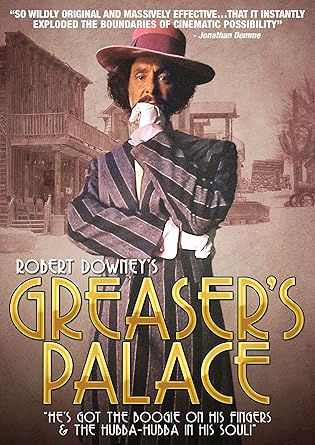
Nizovi i nizovi stalnih iznenađenja, s Isusom u glavnoj ambijentalnoj ulozi. Buñuel i Jodorowsky dotaknuti jurećim automobilom.
‘Nearly every event in Greaser’s Palace arrives unexpectedly and unannounced; there are few movies as totally unpredictable as this one. Jesus appears as a song-and-dance man, and has an agent. Characters get shot unexpectedly and repeatedly, and return from the dead with psychedelic stories about the afterlife. A midget and a transvestite live together in a prairie homestead as man and wife. A man tries to rape a wooden Indian. Mariachi music is used as an instrument of torture. The weirdness of this world is underplayed; none of the characters, with an important exception, acknowledge or even notice that anything is even the slightest bit off. This attitude makes some of the events come off even funnier, but it also makes the proposed comedy impure and tainted. Downey never signals to us whether he’s making a joke or not, and so we’re never sure whether we’re supposed to laugh or not. A town is assembled, quietly listening to a woman sing a song about the virtue of chastity. Suddenly, a man starts screaming in pain because a man dressed as a Halloween ghost burns him with a lit cigar. He is dragged by a gang of cowboys out into a dirt road and shot by his father for interrupting the festivities. Is this funny, or disturbing? Who can say? We don’t have a stock emotional response to that kind of scene; we have to make up our reaction on the fly.’ — G. Smalley, 366 Weird Movies
Robert Downey Sr.’s films are ribald, socially-conscious, highly experimental works that make Richard Lester’s oeuvre seem polite and Godard’s plot-heavy. Though he achieved cult success with 1969’s Putney Swope, some of Downey’s other, more radical works from the period are arguably more interesting, and their revival by way of an Eclipse box set is exceptional news. Up All Night With Robert Downey Sr. brings together five early films which show the director at his unhinged best, and if nothing else should prove a hedge against Downey becoming a mere footnote to his more famous son’s career.
A part of New York’s avant-garde film scene in the 60s, Downey screened his works alongside underground icons Shirley Clarke, Bruce Conner and Kenneth Anger. What he shared with his contemporaries was a patent disregard for convention and an ability to make films on the cheap. He cast his friends and family, shot on available locations, and mostly avoided sync sound. The work transcends its technical and budgetary limitations however, owing to Downey’s impudent sensibility. Plot, realism, and good taste all go out the window. His narratives are instead random, surreal, and chock-a-block full of crass humor—call them post-modern picaresques.
Downey’s first feature, Babo 73 (1964), is case in point. A sui generis political farce, it follows the whimsical adventures of Sandy Studsbury (Taylor Mead), the effete president of the “United Status,” who conducts affairs of state from a beach chair. “I’m morally committed to anyone who’ll vote for me,” he gleefully admits. With the help of his feckless cabinet, Studsbury makes quick work of assassinating prime ministers, bombing Albania, and congratulating himself on his job performance. Filmed in extremely unlikely locations—a crumbling house, a cemetery, a highway median—the picture makes a virtue of abstraction, like an Ionesco play shot through with Beatnik sensibility.
Taylor Mead in Babo 73
Downey’s next and more daring effort was 1966’s Chafed Elbows, the one masterpiece in the set. Composed almost entirely of still photographs, it’s a twisted formal cousin of Chris Marker’s La Jetée, the difference being that Downey’s photos wriggle, writhe and repeat to the rhythm of a bebop beat. It lends the film a cartoon-ish quality that mirrors its “story,” wherein every-doofus Walter Dinsmore (George Morgan) sleeps with his mother, gives birth to some cash, has a nervous breakdown, acts in an underground film, shoots a cop, defenestrates his cousin…and so on. Absurdity is the byword, and no one escapes Downey’s critical eye. Poets, parents, artists and cops are all variously derided as frauds. Chafed Elbows successfully earned Downey a reputation, and after the curious docu-diversion of 1968’s No More Excuses (the less said, the better), he was able to finance the bigger budget, higher concept, Putney Swope. In it, the eponymous hero (Arnold Johnson) is the sole black employee at an advertising firm who gets promoted to Chairman of the Board by fluke. No sooner does he take over, than he replaces the white staff with black and embarks on a doomed crusade to marry his high ideals with big business. Downey’s first film to observe at least a few tenets of classical form, it’s naturally the one that went over biggest on release. It’s got a groovy, revolutionary spirit, but from a formal perspective it’s not half so daring as his previous work.
Downey went on to direct another cult favorite, the unfortunately not-included Greaser’s Palace (1972), and has had an erratic career ever since. In 1975 he made the nigh inscrutable Moment to Moment (included here in a re-cut form as Two Tons of Turquoise to Taos Tonight), then followed it in 1980 with the banal teen comedy Up the Academy. That he never found a solid industry foothold isn’t surprising; originality has never been an asset in Hollywood and Downey’s style is anything but derivative. His early works, nevertheless, retain their freshness, are still vital, and unequivocally those of an unruly American original. - Eddie Mullinshttp://filmmakermagazine.com/46953-up-all-night-with-robert-downey-sr/#.WRWlxGe1vcs