petak, 15. veljače 2019.

Chou Ching-Hui - Animal Farm


Image result for Chou Ching-Hui - Animal Farm

Da, ljudski život je bonsai.


http://www.chouchinghui-art.com/works/visual/6/60


Zoo is a space full of imagination and conflict. It symbolizes joy (for visitors), yet it also symbolizes confinement and segregation (for animals). It symbolizes the convenience and marvels of modern life (a collection of rare animals from all over the world), and it also suggests a hint of the apocalyptic salvation of Noah’s Ark (protecting species on the verge of extinction). 
Animal Farm is full of fancy and realistic theater scenes, includes a lot of symbols, matching a familiar interior space with a artificial environment of the zoo, describes “the society is as a cage, where we are jeering at the people living in there”. Animal Farm was shoot by a full-focus camera allowing the audience to clearly see things happening in every corner of the photos and gaining the same feeling with Chou. Animal Farm includes 3 different themes: Body Existence, Life Boundary, and Social Environmental Frame. These themes let the audience rethink the situation, which we are living in.
Invested with a great amount of resources, Chou and his teammates spent for 5 years to plan and do the project, Animal Farm. The shooting of project took place in Hsinchu Zoo and Shou Shan Zoo in Taiwan, which has a very intimate relationship with the idea of the project.
https://www.lagalerie.hk/chouchinghui/

With Taiwan in mind we head for Taipei’s Chini Gallery stand at Art Stage to meet artist Ching-hui Chou and gallerist Audrey Tu. Working initially as a photo journalist Ching-hui Chou soon began to develop and fund his own creative projects which included Frozen in Time, Images of a Leper Colony (exhibited 1995 Taipei Fine Arts Museum and 1997 National Ching-Hua University Arts Center in Hsinchu); Vanishing Breed, images of Workers (exhibited 2002 Taipei Fine Arts Museum and 2004 Quanta Building Hall, Taipei); Wild Aspirations, the Yellow Sheep River Project (exhibited 2009 Taipei Fine Arts Museum and 2010 Istituto degli Innocenti, Florence). The Yellow Sheep River Project was published as a limited edition photography book.
Not surprisingly given the dazzling quality and complexity of his work, Ching-hui Chou is the recipient of numerous awards including for The Yellow Sheep River Project the Golden Butterfly Award, the Red Dot Design Award, and the iF Communication Design Award.
We are especially here to view Ching-hui Chou Animal Farm series first exhibited at Taipei’s Museum of Contemporary Art. The series of works named after George Orwell’s allegorical novel Animal Farm.

The series of complex tableaus were created over a period of five years. Two zoological gardens were used for the locations, Hsinchu Zoo and Shoushan Zoo, which were visited by the production crew on numerous occasions. The complex task of organising the shoots, working with the zoos, gaining permissions to use the sites, care taken not to disturb the animals, creating intricate sets, gathering together and casting the actors and organising the technicians required to complete the project was an immense task. The images were taken at dawn and dusk to create the required atmosphere.
The Animal Farm series is composed of 36 works, the complex tableaus and intimate portraits. The large works are just under two meters wide, the portraits just over a metre wide. So all the works are large in scale.
The complex and fable like tableaus are much more than just replacing the animals in the zoo with humans in the zoo. Chi-Ming Lin, Professor and Chairman Department of Arts and Design, National Taipei University of Education, describes the body of works being presented in three different stages of major social structures that modern humans have not been able to escape and are not realising this fact. The stages are, firstly the structure of body consciousness; secondly the structure of survival consciousness and thirdly the structure of collective behaviour and consciousness.

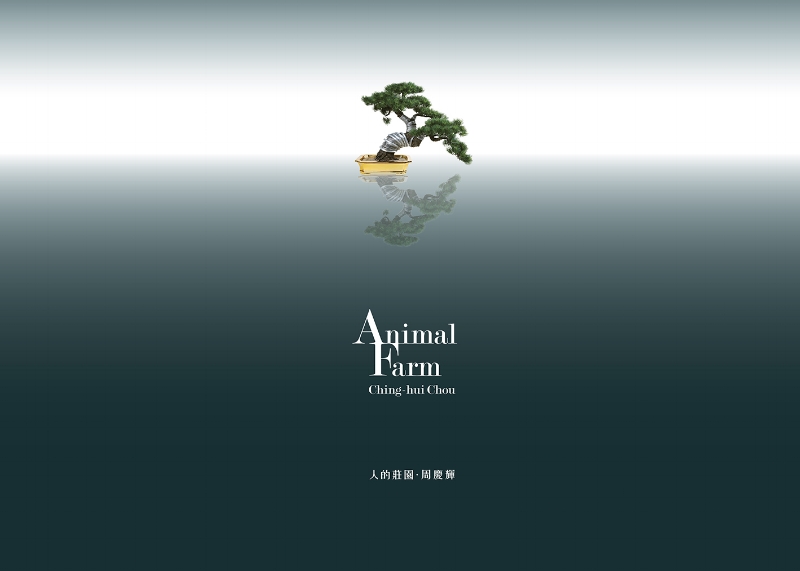
A Bonsai pine tree features in the works and it has a symbolic meaning and purpose. It is both the artist’s signature, a mark of identity but it also represents the need to adjust to obstacles in life, the bindings representing the tangible and intangible constraints that capture and distort people’s lives.

The work called Animal Farm No 1 was photographed at Hsinchu Zoo in the cage where the Brown Lemurs were kept. In the symmetrical archways Ching-hui Chou captures two sets of young couples working out. The image also includes a painting of classics beauties and a poster of contemporary stars.  Here the artist is telling us that the motive for the exercise has more to do with body image than improving one’s health. The couples are self absorbed, ignoring others while enjoying themselves, a reference to modern fitness centres, and the audience, as if watching animals in the zoo, the audience is guided to examine the contemporary trend of seeking beauty, so much part of contemporary fashion.

The work called Animal Farm No 2 was photographed in what used to be the living area for Muller’s Bornean Gibbons in Hsinchu Zoo. In the spatial setting of the main work, several elements were juxtaposed to compare and contrast the background from the foreground. At the farthest point are real woods spanning across the image, then, concrete buildings painted with jungle images that used to be a resting place for animals, and the temporary settings that mimicked supermarket and living spaces constructed by Ching-hui Chou. The foreground, which is meant to be a living space as well as a display space for the animals, is transformed into a diverse theatre of a modern consumer society and including domestic life. Humans perform a pantomime of daily life in this farm converted from a zoo. The scene appears poetic, beauteous Eden on Earth, seemingly satisfying and worry-free, quiet and peaceful, however, at the same time, the scene reflects the idea that humans are trapped in this continual tableau without being able to break free from their confinement.

The work called Animal Farm No 3 was photographed using a birdcage in the Shoushan Zoo. Ching-hui Chou constructed two spaces on left and right of the image which present a contrast of circumstances. On the left, the indoor space is fully equipped with domestic objects and filled with symbols of safety, peace, good fortune and longevity, such as the bodhisattva statue, an old pine tree, and a crane. However, the old man is sitting on the sofa like a patient as time passes by. To the right of the image is a contrasting balcony space where an old lady on a wheel chair is quietly appreciating the harmonious and glorious sunset. Aging is the inevitable fate that human beings must face, it is just like the net cast over the birdcage which allows no escape. Nonetheless, how one spends their twilight years all depends on attitude of mind and decision in life.

The work called Animal Farm No 4 was photographed at the Chimpanzee cage at Shoushan Zoo. Here Ching-hui Chou built two symmetrical rooms. The room to the right of the image shows an empty study where the work has paused. The distorted portrait of Francis Bacon and the staring animals suggest create an atmosphere of stress in the study. To the left is a bedroom, here the painting is of a holy mother who is breastfeeding a child. The husband watches his wife inject Progesterone. In this orderly space the idea of having a child adds content to their lives. These juxtaposed rooms speak of the dilemma. Particularly regarding the pressures in Asia, of being able to sustain the pressures of having a family and career at the same time.

In Animal Farm No 5 Ching-hui Chou transforms the Barbary Sheep enclosure in Shoushan Zoo into a silent theatre of “art of the market.” In the image, in addition to the gold and silver coins spilled all over the ground, the artist follows the terrain and arranges four painters to perform and display their works. Obviously, this is a world of art as well as a world of money. Taking a closer look, these four artists also represented different artistic preferences. The artist on the top right corner gazes into a modern architectural model in the birdcage, but the painting on his easel is something very different. The second painter in the lower left hand corner of the image is pondering about a sculpture, on his easel is an image of a documentary report revealing war and famine. The third painter in the middle of the scene uses a model, huddled up as if sleeping on the street. Nevertheless, the subject of his painting is a naked woman lying down at her ease. The fourth painter on the lower left hand corner of the image is not using any physical references; he simply composes his work with head portraits from the banknotes of different countries. However, the amount of coins around and under his feet, which represents market value and monetary gains for a work, outperformed all the other artists.

The work called Animal Farm No 6 was photographed at the viewing area for the Celebes Crested Macaque at Shoushan Zoo. The construction of a fashionable and contemporary domestic scene includes a patient like women, pale faced and wearing a robe. In the middle distance the woman appears again this time wearing an elegant blue cheongsam and stretched out on a clinic’s chaise lounge chair. In the front of the work our patient suggests that even the well off cannot eliminate their psychological struggles. A psychotherapist sits maintaining a similar stare, listening and jotting down notes, without interacting with the patient. The wire mesh can be looked through but the high wall at the back of the image excludes the outside view, enforcing a mood of frustration, the powerless psychotherapist and the helpless patient.

The work called Animal Farm No 7 was photographed in the area where the Black Panthers are kept at Shoushan Zoo. The image includes three distinct elements, a night sky with trees, symbolising natural surroundings; a concrete fortress symbolising and animal cage and a central area enclosed by metal bars that signifies a zone of civilisation. The most inner space is a jail with a jail, a cage within a cage. The woman is self absorbed and melancholy and she examines her bleeding nose. The stiches around her waist tell the viewer that the woman has recently undergone liposuction. She is surrounded by designer bags, high-heeled shoes, jewellery, couture clothing, cosmetics and Barbie dolls. Here Ching-hui Chou is telling us that the pursuit of beauty through only physical appearance and consumer fashion items is out of control and here it is compared to religious zealousness.

In Animal Farm No 8 Ching-hui Chou utilises the Orang-utan enclosure in Hsinchu Zoo. This is a natural setting, which merges real and virtual elements. Here the artist places six child actors in different places, four are connected to each other with hoses and seek out one another using flashlights, one girl is sending out communication signals via balloons, as the other girl sits on a platform calmly observing the on-going events. Today smart phones have become more powerful and the mass media continues to develop. New means of communication and Internet communities have replaced face-to-face interpersonal exchanges in a fast-paced and unbounded way. The visual presentation of this work provides strong evidence for “being able to be connected on-line but still feeling all alone.” This is a new social phenomenon felt by more and more people in an era where Internet communities can be formed easily through social media.

Animal Farm No 9 features the Hippo enclosure in the Shoushan Zoo, the image a wedding scene as well as a riddling drama. In the foreground, a male figure in a white wedding dress, is either entering the location or exiting it and is urinating into the pond. In the middle distance, a bride is calmly stepping towards a waterfall, the back of her dress is stained with blood, and the audience cannot tell whether she does not notice or simply does not care. Twins, hard to tell if they are male or female, hold flowers in their hands and are there to witness the ceremony. The Chinese antique chair at the back of the scene is empty, signaling the absence or disapproval of the elders. The artist employs the existing concrete wall and pond to form a third site that embodies “the private joys.” The inflatable doll, the lift ring and the float together create a scene of the lost paradise, representing the surfacing of lust from the subconscious.
https://www.creativecowboyfilms.com/blog_posts/ching-hui-chou-animal-farm


Robert Macfarlane and Adam Scovell - Holloway


Pastoralni pred-horror.


Further exploration of Dorset’s sunken pathways by Robert Macfarlane and film-maker Adam Scovell:
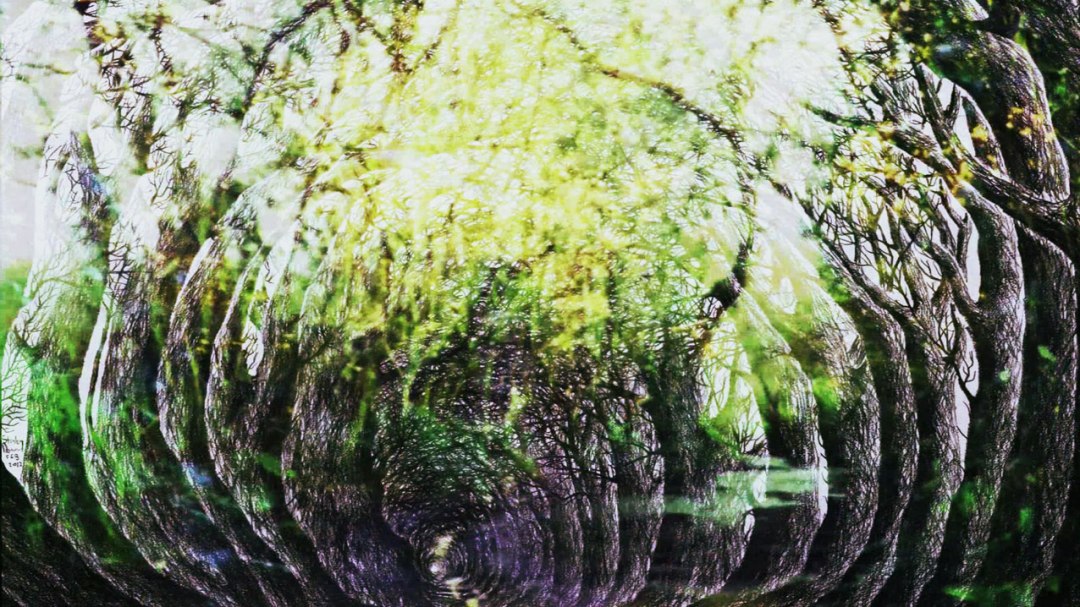
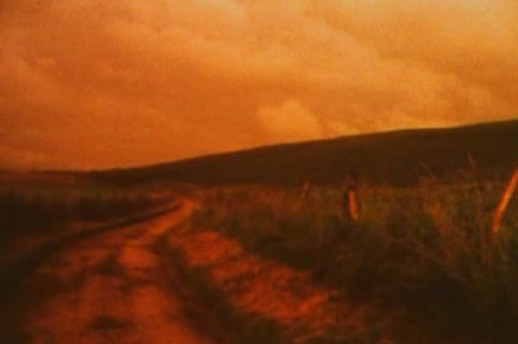
In 1971 Derek Jarman made a ten-minute silent short called Journey To Avebury, documenting a summer walk through the chalklands of southern England. The film seems, at first, more pastoral home-movie than avant-garde: sheep graze, footpaths dwindle into the long distance. Gradually, though, an eeriness builds. Where are the people? Who is holding the camera? The landscape feels emptied, rather than empty. Clouds glower and loom. A psychic weather communicates itself to the viewer: close, clammy, threatening. Vital to this atmosphere is the Super-8 film on which Jarman shot the work. Super-8 flickers and blebs. It bleeds. Colours lustre and thicken within it. Its scratchy textures suggest another set of frames underneath, showing through here and there; other stories trying to pry their ways out.
journey_avebury4
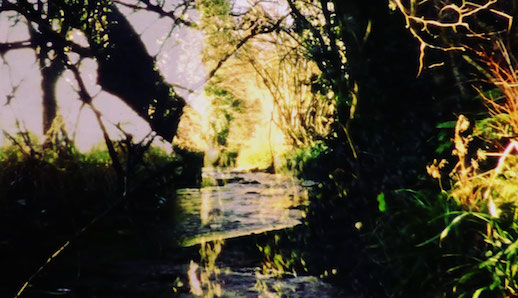
Early last year, I began a collaboration with a talented young film-maker called Adam Scovell. Inspired in part by Jarman, and by the possibilities of Super-8 as a medium that was also a form, we set out to make a short film about the sunken lanes in South Dorset that are known as holloways. I had become fascinated by these strange folds of land: by the manner in which history seemed to repeat – re-pleat – itself within and around them, across centuries, and by the patterns of echo and loop that I perceived the holloways as somehow generating. Super-8 – Adam’s preferred stock – seemed the perfect film on which to shoot this subject, given its palimpsestic surface and its shivery rhythms. I wrote a text to be spoken as voiceover, which I tried to ingrain with doublings and reversals (of image, word, sound). We wanted to make a film that cast a brief strong spell.
Adam spent two days filming in Dorset. He took his 1970s Canon camera, and three 3 ½-minute rolls of Kodak. That was all. No room for error on a nine-minute film. None of the digital luxuries of firing off test-bursts, or letting the camera run. I admired his parsimony and control; wished I could acquire some as a writer. He hit winter days of white light, rain, sun flares and water flooding the bellies of the holloways like mercury.
Digital-Holloway-4
Then Adam edited. On and off for seven months – getting on for a month per minute. I admired his patience and commitment; wished I could acquire some as a writer. He layered in wildtrack of the holloways, recorded by the artist and composer James Bulley. He underlaid the Super-8 here and there with Stanley Donwood’s artwork: spectral pencil underworld to the celluloid upperworld.
still 1
At last there was a near-final edit. At that point we approached the musician and poet Richard Skelton to see if he would score the film. He agreed, and wrote original music for it. So it came together. Hommage to Jarman and the holloways. A layered film about a layered place; a film of folds about a folded place.
The Super-8 had a last surprise for us, though. Embedded in Adam’s footage were several dark forms, human-ish in outline, unidentifiable but unmistakable, visible within the leaves or the shadows. ‘What the hell is that thing at 2.02?’, I e-mailed Adam. ‘I’m glad you can see it too,’ he replied. ‘My dad thinks I’ve gone mad…’.
https://www.caughtbytheriver.net/2015/07/robert-macfarlane-stanley-donwood-holloways/


It feels odd to finally be able to say that Holloway is finished.  This oddness derives not just from the fact that it has been the longest planned film that I’ve produced so far (starting all the way back from Robert Macfarlane’s first email to me in February 2014) but because the subject of the film itself is never-ending.  The holloways of Dorset do not end because really they fail to leave the minds of those who walk upon their paths.  Technically though, the film is finished and though I have mentioned variously the planning and the process of filming it in several articles, there’s still a few elements that I feel round off the film and project as a whole.
In Robert’s main chapter of writing on the holloways in The Wild Places, he suggests both the process and what could even be termed the genre-like form that I wish the film to sit within:
An artistic tradition has long existed in England concerning the idea of the ‘unseen landscape’, the small-scale wild place.  Artists who have hallowed the detail of landscape and found it hallowing in return, who have often found the boundless in the bounded, and seen visions in ditches. (2007, p.227).
Holloway is immersed in this unseen landscape, aiming to create textures from it in order to provide the very real sense of diving into the underworld that walking these paths actually spawns.  As is refreshing when finally escaping out of these paths and back into vast plains of landscape, it is often contrasted with visuals of the more open aspects of this area; a rural equivalent of Orwell’s “coming up for air” so to speak.
edited-8
If you managed to catch Robert’s fantastic Guardian article on the “English Eerie” a few months back, you may also be aware of the chief influence on this film; an influence I don’t mind acknowledging as the differences between the work is vast enough to avoid accusations of copy.  In the article Robert mentions that “… the contemporary eerie feeds off its earlier counterparts, as with Millar off Blackwood, Fisher off James and Scovell off Jarman.” having earlier explained that he’s been working alongside with me “…to adapt a co-written book called Holloway into a nine minute Super-8 short, inspired in part by Derek Jarman’s early silent film, Journey To Avebury (1971).” (Guardian, 11/04/2015).  Jarman’s film presents a form that arguably also ties into the phenomenological conception of Robert’s unseen landscape artists and it is the same sense of discovery, of being lost (in time as well as in space) and the sheer power of landscape on grain that we both wish for Holloway as a film to convey.  Hopefully this comes across in earnest and in the best spirit of a very polite but subtle tipping of the Super-8 hat to the alchemical sage.
Perhaps the final aspect to mention is the difference that music makes and the presence Richard Skelton‘s work in the film.  Skelton came to the project late on for a number of reasons.  I was only introduced to his music in the last few months (ironically whilst in the midst of editing the film visually) and it was not until the connection was made between the music a friend had been recommending and the musician to whom Robert devotes a whole chapter of his latest book, Landmarks, that the choice of who to score the film became completely obvious.  It goes without saying that his textural drones and occasional On Land-esque melodies add wonderfully to the film’s undercurrents of eeriness.
edited-9
I can only end with offering my deepest thanks to all who helped make the project possible.  My thanks to Richard for his brilliant music, to Stanley Donwood for kindly letting me use his stunning artwork, to James Bulley and Giles Stogden for their fantastic soundscape, to Dan Richards for his support (and for sending me a copy of his latest book which is superb), to Jeff Barrett for getting it out there and publishing it on Caught By The River and to Hell Barn Cottages in Dorset for giving me a cheap rate in their haunted barn.  And finally, thanks to Robert who has given me more creative support over the last year or so than just about anyone else I know.  Here’s to the next one.
A campaign to save one of the Dorset Holloways can be found here.
Adam.
edited-14 Digital-Holloway-4 Digital-Holloway-6 Digital-Holloway-8


Author Robert Macfarlane and film-maker Adam Scovell have put together a wonderfully eerie short film adaptation of the best-selling Faber book, Holloway. In July 2005, Robert Macfarlane and Roger Deakin – author of Wildwood – travelled to explore the holloways of South Dorset’s sandstone. They found their way into a landscape of shadows, spectres & great strangeness. Six years later, after Roger Deakin’s early death, Robert Macfarlane returned to the holloway with the artist Stanley Donwood and writer Dan Richards. The book – now a bestseller – is about those journeys and that landscape.

Moving in the spaces between social history, psychogeography and travel writing, Holloway is a beautiful and haunted work of art – so much so, that it lends itself perfectly to the medium of film. Macfarlane’s collaboration with film-maker Adam Scovell is a haunting further exploration of Dorset’s sunken pathways.

“I had become fascinated by these strange folds of land: by the manner in which history seemed to repeat – re-pleat – itself within and around them, across centuries, and by the patterns of echo and loop that I perceived the holloways as somehow generating. Super-8 – Adam’s preferred stock – seemed the perfect film on which to shoot this subject, given its palimpsestic surface and its shivery rhythms. I wrote a text to be spoken as voiceover, which I tried to ingrain with doublings and reversals (of image, word, sound). We wanted to make a film that cast a brief strong spell.”
https://www.faber.co.uk/blog/holloway-robert-macfarlane-short-film-released/
 

petak, 1. veljače 2019.

Werner Tübke (1929-2004) - Meesterschilder tussen Oost en West

Image result for Werner Tübke


Vječni srednji vijek.


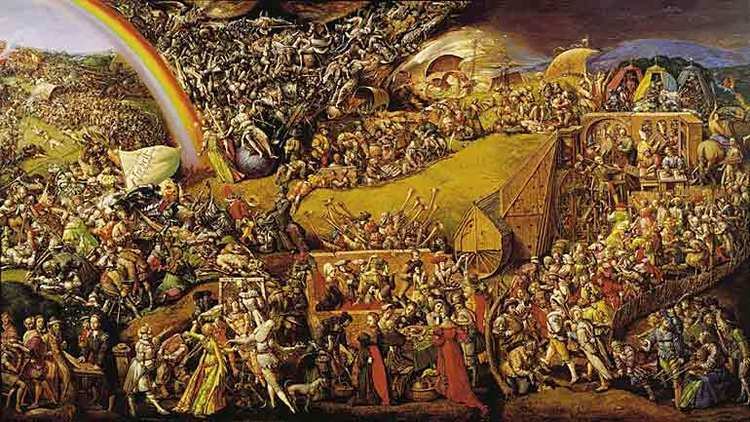
Step right up into the world of Werner Tubke! The painter and illustrator from Leipzig created fantastical imagery, replete with virtuosity and a love of storytelling. In the style of the old masters, he transformed the everyday and the political into something that transcends time, and in that way developed his own distinct, anachronistic viewpoint. As a co-founder of the Leipziger Schule, Tubke paved the way for a figurative art, which has earned him international recognition since the 1970s. Reiner E. Moritz met with the GDR's extravagant prince of painting in his studio and accompanied him at work on his showpiece, the German Peasants' War panorama in Bad Frankenhausen.


Related image


Related image


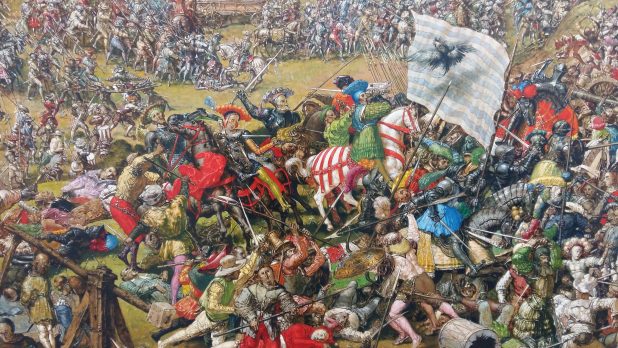
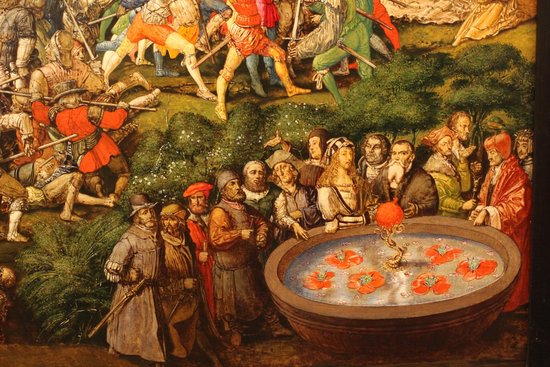
The immense panorama by Werner Tübke (1929-2004) in Bad Frankenhausen is sometimes referred to as the Sistine Chapel of the North.  Tübke painted the panorama between 1976 and 1987. The subject is the German Peasants' War of 1524-1526; the people's revolt against the powers that be in the south of the German speaking area, which the GDR saw as a precursor for the People's Republic. Tübke is seen as the most important painter of the GDR. He was certainly no superficial propagandist . His virtuoso, theatrical and sometimes bizarre work retained its aesthetic significance, even after the fall of the wall in 1989. Museum de Fundatie will present the first retrospective exhibition of Tübke’s paintings outside Germany next spring. This will include the 15 meters long preliminary study (scale 1:10) of his panorama from the Berlin National Gallery’s collection.
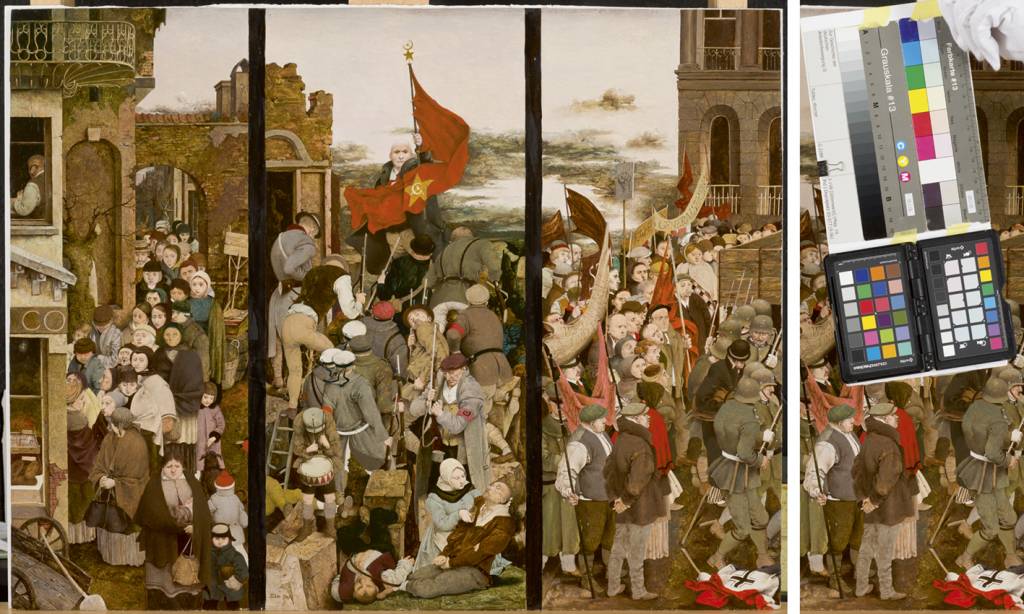
Werner Tübke painted a number of large scale state assignments. In addition to the panorama, he painted an allegory of The working class and intelligentsia for the Karl-Marx-Universität in Leipzig (1970) and a multi-panel on Man – the measure of all things for the Palast der Republik in Berlin (1974). Tübke studied at the Hochschule für Grafik und Buchkunst in Leipzig at the end of the nineteen forties. At the beginning of the nineteen fifties he continued his education at the Caspar-David-Friedrich-Institut in Greifswald, where he also studied art history. He made his first study trip to Italy in the early seventies. Initially, Tübke came under fire as his work refused to conform to the socialist realism demanded at the time, however the GDR government later embraced him as the ultimate interpreter of the communist ideal.
As an artist, Tübke’s prominent position in the GDR has always been a source of controversy, despite his exquisite mastery. His traditional style and working approach also saw the avant-garde dismiss him as non-modern and therefore of little interest. Upon closer inspection however, his work reveals a very original artist indeed. An artist who within the context of an assignment chose to plough his own furrow. An artist fully autonomous in both his art and his social opinions. His depiction of the German Peasants' War for example is no political pamphlet. Tübke painted a universal human drama; the disillusioned end to a utopia. If there is one striking lesson from history Tübke presents us with, it is that nothing ever appears to be learned.
The core theme in Tübke's paintings is the 'condition humaine'. They depict man resplendent with bells and frills, however these are a decorative order tending towards the grotesque. The jester makes a regular appearance in Tübke's work, as do the marionette and the harlequin. The paintings seem to announce that all is vanity and the world a mere stage. Tübke saw himself as link in a centuries-old tradition chain which he considered of such essence and scale that he refused to be disturbed by the fleeting and transient experiments demanded by modernism. The art of a wide and impressive range of predecessors, including Hieronymus Bosch, Albrecht Dürer, Matthias Grünewald, Caspar David Friedrich and Otto Dix, produce a natural and convincing resonance in his work. The anti-traditionalist front which characterises western art from after 1945 is as good as absent in the art of the GDR. This left open fertile ground for traditional painting to flourish towards new heights.
https://www.museumdefundatie.nl/en/werner-tubke-2/
Image result for Werner Tübke
Related image
Related image
Related image
Related image
Related image
Image result for Werner Tübke
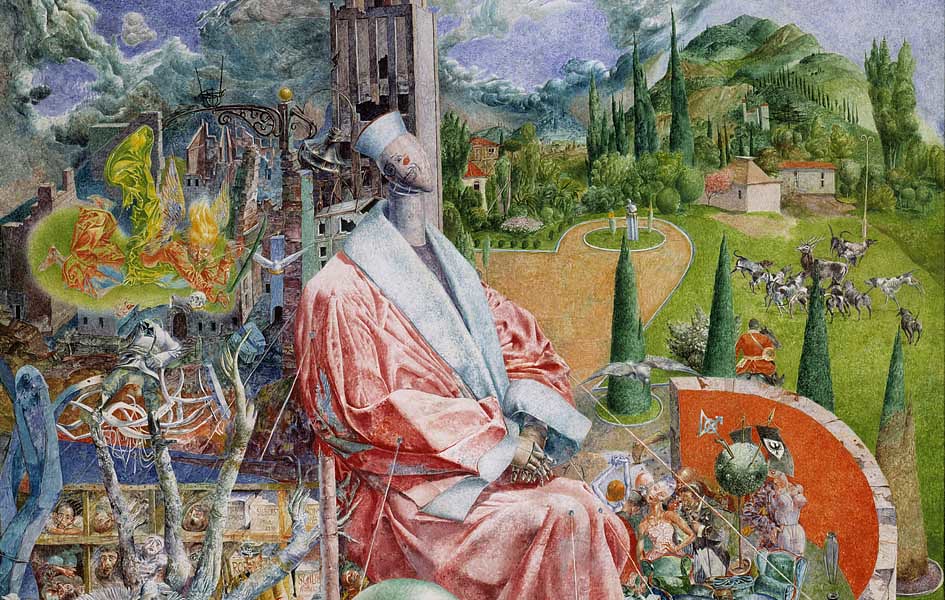
German painter, born in Schönebeck, one of the best-known but also one of the most controversial figures in the art of the Communist DDR. He joined the Artists' Union in 1952 as well as the East German Communist Party. His relations with the authorities could be problematic. In 1959 he was criticized for ‘concessions to modernist views of art’. His style drew on medieval and Renaissance sources and was far closer to the Magic Realism of Western Europe in the interwar period than to Socialist Realism. In early paintings he combined religious imagery with state-approved political subjects. The Portrait of the Cattle Breeder Brigadier Bodlenko (1962, Museum der Bildenden Künste, Leipzig), an equestrian portrait in the style of a medieval knight but sporting a modern wristwatch, was attacked as ‘a ghostly, bizarrely estranged relationship to life in a country that is engaged in building a communist society’.
In 1965 he produced a cycle of paintings entitled Die Lebenserinnerungen des Dr. jur. Schulze (Nationalgalerie, Berlin). Although not a commissioned work, it followed official ideology in depicting continuity between the Nazi regime and the present-day politics of West Germany. The principal figure is a judge who, having perverted the judicial system during the Third Reich, remains a lawyer in the Federal Republic. The jumble of images has been compared by Richard Pettit to the apocalyptic scenes of Bosch and Bruegel. Tübke was vehemently criticized for ‘idealism’ and especially for proximity to Surrealism. By the 1970s the complexity of such work had become sanctioned by official criticism under the category of Simultanbild (Painting of Simultaneous Images) or ‘dialogical pictures’, which depended upon an intellectual dialogue with the spectator. The acceptance of Tübke's art was one manifestation of a change in official cultural policy in which artists of the past such as Albrecht Dürer and Lucas Cranach were celebrated. In this context, Tübke, by then one of the leading figures in East German art, was commissioned in 1976 to paint a gigantic panorama entitled Early Bourgeois Revolution in Germany. It depicts the Battle of Frankenhausen (1525), which led to the defeat of the peasants, and is housed in a specially constructed building in Bad Frankenhausen. Tübke's ambition was to link the Reformation, the Renaissance, and the Peasants' War. The work was completed in 1987. Although he trained his own team of assistants, most were unable to cope with the demands of the project, the largest painting in Germany according to the Guinness Book of Records, and Tübke executed approximately two thirds of the work himself. His leading critical supporter in West Germany, Edward Beaucamp, wrote in 1993 that in the panorama ‘the artist in the end triumphs over the sponsor’ and that he ‘transformed the state monument into a pure art monument’.
By the time Germany was unified in 1989, Tübke already had a substantial reputation in the West. As early as 1972, West German curators had surreptitiously tried to persuade him to defect. His relationship to the Old Masters was very much in accord with the vogue for Postmodern quotation in the 1980s. Nonetheless, his most important post-Communist work, a three-winged altarpiece for the church of St Salvatoris in Clausthal-Zellerfeld (1997), was attacked by the critic Peter Iden as ‘devotional kitsch’. Alongside Fritz Cremer, Wolfgang Mattheuer, and others, Tübke exemplifies the problems of making simple distinctions between conformists and nonconformists among the artists of the DDR, let alone of making moral judgements on their conduct.
http://www.oxfordreference.com/view/10.1093/oi/authority.20110803110032525


https://www.waandersdekunst.nl/werner-tuebke-meesterschilder-tussen-oost-en-west.html


ponedjeljak, 5. studenoga 2018.

Naomi Uman - Removed (1999)

Image result for Naomi Uman - Removed


Uzrok žudnje, uzrok bilo čega, uvijek je prazan, tek ga naknadno punimo nekim "sadržajem". Ili: sve postoji bez uzroka, uzrok je uvijek retroaktivni proizvod, posljedica.


“I am an experimental filmmaker. My non-fiction films draw from personal experience. I live with my subjects for long periods of time, often waiting to film or record sound until I have become integrated into a community or a family. I had lived with a family of immigrants, both documented and undocumented, for a period of almost a year before making a film that was unflinching in its portrait of their lives. This film, which turned a critical eye on the subject family and the situation which creates this separate and unequal world in which they live within the United States, caused the public to question my right as a filmmaker to criticize people whose status as immigrants was a status that I had never experienced myself. Taking this to heart, I decided to embark on my own immigration.” (NU) - https://www.courtisane.be/en/event/profile-naomi-uman


Ukrainian Time Machine: Living Films by Naomi Uman

IN PERSON: NAOMI UMAN ►  Like a crochet needle swiftly passing through loops of silk and wool, like sun-thickened fingers prying at garlic-clove sheaths, like a chorus of wedding songs around a table of varenyky and boiled dumplings, Naomi Uman’s camera lives amongst the people, homes and villages she films. Setting out to retrace the footsteps of her family’s own immigrant history, Naomi, an American artist who divides her time between Los Angeles and Mexico City, made a reverse journey of her great-grandparents' emigration from Uman, Ukraine. She bought a house in Legedzine, just outside of Uman, toured films around the country, befriended village babushki, and established an artist residency for cultural exchange. The films in “Ukrainian Time Machine” evolved out of the tactile and visceral experience of living in Legedzine. Kalendar chronicles her early days of Ukrainian language lessons. Clay is a portrait of a brick factory that sits atop the ruins of the 5000- year-old, clay-based Trypillian civilization. Unnamed Film contains footage, in chronological order, shot from the time she arrived in Legedzine to the time she left. “Ukrainian Time Machine” is the latest extension of an artistic practice that involves Uman’s prolonged immersion in the world of her subjects; in previous projects, she lived with a diary-farming family in rural Mexico and with a Mexican immigrant family employed in industrial dairy production in California.
http://www.thecinematheque.ca/dim/ukrainian-time-machine-living-films-naomi-uman


In her 1999 short film Removed, Naomi Uman brilliantly intervenes in the scopophilic pleasure of visually consuming women's bodies on screen by literally erasing only the women's naked bodies from the frame. This film bears serious consideration on numerous levels beginning with the painstaking process by which the artist obliterated the women's bodies by hand, frame-by-frame (through the use of female-coded domestic products of nail polish remover and bleach) through a process that may be thought of as an ironic inversion of the media industries' practices of "retouching" to achieve apparent perfection in the bodies of (especially) women models and actresses. Removed also invites analysis in terms of the relative capacities for eroticism in sound and image. What is lost from the intended function of these scenes when pornography's conventional form of visual gratification is withheld? - Critical Commons Manager
http://www.criticalcommons.org/Members/ccManager/clips/removedh264.mp4/view


FILMS:
REMOVED (1999, 5 min.)
Using a piece of 1970s porn film, nail polish and bleach, Uman creates a new pornography, one in which the woman exists only as a hole -- an empty animated space.

PRIVATE MOVIE (2000, 6 min.)
A love story in three parts. Through studies on light, movement, happiness, glowing darkness and flickering melancholia, this film tells of a woman's journey of love, with nostalgia, pets, places, and men.


HAND EYE COORDINATION
(2002, 11 min.)
This film tells the story of its own making as it explores the manual manipulations upon the film body, examining the cinematic result of mechanical interventions.

LECHE (1998, 30 min.)
Filmed in black and white 16mm, hand-processed and hung to dry, Leche examines details of the life of one family, living on an isolated dairy ranch in Central Mexico.

MALA LECHE (2003, 47 min)
Considered a companion piece, this film follows the same family presented in Uman's earlier film Leche. Now living in California's agricultural Central Valley, the family continues to work with dairy cattle but under very different circumstances.


In pornography – a genre that Linda Williams has defined as “obsessed with visible proof” – bodies are spectacles, displayed and dissected by the camera in pursuit of pleasure’s physiological truths. [1] In Naomi Uman’s Removed (1999), the sexualised feminine form is obscured, interrupting pornography’s attempts to quantify and authenticate female pleasure. Uman’s film can also be situated in the artisanal realm of “Handmade Cinema” in that it moves away from “photographic representation” in favour of “abstract form … textual richness and sensory depth”. [2] To create Removed, Uman painstakingly ‘erased’ the female figures from a 1970s German soft-core porn film, frame by frame. The result: an experimental re-working of pornography that is haunted by crackling white forms wherever the celluloid was tampered with. Uman’s handiwork functions as both a dismantling of the cinematic body and a process of collage. She also performs a kind of “recorporealisation” of female film bodies, using haptic labour to complicate the idea of the camera as an objective optical apparatus in the pursuit of a fixed truth. [3]
In an interview with the Millennium Film Journal, Uman talks in detail about the construction of Removed – made during stints of boredom while she was working her job as a 35mm projectionist at The California Institute of the Arts (CalArts). Re-touching her own acrylic nails, Uman became aware that the nail polish would “resist the action of bleach”. She covered everything on the found footage with nail polish, except for the women’s bodies. She then doused the film strip in bleach, “leaving the women … ‘naked’ and vulnerable” to the bleach’s effects (bleach has a “chemical reaction with the emulsion and causes it to be removed from the plastic film base”). [4] Uman’s process is therefore not about ‘erasure’ so much as intervention. Here, absence and presence become two sides of the same experimental gesture. By painting the film strip with nail polish, protecting the women’s surroundings and allowing the bleach to distort the image of their forms, Uman conjures the pornographic depiction of women anew. She transforms female film bodies into shimmering ghosts.
Certainly Uman’s film is a disruption to porn’s visual fixations – the writhing white forms of Removed absorb the gaze with their alien presence. The spectrality of Uman’s work extends beyond a critique of mainstream pornography’s scopophilia, however. What interests us here is the way in which the gruelling techniques of Uman’s handmade cinema serve to materialise female sexual pleasure and question visual methods of authentication. Like the doubled absence and presence of Removed, our reading in this article will be twofold. In the first reading, Hilary Bergen sees a connection between Uman’s creative process and the technique of rotoscoping, an animation technique used to extract motion from the human body in the pursuit of realism. For Bergen, the porn actors whom Uman obscures become suppliers of a hidden and controversial labour – they are like the “secret dancers” who lent their motion to the characters of early animation. [5] Because Uman’s meticulous approach yields visual results that are similar to rotoscoping, her film evokes the kinetic qualities of female pleasure. That kineticism is teased out through her intimate tracing of the space inhabited by each female body on every frame of celluloid. In the second reading, Sandra Huber observes a link between Uman’s work and the portrayals of sexual fluid in the nineteenth century phenomenon of ectoplasm (a gauzy white substance that emerged from the orifices of female mediums and was said to be a materialisation of the spirit world). While ectoplasm had the consistency of semen, its secretion from a female body meant that it was often brought into historic discussions around fraudulence (especially where photographic ‘evidence’ was concerned).
Our interest in ‘truth’ in this article lies not in the presumed objective view of any camera but in the embodied and experiential practice of the women whose bodies perform labour (or enact the labour of performance). Discussing mainstream, hard-core pornography, Linda Williams writes of how the “woman’s ability to fake the orgasm that the man can never fake (at least according to certain standards of evidence) seems to be at the root of all the genre’s attempts to solicit what it can never be sure of: the out-of-control confession of pleasure, a hardcore ‘frenzy of the visible’”. [6] In contrast with the visibility (and overwhelming presence) of male sexuality (erection, ejaculation), female sexual pleasure cannot often be explicitly seen. It therefore relies upon a kinetic and audiovisual performance of the body – an output that is primarily affective and ephemeral rather than material and enduring. Such output is made explicit through Uman’s experimental re-working. Following Williams, our dual reading of Removed acts as a feminist intervention into modes of authentication surrounding female sexuality. As Uman’s source film would not be classified as hard-core pornography as such (it does not feature explicit penetration or contain close-ups of genitalia), it may seem counterintuitive to rely on Williams’ arguments. Nonetheless, Uman’s interventions speak directly to what Williams describes as a ‘frenzy of the visible’. By obscuring the spectacle of the female body, Uman diverts the fact-seeking gaze that wishes to clearly see all. Our intention is not to misread Uman’s film based on the specificities of genre but to think about how her creative methods contribute to conversations around visual proof (of pleasure, of authenticity), complicating the link between what is visible and what is true for the female body.
Our readings are united through our fascination with the role of the body, especially in terms of the body’s connection to mechanical ‘truths’ (be they ‘money shots’ or scientific motion studies). We see Removed as a feminist alternative to methods of truth-making that are primarily photographic. Certainly the film’s interest in seeing is also reflected in its narrative content. In one scene, a woman asks her lover to describe a sex act to her. Based on their body positions (she is lying on his lap), only he has visual access to that act. Her plea (“Oh Walter! Tell me what you see! … I want to know everything!”) singles out his gaze, substituting descriptive language for visual evidence and robbing her of her own vision. As he describes the scene in detail to his lover, she herself remains an amorphous white blob. Her presence on-screen cannot be fully seen nor can it be captured with words. As we discussed previously, Uman’s process of making the film involved tracing the female figure frame by frame in order to expose it to chemical action. Ironically, this act of singling out produces a body that lacks boundaries; through motion, the women of Removed bleed into the space around them, dizzying the gaze that tries to fix them. Form and content unite in a shared instability.
Given the abundance of mirrors and deferred gazes that occur in Removed, as well as the characters’ emphasis on the role of imagination in the production of arousal, we can invoke the thought of Jacques Lacan. Lacan’s concept of the lamella, in particular, is akin to ectoplasm in its placenta-like nature. The lamella also possesses a kind of vibrant, lively movement that is useful for both of our readings. Lacan compares the lamella to the “membranes of the egg”, situating it in the realm of the always-enigmatic feminine/maternal. As he writes, it is something “extra-flat, which moves like the amoeba” and is “like the amoeba in relation to sexed beings, immortal – because it survives any division, any scissiparous intervention”. [7] The lamella is reproductive yet unnatural. Cyborg-like, it has its own agency. It can survive the removal of its source but its connection to the libido also tethers it to the human body. As Lacan puts it, the lamella results in “pure life instinct, that is to say, immortal life or irrepressible life, life that has need of no organ, simplified, indestructible life”. [8]
There is something ghostly about the lamella in that it is both a figuration in Lacan’s theoretical framework and it can also be read alongside other material instances. Like a monster, the lamella becomes real in that it is made sensually palpable through our imagination of it. In contrast with the pornographic gaze that Williams describes, the erotic space of fantasy is unpredictable and generative. It is never fully seen, always partially hidden and remains full of potential. Like the verb ‘secrete’ which holds the double meaning of ‘to shroud’ and ‘to reveal’, both Uman’s disappeared women and the bodies of ectoplasmic mediums occupy an uneasy space between presence and absence. That space is kinetic and alive and, above all, embodied. That space communicates, as Brian Massumi writes, “when gesture is deprived … of its terminus, its pragmatic truth potential is suspended”, making it “a purely speculative activity”. [9] The lamella, which also evades terminus, is similar to both ectoplasm and corporeal motion. Though both are produced by the body, their production occurs in excess and extension of the body. Similarly, Uman’s ghostly forms express a strong sense of fluidity. In our doubled reading, we identify fluid properties of the body which, in their secretion, keep secrets rather than revealing ‘truths’.
Reading One: Kinetic Traces
Removed uses palpable and embodied labour to alter what was originally captured by way of the camera. By way of handmade re-composition, Uman conjures new bodies and objects to interrogate the visual semiology that we accept as given. In Removed, effacement and summoning are revealed as sister acts; a repetition with a difference wherein “there is always some detritus strewn about in the aftermath, some bruising to the surface” and “the rejected entity has a habit of returning, ghostlike”. [10] Uman’s alterations to the original film strip serve not so much to blot out the porn actor’s nude figure but to obscure her shape and her facial expressions. She transforms her into a new entity, radically re-working the generic context of hard-core pornography. The bleach fades the contours of the figure into a hazy mist, enacting a kind of reverse striptease that verges on censorship. The result is, as Uman herself observes, somehow “far more erotic than the original”. [11] Whereas Roland Barthes proposes that “[w]oman is desexualized at the very moment when she is stripped naked”, Uman’s intervention suggests another possibility. [12] Her labour activates a viewer who “strains to see what is denied” and “is inexorably drawn to what is withheld”- namely, the pornographic female form as we know it. [13]
Removed is more than just a feminist intervention into the pornographic genre (although it is that, too). Rather than exposing what many believe to be the “essence of [mainstream] pornography – woman without substance”, Uman renders woman as substance, a powerful, pulpy, roiling presence. [14] In his work on ‘screendance’, Douglas Rosenberg introduces the term “recorporealisation”, writing that in order for a body to be recorporealised, it must first be decoporealised or stripped of its somatic and fleshly resonances through mediatisation. [15] Under Uman’s recorporealisation of her, the women of Removed become ‘untouchable’ – the male hands that attempt to stroke their bodies “simply sink into light”. [16] Strangely, it is Uman’s abstinence from touching the whole bodies of her filmic women that renders them impervious to the male touch on-screen. Uman allows the bleach to do its work on the female figures, transforming them into skeins of light. Uman has said that she “wanted to see what would happen if [she] remove[d] the women” from her found footage, asking: “Would it still be pornography?” [17] In Uman’s film, however, the ‘erased’ body returns with a new and more powerful force. The body becomes hyper-visible as a relational and material-kinetic presence. What is manifested on-screen is the body’s kinetic twin; a double which both exceeds the body and originates from within.
read further:
Hilary Bergen and Sandra Huber: Pornography, Ectoplasm and the Secret Dancer: A Twin Reading of Naomi Uman’s Removed