četvrtak, 8. veljače 2018.

Qualia Computing - There is no other intellectual challenge more important or pressing than qualia


Reverse-engineering of consciousness.
Ok, našli smo leteći tanjur, sad moramo otkriti kako su ga izvanzemaljci napravili; ok, našli smo u sebi samosvijest (unutrašnji "osjećaj" svijesti = qualia), sad trebamo otkriti kako ju je "evolucija" napravila.


https://qualiacomputing.com/


“Everyone takes the limits of his own vision for the limits of the world.” (Schopenhauer)


The concept of qualia is clearly at the heart of the next stage of human intellectual endeavors.
There is no other intellectual challenge more important or pressing than qualia.
The revolution can only be brought about by a combination of a rigorous scientific thinking and a trembling sensitivity.


It is the greatest intellectual challenge for humanity at present to elucidate the first principles behind the fact that there is such a thing as a subjective experience. The hallmark of our subjective experiences is qualia. It is the challenge to find the natural law behind the neural generation of qualia which constitute the percepts in our mind, or to go beyond the metaphor of a “correspondence” between physical and mental processes. This challenge is necessary to go beyond the present paradigm of natural sciences which is based on the so-called objective point of view of description. In order to pin down the origin of qualia, we need to incorporate the subjective point of view in a non-trivial manner.
The clarification of the nature of the way how qualia in our mind are invoked by the physical processes in the brain and how the “subjectivity” structure which supports qualia is originated is an essential step in making compatible the subjective and objective points of view.
The elucidation of the origin of qualia rich subjectivity is important not only as an activity in the natural sciences, but also as a foundation and the ultimate justification of the whole world of the liberal arts. Bridging the gap between the two cultures (C.P.Snow) is made possible only through a clear understanding of the origin of qualia and subjectivity.


2018

Every Qualia Computing Article Ever

2017

Burning Man* (long)
Psychedelic Science 2017: Take-aways, impressions, and what’s next* (long)
How Every Fairy Tale Should End
Political Peacocks (quote)
OTC remedies for RLS (quote)
Their Scientific Significance is Hard to Overstate (quote)
Memetic Vaccine Against Interdimensional Aliens Infestation (quote)
Raising the Table Stakes for Successful Theories of Consciousness*
Qualia Computing Attending the 2017 Psychedelic Science Conference
GHB vs. MDMA (quote)
Hedonium

2016

The Binding Problem (quote)
The Hyperbolic Geometry of DMT Experiences: Symmetries, Sheets, and Saddled Scenes* (long)
Thinking in Numbers (quote)
Praise and Blame are Instrumental (quote)
The Tyranny of the Intentional Object*
Schrödinger’s Neurons: David Pearce at the “2016 Science of Consciousness” conference in Tucson
Beyond Turing: A Solution to the Problem of Other Minds Using Mindmelding and Phenomenal Puzzles*
Core Philosophy*
David Pearce on the “Schrodinger’s Neurons Conjecture” (quote)
Samadhi (quote)
Panpsychism and Compositionality: A solution to the hard problem (quote)
LSD and Quantum Measurements: Can you see Schrödinger’s cat both dead and alive on acid?* (long)
Empathetic Super-Intelligence
Wireheading Done Right: Stay Positive Without Going Insane* (long)
Just the fate of our forward light-cone
Information-Sensitive Gradients of Bliss (quote)
A Single 3N-Dimensional Universe: Splitting vs. Decoherence (quote)
Algorithmic Reduction of Psychedelic States* (long)
So Why Can’t My Boyfriend Communicate? (quote)
The Mating Mind
Psychedelic alignment cascades (quote)
36 Textures of Confusion
Work Religion (quote)
Qualia Computing in Tucson: The Magic Analogy*
In Praise of Systematic Empathy
David Pearce on “Making Sentience Great” (quote)
Philosophy of Mind Diagrams
Ontological Runaway Scenario
Peaceful Qualia: The Manhattan Project of Consciousness* (long)
Qualia Computing So Far
You are not a zombie (quote)
What’s the matter? It’s Schrödinger, Heisenberg and Dirac’s (quote)
The Biointelligence Explosion (quote)
A (Very) Unexpected Argument Against General Relativity As A Complete Account Of The Cosmos
Status Quo Bias
The Super-Shulgin Academy: A Singularity I Can Believe In (long)
The effect of background assumptions on psychedelic research

2015

An ethically disastrous cognitive dissonance…
Some Definitions (quote)
Who should know about suffering?
Ontological Qualia: The Future of Personal Identity* (long)
Google Hedonics
Solutions to World Problems
Why does anything exist? (quote)
State-Space of Background Assumptions
Personal Identity Joke
Getting closer to digital LSD*
Psychedelic Perception of Visual Textures 2: Going Meta
On Triviality (quote)
State-Space of Drug Effects: Results*
How to secretly communicate with people on LSD*
Generalized Wada Test and the Total Order of Consciousness*
State-space of drug effects
Psychophysics for Psychedelic Research: Textures* (long)
I only vote for politicians who have used psychedelics. EOM.
Why not computing qualia?*
David Pearce’s daily morning cocktail (2015) (quote)
Psychedelic Perception of Visual Textures
Should humans wipe out all carnivorous animals so the succeeding generations of herbivores can live in peace? (quote)
A workable solution to the problem of other minds*
The fire that breathes reality into the equations of physics (quote)
Phenomenal Binding is incompatible with the Computational Theory of Mind
David Hamilton’s conversation with Alf Bruce about the nature of the mind (quote)
Manifolds of Consciousness: The emerging geometries of iterated local binding
The Real Tree of Life
Phenomenal puzzles – CIELAB
The psychedelic future of consciousness
Not zero-sum
Discussion of Fanaticism (quote)
What does comparatively matter in 2015?
Suffering: Not what your sober mind tells you (quote)
Reconciling memetics and religion.
The Reality of Basement Reality
The future of love

2014

And that’s why we can and cannot have nice things
Breaking the Thought Barrier: Ethics of Brain Computer Interfaces in the workplace
How bad does it get? (quote)
God in Buddhism
Practical metaphysics
Little known fun fact
Crossing borders (quote)
A simple mystical explanation


In this video I outline the core philosophy and objectives of Qualia Computing. There are three main goals here: 
  1. Catalogue the entire state-space of consciousness
  2. Identify the computational properties of each experience (and its qualia components), and
  3. Reverse engineer valence (i.e. to discover the function that maps formal descriptions of states of consciousness to values in the pleasure-pain axis)
While describing the 1st objective I explain that we start by realizing that consciousness is doing something useful (or evolution would not have been able to recruit it for information-processing purposes). I also go on to explain the difference between qualia varieties (e.g. phenomenal color, smell, touch, thought, etc.) and qualia values (i.e. the specific points in the state-spaces defined by the varieties, such as “pure phenomenal blue” or the smell of cardamom).
With regards to the 2nd objective, I explain that our minds actually use the specific properties of each qualia variety in order to represent information states and then to solve computational problems. We are only getting started in this project.
And 3rd, I argue that discovering exactly what makes an experience “worth living” in a formal and mathematical way is indeed ethically urgent. With a fundamental understanding of valence we can develop precise interventions to reduce (even prevent altogether) any form of suffering without messing up with our capacity to think and explore the state-space of consciousness (at least the valuable part of it).
I conclude by pointing out that the 1st and 2nd research programs actually interact in non-trivial ways: There is a synergy between them which may lead us to a recursively self-improving intelligence (and do so in a far “safer” way than trying to build an AGI through digital software). - algekalipso

OPEN Foundation: 31 video-lectures on psychedelic research


openfoundation
Narkoanaliza, normalizacija psihodelije.


The OPEN Foundation (Stichting OPEN in Dutch) is an interdisciplinary organization that aims to stimulate research into all aspects of the psychedelic experience. By organizing lectures, conferences and other informative meetings at universities, the goal of OPEN is to draw the attention of researchers towards this promising scientific subject. We want to spread honest information on both the potential and the risks of psychedelics, and hope to decrease the taboo that still surrounds the study of psychedelics. OPEN functions as a central node in an ever increasing network of national and international experts in the field of psychedelic research. A central focus in the coming years will be the facilitation and funding of psychedelic research in the Netherlands.


Stephen Whitmarsh - A Fully Emerged Neuroscience Expedition into the Shamanic Ayahuasca Experience from OPEN Foundation on Vimeo.

Wouter Hanegraaff - Entheogens and Contemporary Religion from OPEN Foundation on Vimeo.

Robin Carhart-Harris - Neuroimaging Studies with Psilocybin and MDMA from OPEN Foundation on Vimeo.

Konstantin Kuteykin-Teplyakov - Molecules of Mysticism: Pharmacology meets Anthropology from OPEN Foundation on Vimeo.

Joe Bicknell - Cognitive Phenomenology of the Psychedelic Experience from OPEN Foundation on Vimeo.

Torsten Passie - Astonishing Similarities of Physiological and Psychoactive Drug Induced States from OPEN Foundation on Vimeo.

Klaas Pieter van der Tempel - Psychedelic Consciousness and the Future of Academia from OPEN Foundation on Vimeo.

Ayahuasca and Antropology, Amazonian Shamanism & Western Science from OPEN Foundation on Vimeo.

subota, 16. prosinca 2017.

Herbert Achternbusch - Das Gespenst [The Ghost] (1983)


Nemaš nikakve šanse, ali iskoristi je. Filmovi služe preživljavanju.


The Antic Visions of Herbert Achternbusch
Who is Herbert Achternbusch?

“I always have a simple story, but I tell it so fanatically and wildly and tenderly and cursingly and on fire and in need of being loved that you’ll find a slice of life in front of you.” [1]
The first time I saw Herbert Achternbusch he was hypnotizing a chicken in Werner Herzog’s The Enigma of Kaspar Hauser. Anybody who has seen the film might recall the chicken, but who is Herbert Achternbusch? It is a question that cannot be simply answered. Achternbusch captions his entire artistic output with a paradox: ‘You don't have a chance, but use it’. Trying to make sense of his work, this epigram sounds appropriate.
Matters are not helped by the unavailability of most of his films on DVD. In Germany, a boxset devoted to Achternbusch is now out of print, although two key works—Heilt Hitler (1986) and Das Gespenst (1982)—remain in circulation. Aside from the occasional retrospective there is little possibility of English language audiences becoming acquainted with the artist’s work. Though Achternbusch has produced copious writing, poetry and plays—images and ideas from which feed into the material of his films and vice versa—none have been translated as far as I am aware, which further hinders those without a working knowledge of German. Little critical work has been done to date on Achternbusch either, which leaves him among the few notable figures from the German cinema of the 1970s and 1980s to be almost totally unappreciated within Anglophone film culture.
Herbert Achternbusch
In November 1974, as Herzog set out on foot from Munich to Paris to visit the German film critic and historian Lotte Eisner after she was hospitalised following a stroke—a trip he records in his book Of Walking in Ice—he made a stop just 500 metres from his home. It is the first episode of his journey: a visit to Herbert Achternbusch, himself recovering from a broken leg after jumping from a Volkswagen van. Herzog writes of the visit that Achternbusch attempted to tell his fortune, failing to do so “because he can’t find the paper with the interpretations. There is the Devil, with the Hangman in the second row, hanging upside down.” [2] This amusing anecdote reveals both Achternbusch’s significance to his fellow filmmaker, as well as hinting at the type of upended iconography that suffuses his films.
Herzog based his film Heart of Glass on a story by Achternbusch. The trope of the self-proclaimed visionary is found throughout Achternbusch’s work, as in Herzog’s; the man out of time and place, confronted by an uncomprehending world, mocked or dismissed. The religious connotations of such a character type were eventually made explicit when, perhaps unsurprisingly, Achternbusch decided to portray Jesus Christ.
Achternbusch in Heilt Hitler
The director always takes the lead role in his films. He is often named ‘Herbert’ but usually appears as a cipher for an array of cultural historical signifieds, albeit crude stand-ins—for Christ, a Comanche, or a German soldier to name a few. In doing so he repeatedly points up the absurdity of identification with marginalised, traumatised and suppressed peoples. All the while, in his intensely idiosyncratic cinema, Achternbusch seems to be demanding that the memory of the past be reified continually, no matter how tersely, scathingly or comically it is brought to bear on contemporary German society. Not surprisingly, the horrors of the Second World War loom heavily.
There’s no shortage of filmmakers with whom Achternbusch shares a desire to satirise Christianity. The once-banned Das Gespenst is as ana(r)chronistic as Robert Downey’s Greaser’s Palace and Peter Medak’s film of Peter Barnes’s The Ruling Class—resurrecting a messiah figure and dropping him into a modern, sceptical world. The crucifixion imagery is equally profane, startling and hilarious in all three films. The additional image of three ‘crucified’ frogs in Achternbusch’s film, however, mocks this Biblical episode with still more viciousness.
The wordplay, blasphemy and toilet humour in the conversations between characters in Das Gespenst also bring to mind the work of Samuel Beckett; the police officers Poli and Zeitsi in particular are reminiscent of Vladimir and Estragon. An unrepentant, bleak humour characterises these works, unquestionably reducing their potential for popularity with a general audience.
There are glimmers of the cinematic past, foremost the slapstick of Chaplin, Keaton and Lewis—all acknowledged inspirations, whom Achternbusch wrote about during a period as a film critic—but seemingly no desire for respectful homage, nor even all that much prodding subversion of Hollywood tropes. Acthernbusch rarely opts to shape a film according to the commonplaces of the medium as a popular artform: clear narrative arc, character psychology, linear editing, genre. Confusion is wilfully generated, as characters and matters of action are at odds, or move in circles—try, for instance, to grasp the genealogies that only several actors embody in Heilt Hitler.
“In the cinema I want to experience myself. A film that does not reassure me of my emotional existence is of no use to me. I want the cinema for survival. Too much of my life has wandered off into dreams.” —Die Atlantikschwimmer, 119 [3]
Margarethe von Trotta in Das Andechser Gefühl
Although Achternbusch’s films might appear unsophisticated in terms of technical realisation, and expressive formal qualities such as mise en scene, lighting, camera movement and editing might be hindered by the evident low budget of the productions, the director and his crew manage some extraordinarily enchanting and frightening images.
Achternbusch makes effective use of sourced music as well. The use of Judy Garland’s ‘Do It Again’ in Hick’s Last Stand (1990) gives a sense of yearning to the grey, overcast skies of the USA’s west coast—with another Garland association, two rainbows side by side, to boot—despite the ridiculous image of the director in white cowboy boots and cheap Native American head dress thumbing rides.  In Heilt Hitler, Dvorak’s New Morning lends the dissonant image of a hobbling Nazi soldier alienated in a Germany trying to move on and live after the horrors of Stalingrad an unexpectedly mournful tone.
Achternbusch’s interest in shooting natural landscapes, not only in Bavaria, but elsewhere in Germany and overseas leads him to terrains of luscious colour and rawness. The images of Greenland in Servus Bayern (1977) and the changing aspects of the American Midwest in Hick’s Last Stand reflect Achternbusch’s itinerant disposition; his desire to trace his ideas and interests far beyond the provincial backwaters of his native state, much like his friend Herzog. He has remarked: “I write books until it hurts to sit, and when I want to move I make films.” [4]
Achternbusch regularly guides the action like a Passion play through the streets of Munich, or to a hilltop bar in Andechs, giving unrehearsed reality a chance to break through his fictions, captured in the puzzled amusement of onlookers. The episodic, theatrical character of many of the scenes in Achternbusch’s films are characteristic of a playwright, but they are matched by such bravura cinematic displays as those at the Oktoberfest in Bierkampf (1977), and the fourth-wall-fracturing, extended straight-to-camera confrontation of a poet’s female lover in Servus Bayern.
The regular emphasis on spoken language—relentless, arcane and punning—can avert our attention from the clever visual humour; especially where that very language is transformed into a satirical image. Thomas Elsaesser, one of the few critics to write about Achternbusch at length in English, also draws attention to this, noting an example in Servus Bayern, in which the protagonist leaves Germany for the icy wilderness of Greenland: “a persecution fantasy becomes both the parody of a heroic myth about exile and the occasion for acting out the literary cliche of contemporary Germany traversing the ice-age of political life.” [5] Autobiography is dissolved for the purposes of turning a character—even one with the same name—and one’s body, into a vessel for references, formal possibilities and visual poetry, as well as self-effacing clownishness.
Achternbusch in Bierkampf
In Bierkampf the acted drama gives way to outbursts of very real aggression and violence among attendees at the peak of Munich’s famous beer festival. It is thrilling to watch the split-second changing reactions of the drinkers; from half-drunk good humour, or curiosity, to counter-attacks and pissed-off grappling. The long unedited shot towards the end of the film, which sees cinematographer Jörg Schmidt-Reitwein following Herbert’s antics, pratfalls and scuffles—undaunted and with his camera unproblematically accommodated by the crowds—is a masterclass in confrontational performance, athleticism and mobile camera technique.
Acthernbusch collapses chronology, subjectivity, styles and spaces. Slapstick, poetry and absurdity co-inhabit with ancient history, literary surrealism and post-war trauma. There’s no formal or conceptual neatness. Though the effect is often baffling, the desire for meaning and a sense of longing is usually enacted in these works, described by the characters. Like the ‘Andechs feeling’ that troubles the protagonist of Achternbusch’s first feature film, in which he plays a teacher who stares across the landscape, clutching a glass of beer, and longs for communion with a beautiful actress (played by Margarethe Von Trotta) to feel that he is not alone. Always a melancholy, or solemnity beneath the hilarity.
A certain disorder reigns; a devilish, offensive impropriety that Achternbusch throws back at the classical and highbrow pretences of his fellow filmmakers and the prevailing conditions of the art form. Of one public discussion in the US about the New German Cinema, at which he appeared alongside Sohrab Shahid Saless, Achternbusch once recalled: “We were supposed to be representatives, against the background of the film festival of the rejects, we were meant to be the third line, show that there is a lot more territory around the heroes and the stars, prove that the German cinema has unlimited potential; we, the two nihilists, who every time we make a film barely break free from the slimy embraces of all the forward-looking assholes, those know-alls without a spark.” [6]
My thanks to Thomas Elsaesser for providing the following reference materials, which include his English translations of extracts from Achternbusch’s writings: ‘Herbert Achternbusch’, first published in Discourse (Berkeley) no 6, Fall 1983, 92–112 (the first essay in English on Achternbusch) and ‘Mourning as Mimicry and Masquerade’, from German Cinema - Terror and Trauma: Cultural Memory since 1945 (New York: Routledge, 2014), 215-243. 
Notes:
[1] Gerd Gemünden, Framed Visions: Popular Culture, Americanization and the Contemporary German and Austrian Imagination (University of Michigan Press, 1998), p. 112 
[2] Werner Herzog, Of Walking in Ice (Free Association, 2007), p. 1
[3] Thomas Elsaesser, ‘Herbert Achternbusch’, Discourse (Berkeley) no 6, Fall 1983, pp. 92–112
[4] https://www.iffr.com/professionals/persons/herbert-achternbusch/
[5] Thomas Elsaesser, ‘Herbert Achternbusch’, Discourse (Berkeley) no 6, Fall 1983
[6] Thomas Elsaesser, ibid.


Herbert Achternbusch (born 23 November 1938 in Munich) is a German writer, painter and filmmaker. His anarchist surrealistic films are not known to a wide audience in Germany, although one of them, Das Gespenst (The Ghost), caused a scandal in 1983 because of its alleged blasphemous content.[1] Werner Herzog, a director of the New German Cinema, based his film Heart of Glass on a story by Achternbusch.
In 1981, he directed the film Der Neger Erwin, which was entered into the 31st Berlin International Film Festival.[2] The following year, he directed The Ghost, which was entered into the 33rd Berlin International Film Festival.[3] In 1988, his film Wohin? was entered into the 38th Berlin International Film Festival.[4] In 1995, his film Hades was entered into the 45th Berlin International Film Festival.[5]
Herbert Achternbusch was awarded the German international literary Petrarca-Preis in 1977, but he declined.[citation needed] In 2010, he was awarded the Kassel Literary Prize. He won the Mülheimer Dramatikerpreis in 1986 and 1994. - wikipedia

ponedjeljak, 11. prosinca 2017.

Richard Marshall - End Times Philosophy Interviews: The First 302


Monumentalna kolekcija filozofskih razgovora. (Povrh svega, svaki intervjuirani filozof izabire svojih najdražih 5 filozofskih knjiga.)


As we hit the 300 mark a couple of weeks ago I thought it might be a good idea to organise them in one place for readers who might find it useful. So here is the whole series so far. The categories used are pretty rough and ready but should help orientate people.
Epistemology, Language and Logic
1. Henrich Wansang :logics: more than one way to skin a cat…
2. Richard Heck:frege, dummett, vagueness, liars and julius caesar
3. Mark Textor: brentano’s mind, frege’s sense
4. Christopher Hitchcock causation, probability and philosophy
5. Volker Halbach on the nature of truth
6. John Turri philosophers wrong about knowledge since plato bombshell!
7. Marc Lange law
8. Bradford Skow reasons why
9. Miriam Schoenfield how rational is our rationality?
10. Berislav Marusic evidence, agency and bad faith
11. Anil Gupta against post-truth: the logical experience of knowledge, the circularity of truth etc
12. Hanoch Ben-Yam turing tests, chinese rooms, sherlock holmes, wittgensteinian vagueness and descartes
13. Sarah Moss saving wittgenstein, credence knowledge and semantics
14. Ernest Sosa the virtue epistemologist
15. Bob Hale frege and necessary beings
16. Greg Restall the logical pluralist
17. Bruno Whittle paradoxes and their logic
18. Mahrad Almotahari not and other metalinguistic stuff
19. Jose Zalabardo scepticism and early wittgenstein
20. Sara L Uckelman dynamic epistemology
21. Robert Brandom between saying and doing
22. Jeffrey King propositions, analysis and context
23. Diana Raffman unruly words
24. Penelope Maddy the stuff of proof
25. Penny Rush the metaphysics of logic
26. Margaret Cuonzo paradoxes
27. Ofra Magidor category mistakes
28. Stephen Yablo about aboutness
29. Stephen Read medieval matters
30. Pascal Engel truth, success and frank ramsey
31. Catarina Dutilh Novaes on cognitive artifacts
32. Sam Wheeler III davidson and derrida
33. Agustín Rayo absolute generality
34. Scott Soames kripke’s unfinished business
35. Peter Ludlow what the hell are we doing here ?
36. Gillian Russell a kill bill philosopher
37. Timothy Williamson modality and metaphysics
38. Paul Horwich deflationism and wittgenstein
39. Jennifer Lackey on testimony
40. Stephen R. Grimm understanding understanding
41. Robert Stalnaker the possible worlds hedgehog
42. Joel David Hamkins playing infinite chess
43. Colin McGinn brief encounter with the mysterian
44. Hilary Kornblith on reflection
45. Tim Crane mindful
46. Frances Egan meaning as gloss
47. Roy Sorensen philosophy’s madhatter
48. Herman Cappelen no intuitions no relativism
49. Ernie Lepore meaning, truth, language, reality
50. Arif Ahmed a wittgenstein kripke vertigo disturbance
51. Gonzalo Rodriguez-Pereyra truthmaking
52. Alexis Burgess imagining god creating poppies
53. Gila Sher the place of philosophy
54. Sarah Sawyer a natural kind externalist
55. J.C. Beall spandrels of truth
56. Michael Lynch truth, reason & democracy
57. Graham Priest logically speaking
58. Jason Stanley philosophy as the great naïveté
59. Eric Schwitzgebel the splintered skeptic
60. Timothy Williamson classical investigations
61. Justin Khoo disagreement


Aesthetics
62. Dennis Schmidt tragedy and philosophy
63. Andy Hamilton self-consciousness, aesthetics, music
64. Paul Crowther post-analytic phenomenology vs market serfdom
65. Karsten Harries heidegger, art, architecture
66. Peter Kivy apologia pro vita sua: my work in philosophy
67. Nickolas Pappas philosophy and aesthetics
68. James Grant: the critical imagination


Ethical, Moral, Political and Legal philosophy, and Philosophy of Religion
69. Matt Lister: thinking about globalisation, immigration and refugees
70. Adina L Roskies: brains
71. Helen Frowe: understanding defensive killing
72. Fabian Wendt why compromise? why peace?
73. Fiona Woollard on doing and allowing harm
74. David Wong the pluralist
75. Saba Bazargan-Forward just war
76. John Broome weighing goods and people: ethics out of economics: rationality through reasoning…and climate change
77. David E Cooper the measure of things
78. John Kleinig ethics, law and politics
79. Edward Harcourt wittgenstein’s ethical enterprise and related matters
80. Ron Mallon constructing race
81. Dale Jamieson reason in our dark time
82. Samuel Scheffler death, afterlife, justice and value
83. Derrick Darby keeping it real: the colour of mind
84. Ralph Wedgwood on the nature of normativity
85. TM Scanlon what we owe each other
86. Jerry Gaus the tyranny of the ideal
87. Nomy Arpaly in praise of desire and some
88. Tina Fernades Botts philosophy and diversity
89. David Estlund who rules?
90. Ewa Binczyk the rhetoric and lethargy of the anthropocene
91. Sarah Paul how far do you have to go before it’s a crime? and other puzzles
92. Jonathan Wolff political philosophy
93. Katja Vogt the pyrrhonian skeptic
94. Torbjorn Tannsjo the hedonistic utilitarian
95. Allan Gibbard thinking how to live
96. Katarzyna de Lazari-Radek from the point of view of the universe
97. Matthew Kramer law and ethics
98. Philip Kitcher life after faith
99. Costica Bradatan why murder philosophers?
100. Lisa Herzog philosophy of markets
101. Luciano Floridi philosophy from the zettabyte
102. Chris Lebron the colour of our shame
103. Lori Gruen philosophy of captivity
104. Lorenzo Zucca towards a secular europe
105. Joseph Raz from normativity to responsibility etc
106. Rebecca Gordon saying no! to jack bauer: mainstreaming torture
107. Katrina Sifferd responsibility and punishment
108. Susannah Cornwall queer theology and sexchatology
109. Tim Mawson the rationalist theist
110. Johanna Oksala foucault’s freedom
111. George Pattison towards hope
112. John Martin Fischer deep control, death and co
113. Greg Dawes on theism and explanation
114. Steven B. Smith an east coast straussian on political philosophy
115. Ruth Chang the existentialist of hard choices
116. Jeremy Sheamur on popper and hayek
117. Clare Chambers sex, culture and justice
118. Mark Andrew Schroeder being for
119. Robert Talisse and Scott F. Aikin. epistemology and democracy
120. Stephen Darwell from the second person
121. Albert Atkins peirce, pragmatism and race, racism
122. Howard Williams kant in syria
123. Omar Dahbour ecosovereignty
124. Samir Chopra go hack yourself
125. Pamela Hieronymi forgiveness, blame, reasons…
126. John Gardner law as a leap of faith
127. Kimberley Brownlee conscience and conviction
128. Sibyl A. Schwarzenbach on civic friendship
129. Thom Brooks in search of global justice
130. Virginia Held the ethics of care
131. Jeff Malpas landscaping heidegger
132. Quentin Skinner liberty before liberalism & all that
133. Kathleen Higgins eros art wisdom
134. Ann Cahill carnal ethics
135. Jason Brennan on the ethics of voting
136. David Enoch shameless realism goes robust
137. Valerie Tiberius mostly elephant, ergo…
138. Simon Blackburn whisperer of doubt
139. Jonathan Dancy ethics without principles
140. Elizabeth Anderson the new leveller
141. Mitch Berman clearing away confusions and debris
142. Andrei Marmor the endless search for truth
143. Meir Dan-Cohen a certain distance
144. Christine Korsgaard treating people as ends in themselves
145. Cecile Fabre on the intrinsic value of each of us
146. Alan Gilbert fighting from below for recognition as human
147. Japa Pallikkathayil rethinking the formula of humanity
148. Hilde Lindemann no ethics without feminism


Continental Philosophy, Pragmaticism and Early Mods
149. Ola Sigurdson: embodiment
150. Julian Young: schopenhauer, nietzsche, heidegger: sex, death and boredom
151. Dennis Rasmussen the infidel and the professor
152. Bart Schultz the happiness philosopher
153. William Lewis the fall and rise of louis althusser
154. Alexander Nehamas nietzsche and friendship
155. Emily Thomas jerk and whoosh time
156. Kyoo Lee jazz: reading descartes otherwise
157. Cheryl Misak recalibrating pragmaticism
158. Leonard Lawler french continentals
159. Anil Gomes kant, other minds and intersecting issues…
160. Ray Brassier nihil unbound
161. Don J Garrett having cake and eating it with hume and spinoza
162. Tom Jones on pope’s philosophical poem: ‘an essay on man’
163. Rebecca Copenhaver reid’s common sense, berkeley’s vision and whether gentile’s fascism should matter more than berkeley’s slave plantation
164. Paul Russell hume’s irreligious core
165. Allen Wood kant, marx, fichte
166. Karl Ameriks kant’s historical turn
167. Andrew Huddleston nietzsche, art and the neo-hegelian commitment
168. Brian Copenhaver italian philosophy, magic and peter of spain
169. Kurt-Otto Bayertz on german materialism
170. Alison Stone hegel, irigaray, motherhood & feminist philosophy
171. Terry Pinkard the legacies of idealism
172. Felix Ó Murchadha heidegger, politics, phenomenology, religion
173. Daniel Garber history from the early modern philosophers
174. David James fichte and rousseau
175. Dalia Nassar on the romantic absolute
176. Paul Lodge leibniz: strange monads, esoteric harmony and love
177. Jeffrey K. McDonough leibniz, berkeley, kant, frege; bees, toasters and julius caesar
178. Erica Benner the ethical machiavelli
179. Anthony Gottlieb dreams of reason
180. Tom Eyers lacan and french post-rationalism
181. Andrew Bowie schelling, adorno and all that jazz
182. Lisa Downing early mod philosophy
183. Cecelia Watson on william james and john la farge
184. Ken Gemes on the tragedy of life
185. Brian O’Connor adorno’s negative dialectic and so on
186. Fred Rush idealism and critical theory
187. Alison Assiter kierkegaardian
188. Taylor Carman mature: heidegger and merleau-ponty
189. Todd May the poststructural anarchist
190. Steven Nadler books forged in hell etc
191. David Bakhurst soviet philosophy and then some
192. Gordon Finlayson habermas, adorno, politics
193. C.G. Prado dangerously frank
194. Gary Gutting what philosophers know
195. John Haldane aquinas amongst the analytics
196. Jessica Berry a pyrrhonian nietzschean stakeout
197. Richard Moran keeping sartre, and other passions
198. Frederick Beiser diotima’s child
199. Ursula Renz after spinoza: wiser, freer, happier
200. Lee Braver on heidegger, wittgenstein, derrida
201. Robert Stern hegel’s modest metaphysician
202. Katerina Deligiorgi our complex, difficult & fragile enlightenments
203. Eli Friedlander awakening benjamin
204. Jeffrey Bell philosophy at the edge of chaos
205. Brian Leiter leiter reports
Philosophy of Mind, Philosophy of Action
206. Katalin Farkas internalism and descartes’ demon and stuff
207. Jan Slaby against empathy and other philosophical beefs
208. Marya Schechtman the constitution of selves: locke and the person led view
209. Barbara Gail Montero thought in action, panpsychism (and not using the f-word)
210. Mohan Matthen on perception, aesthetics etc etc
211. Dan Robinson keeping the manifest image in mind
212. Jonathan Cohen colour
213. Margherita Arcangeli imagination supposition, imagine
214. Thomas K Metzinger all about the ego tunnel
215. Eric Steinhart digital ghosts
216. Berit Brogaard truth, knowability, mind and romantic love
217. Kathinka Evers neuroethics
218. Joelle Proust metacognition
219. Evan Thompson waking, dreaming, being
220. Alvin Goldman thinking about mindreading, mirroring and embedded cognition et al…
221. Susan Schneider mental lives and fodor’s lot
222. Elizabeth Camp metaphors and minds
223. Susanna Schellenberg epistemic forces and perception
224. Susanna Siegel phenomenology never goes out of date
225. Edouard Machery without concepts
226. Anne Jaap Jacobson the neurofeminist
227. Jerry Fodor meaningful words without sense, & other revolutions
228. Richard Brown shombies vs zombies
229. Pete Mandik brain hammer
230. Mark Rowlands hour of the wolf
231. Kieran Setiya what anscombe intended & other puzzles
232. Alfred Mele the four million dollar philosopher
233. Roger Teichmann ninety-four pages & then some
234. Peter Carruthers mind reader


Metaphysics, Philosophy of science
235. Shan Gao: does god play dice?
236. Bas C van Frassen how to talk about empiricism
237. Michail Peramatzis aristotelian metaphysics
238. Barry Loewer descrying the world of physics
239. A.W. Moore modern metaphysics – the analytic/continental mix
240. Roman Alshuler time and the philosophy of action
241. Peter Lewis why philosophy of quantum mechanics is more important than that of poached eggs
242. Maria Kronfeldner darwinian creativity, memetics and some
243. James Marcum kuhn’s science and does medicine really care about patients?
244. Jessica Leech what kind of a fact is a flying pig for kant? and things like that
245. Elliot Sober from a biological point of view, and then some
246. Chiara Lisciandra robust
247. Tim Lewens evolution, bioethics and human nature
248. Michael Strevens bigger than chaos
249. Tuomas E Tahko necessary metaphysics
250. Joshua Mozersky time, language, ontology
251. Bana Bashour naturalism’s final causes
252. Richard Healey how pragmatism reconciles quantum mechanics with relativity etc
253. Roberto Casati what’s a hole made of and other enigmas
254. Markus Gabriel why the world does not exist but unicorns do
255. Jonathan Birch darwinian conundrums
256. Stathis Psillos philosophy of science
257. Stephan Kraemer on what there is for things to be
258. Friederike Moltmann parts, wholes, abstracts, tropes and ontology
259. Anna Marmodoro powers, aristotle and the incarnation
260. Richard Dawid string theory and post-empiricism
261. Thomas Sattig the double life of objects
262. Alastair Wilson multiverses and sleeping beauty
263. Peter Godfrey-Smith philosophy of biology
264. Frank Jackson mary’s room and stuff
265. Daniel Stoljar epistemic consciousness
266. Massimo Pigliucci rationally speaking
267. L.A. Paul metaphysical
268. Sean Carroll philosophy from the preposterous universe
269. Alex Rosenberg the mad dog naturalist
270. Tim Maudlin on the foundations of physics
271. Amie L. Thomasson on the reality of sherlock holmes etc
272. Jonathan Bain philosophy and physics
273. Daniel Dennett intuition pumping
274. Rebecca Kukla the relentless naturalist
275. David Papineau physical
276. E.J. Lowe metaphysical foundations for science
277. Stephen Mumford hidden powers
278. John Heil the universe as we find it
279. Gary Kemp on the weightlessness of reality
280. Michae Tye thinking fish & zombie caterpillars
281. Huw Price without mirrors
282. Scott Berman the platonist
283. Craig Callender time lord
284. Eric Olson the philosopher with no hands
285. Patricia Churchland causal machines
286. Kit Fine metaphysical kit
Ancient Philosophy
287. Gail Judith Fine all you wanted to know about plato on meno’s paradox, and other gems
288. Catherine Wilson epicureanism, early mods and the moral animal
289. Brooke Holmes philosophical frontiers of ancient science
290. Iakovos Vasiliou plato aims at virtue
291. Richard Kraut against absolute goodness
292. David Roochnik arcadian wisdom
Psychedelics
293. Peter Sjostedt-H the noumenaut: psychedelics and philosophy
Non Western Philosophy
294. Jay L. Garfield buddhist howls
295. Jonardon Ganeri artha: india: philosophy
296. Nicolas Bommarito buddhist ethics
Experimental Philosophy
297. Joshua Alexander cosmo x-phi
298. Chris Weigel x-phi is here to stay
299. Bryony Pierce panabstractism crashes xphi (maybe)
300. Claire White mourning becomes a lecturer
301. Josh Knobe indie rock virtues
302. Eddy Nahmias questioning willusionism


ABOUT THE INTERVIEWER
Richard Marshall is still biding his time.
- www.3ammagazine.com/3am/end-times-philosophy-interviews-first-302/


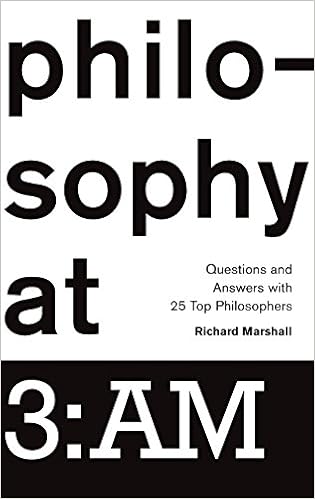
Image result for Richard Marshall, ed., Philosophy at 3:AM: Questions and Answers with 25 Top Philosophers,
Richard Marshall, ed., Philosophy at 3:AM: Questions and Answers with 25 Top Philosophers, Oxford University Press, 2014.                       


read it at Google Books


The appeal of philosophy has always been its willingness to speak to those pressing questions that haunt us as we make our way through life. What is truth? Could we think without language? Is materialism everything? But in recent years, philosophy has been largely absent from mainstream cultural commentary. Many have come to believe that the field is excessively technical and inward-looking and that it has little to offer outsiders.
The 25 interviews collected in this volume, all taken from a series of online interviews with leading philosophers published by the cultural magazine 3ammagazine.com, were carried out with the aim of confronting widespread ignorance about contemporary philosophy. Interviewer Richard Marshall's informed and enthusiastic questions help his subjects explain the meaning of their work in a way that is accessible to non-specialists. Contemporary philosophical issues are presented through engaging but serious dialogues that, taken together, offer a glimpse into key debates across the discipline.
Alongside metaphysics, philosophy of mind, epistemology, logic, philosophy of science, philosophy of language, political philosophy and ethics, discussed here are feminist philosophy, continental philosophy, pragmatism, philosophy of religion, experimental philosophy, bioethics, animal rights, and legal philosophy. Connections between philosophy and fields such as psychology, cognitive science, and theology are likewise examined. Marshall interviews philosophers both established and up-and coming.
Engaging, thoughtful and thought-provoking, inviting anyone with a hunger for philosophical questions and answers to join in, Philosophy at 3:AM shows that contemporary philosophy can be relevant -- and even fun.


Image result for Richard Marshall, Ethics at 3:AM: Questions and Answers on How to Live Well,
Richard Marshall, ed., Ethics at 3:AM: Questions and Answers on How to Live Well, Oxford University Press, 2017.
read it at Google Books


What do ethicists and moral philosophers really think about? What are the most pressing concerns in the discipline today? This collection of interviews with a range of interesting and original thinkers in the field provides a snapshot of contemporary ethics in all its complexity and nuance. It contains 26 probing interviews conducted by Richard Marshall of the cultural magazine 3AM, each consisting of a carefully condensed version of the interview, preceded by a brief biography of the interview subject. Marshall's questions are deeply knowledgeable while always accessible to the layperson, and the interviewees respond in kind with rich and opinionated responses. The result is a deeply engaging entrée into the state of ethics today.


Despite its stated purpose, this anthology of 26 interviews of contemporary philosophers, a follow-up to editor Marshall’s previous Philosophy at 3 AM, is decidedly not for lay readers. Even some undergraduate philosophy majors are likely to find themselves needing to search out definitions for terms such as Pyrrohian and endoxic method. The use of such dense jargon by the interviewees is unsurprising given that Marshall, a contributing editor for the U.K. cultural publication 3 AM Magazine, utilizes such terminology in his questions. This is a shame, because the contributors show themselves perfectly capable, in the introductory sections of their entries, of giving clear-cut explanations of why they chose to become philosophers. But it’s not just the language that’s a barrier to entry—the abstract, cold-blooded analyses of fundamental questions about human motivations and behavior are likely to turn off many readers and end up producing the opposite result of what Marshall intended, yielding a view of philosophy as only an ivory tower academic exercise. - Publishers Weekly

Maurice Lemaître - Le film est déjà commencé? (1951)

Image result for Maurice Lemaître: Le film est déjà commencé?


Neovisno o letrizmu i ex-letrizmu, Lemaître je zapravo već u analognom mediju radio izvrsne glitch-filmove.


www.mauricelemaitre.org/


One of the major works of letterist cinema, LE FILM EST DEJA COMMENCE? had as much of a direct or hidden influence on the New Wave as it does on today's Avant-Garde. Its first screenings in Paris in 1951 became major events. The critics despised it, but this work is and will remain a landmark in film History.


- Film Annonce (Trailer) (1993) 16Mm Color 3'
- Le Film Est Deja Commence? (1951)
35mm, hand-colored b/w, 59' with Marcelle Dumont-Billaudot, Christiane Guymer, Isidore Isou, Maurice Lemaitre, Gil J. Wolman.
Film in French, English translation included.

Heir to the dadaist, surrealist and abstract filmmakers of the 1920's, Lemaître was able to combine equally aesthetics with politics - no easy task and one that fully justifies the current recognition of his work." - Gérard Courant, Liberation
One of the major works of letterist cinema, LE FILM EST DEJA COMMENCE? had as much of a direct or hidden influence on the New Wave as it does on today's Avant-Garde. Its first screenings in Paris in 1951 became major events. The critics despised it, but this work is and will remain a landmark in film History. 
"This film must be projected under special conditions: on a screen of new shapes and material and with spectacular goings-on in the cinema lobby and theatre (disruptions, forced jostling, dialogues spoken aloud, confetti and gunshots aimed at the screen...). This is not just a projection, but a true film performance, the style of which Maurice Lemaitre is the creator.." - Maurice Lemaitre 1951
https://expcinema.org/site/en/vhs/maurice-lema%C3%AEtre-le-film-est-d%C3%A9j%C3%A0-commenc%C3%A9
Maurice LEMAÎTRE Autoportrait anti-supertemporel, 1966-1990, acrylique et technique mixte sur toile, 82 x 54 cm


Maurice LEMAÎTRE Interpellation, 1974, huile sur toile, 100 x 81 cm
Maurice LEMAÎTRE Déclaration amère, 1978, technique mixte sur toile, 100 x 81 cm
http://galeriepatricetrigano.com/fr/artistes/view/52