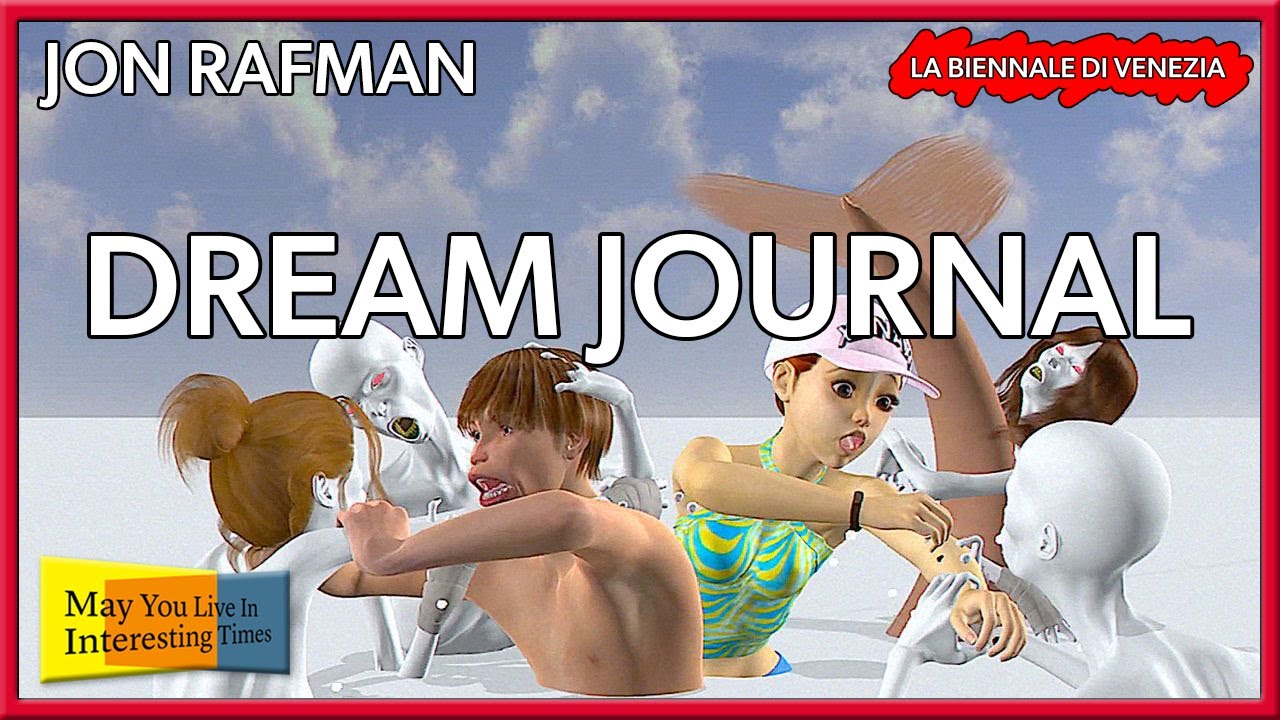
(2013). In this meandering and Robbe-Grillet inflected narrative,
Rafman ruminates on the simulated sunbeams glinting through favela
windows within the game, a melancholy sunrise in a deserted subway car, a
heavy fog over a slate grey harbor. He can only do so, however, after
killing every character—whether enemy or bystander—in the scene. In this
way, Rafman makes visible the tension between the game as object of
contemplation and the game as a continuous stream of connected events.
Although many makers outside of the industry have used video games as
source material—Peggy Ahwesh, JODI, Eva and Franco Mattes, and Phil
Solomon, to name a few—
highlights a particularly
frustrating issue in contemporary game design: namely, a pushy
Artificial Intelligence system that goads the player into constantly
responding to the checkpoints, achievements, and goals that are all in
the service of what tends to be called a game's "narrative." Although
these events don't necessarily develop plot or characters, they are seen
as central components of driving (or forcing) the player toward a sense
of completion and finality that can only be accomplished through linear
gameplay. As a result of this insistent narrative-centric design,
players are prevented from exploring the potential for triple-A games to
take on the unique, interactive potential to create contemplative and
self-reflective video game environments.
, for
example, I was always bothered by the way the game would interrupt me.
Atop my horse, I’d want to admire the stunning vistas of the simulated
Southwest and watch the cotton-tuft clouds hovering above big-sky
country. The designers—or at least some of them—clearly wanted me to
gaze upon this virtual splendor, just as one would meditate on a
painting by Thomas Moran or Albert Bierstadt. However, the game’s AI
would continually interfere, summoning cougars or coyotes, escaped
convicts or roadside bandits, to ruin my perfectly good respite. Perhaps
this was also some historical accuracy intended by the designers of
,
subtly educating players that the West in 1911 was still teeming with
chaos. In other words, if you sat still for too long, you’d get eaten
alive.
.
Beneath every moonlit aurora borealis that shimmers across a creek bed
lurks a malevolent frost dragon. In such a situation, a player can never
become just an ordinary spectator, focusing attention on the game as a
perceptual challenge and an aesthetic experience, but instead must
always play the hero. In these moments, games abruptly breaks the focus
on their immersive graphics in order to insist that the player take
action. The environment is presented only for the sake of distracted
consumption, not for contemplation. Instead of rewarding a player for
becoming invested in the beauty of the game environment, games punish
the player if they deviate from the primary goal at hand.
Rafman’s piece does not explicitly address
the need to undermine narrative, but it does suggest that games could be
built to accommodate a more contemplative player. To date, games
typically only reward a player’s focused attention on their environment
through cleverly placed “easter eggs” or some kind of “achievement.” In
,
for instance, a curious player deviating from marked checkpoints will
be rewarded with brief vignettes. These cut scenes sometimes offer up
narrative information, such as the receipt of a telegram containing
instructions for the game's character, but they are at their most
captivating when they simply allow the moments of respite and aesthetic
contemplation, offering insight into the overall patina of a game world.
This being said, some artists and
developers have designed games that revolve around fleeting moments in
order to create spaces for contemplative play. Most of these titles
reward players for slowness, or prolonged stillness. These games also
entice players to think about the game as an ongoing process, enticing
players to come back to it after several months of not playing. Within
these games, a domineering AI doesn't interfere with the whims of a
player, and as a result these games encourage players to think about
games in a way that isn't primarily focused on narrative.
(2007).
This interactive screensaver allows players to control an elk-like
creature through various locations and vignettes under a dense, mythical
forest canopy. Players interact with other elks over a network and
communicate through non-verbal gestures like bowing, stomping hooves and
dancing. Although interaction is a central component of the game, an
equally important element is the way the game rewards players for
free-ranging exploration and stillness. In order to activate certain
areas of the forest, the player must remain still, allowing their avatar
to come to full resting position. The longer the player remains in
these calm states, the more the scene reveals itself to the player.
also entices players by integrating an element of downtime that few
games would usually implement. The more time a player has spent online
(either allowing their computer to remain passively connected, or in
exploring the forest), the more their avatar visibly ages and matures.
At first, the player's elk is only a fawn, but as the game records their
participation, the avatar grows into a sagacious beast. This element of
Tale of Tales’ design indicates to the player that their prolonged
experience of stillness and rest – both on the part of the player and on
the part of their computer going to sleep – will result in noticeable
character development, suggesting that patience and contemplation are
virtuous qualities of a player.
,
developed by thatgamecompany. In this title, players awake in the
desert surrounded by gravestones and ruins. As the player moves toward
intricate and massive slabs of broken masonry, they encounter floating
pieces of fabric that encircle them and provide temporary flight. As in
,
players find anonymous companions with whom to explore the ruins of
this game. Through activating eroded altars, pillars, and frozen columns
of fabric with their avatar's voice, the player uncovers a simple
narrative about an ancient civilization that sought refuge in a distant
illuminated mountain peak. The player then works alongside their unnamed
partner to reach the summit through perilous trials and dreadful
conditions.
During this relatively short adventure,
players can either choose to advance from scene to scene without the
assistance or company of a sidekick, or else collaboratively explore the
environments of the game. As the game progresses, however, players have
to stick together and sing to one another to enliven each other’s
spirits in order to avoid freezing into immobility. This simple gesture
brings players together, not just to assist one another, but also to
playfully communicate a mutual bond that could only happen through a
networked video game.
As the player explores the
island further, they find a concentration of circling particles that
creates a portal into another season on the island. Each season then has
its own unique sound, adding new layers and new interactions to
explore. In Fall, the falling leaves from the trees blip upon hitting
the amber colored ground. In Spring, the light showers create twinkling
arpeggios that lilt atop the dense chords of blossoming flowers. In a
nod to Vivaldi's masterwork, Key and Kanaga offer a new aural texture
for each season. In doing so, they invite players to consider the
changes that occur to the landscape and to themselves, while frolicking
through luscious hilltops and valley meadows.
All three titles create
contemplative space within the video game as a way to challenge and
present alternatives for Rafman's digging man. The structure of
Endless Forest
rewards stillness and open-ended exploration, in marked contrast with
the irrepressible, attention-demanding narratives that occur in triple-A
titles.
Journey builds on this strategy with a structure that
encourages collaborative lingering, engendering shared contemplative
experiences within a simple narrative structure. And
Proteus abandons narrative entirely, while offering a rich sensory experience. In particular,
Proteus
suggests that the affect of the virtual environments presented in games
is not solely dependent on their graphical similitude to the physical
world. Instead, all three of these games offer oases of respite within a
wasteland of aggressive blockbusters, creating contemplative spaces in
which to approach a kind of interactive rapture.
- rhizome.org/
Still Life (Betamale), 2013
9-Eyes, ongoing

 Remember Carthage, 2013
Remember Carthage
Remember Carthage, 2013
Remember Carthage Carthage is a
new short film by artists Jon Rafman and Rosa Aiello, presented online
for the New Museum’s monthly First Look series.
Jon Rafman and Rosa Aiello, Remember Carthage, 2013 (still). Video on loop, color, sound. Courtesy the artists
An essay film in the tradition of experimental documentarians like Chris Marker or Harun Farocki, Remember Carthage
takes the viewer on an epic journey in search of an abandoned resort
town deep in the Sahara desert. However, one travels not through
archival or personal images but through footage sourced from PS3 video
games and Second Life, depicting ancient civilizations that seem at once
familiar and totally fantastical. Presented in conjunction with the
exhibition “Museum as Hub: Walking Drifting Dragging,” which centers on
artist expeditions, Remember Carthage is a first-person journey
through a historical fantasia that highlights the fictionalizing and
exoticization of culture within gaming and virtual worlds.
The voyage begins on the swaying deck of a ship in unnamed waters
and proceeds through a myriad of different landscapes, from arid deserts
to the gaudy interiors of what appear to be Persian palaces, to
barrooms and bedrooms—each new scene unfolding in sync with the
narrator’s melancholic remembrances. As in other works by Rafman, a
feeling of alienation and loneliness structures the story, with the
narrator searching for a connection and yet unable to grasp what is real
or stable around him. In
Remember Carthage, the filmmakers
emphasize how digital media makes history seem both totally accessible
through archival information and, at the same, completely foreign to us.
Here, the narrator’s search for the abandoned town is rendered
increasingly futile as he traverses a landscape where markers of time
and place often appear to be unmoored, floating signs. And, as his
journey continues, he becomes unable to distinguish authentic sites from
simulated versions.
The repetitive and circular sequencing of the film, with recurring
locations and characters, furthers the protagonist’s sense of
dislocation and interpolates the logic of gameplay—continual death and
resurrection—into his journey. It is unclear whether the narrator in
Remember Carthage
ever arrives; despite constantly moving, he is caught in a horizontal,
virtual dreamworld where his goals become ever more distant.
Jon Rafman is an artist, filmmaker, and essayist whose work explores
the impact of technology on consciousness. His films and artwork have
gained international attention and have been exhibited at the New
Museum, the Palais de Tokyo in Paris, and the Saatchi Gallery in London.
Rafman’s work has been featured in
Modern Painters,
Frieze, the
New York Times, and
Harper’s.
Rosa Aiello is a writer and video artist. She has recently completed
an MA at Oxford in literature and philosophy, and an artist’s residency
at the Banff Centre for the Arts. Her writing and video practice deals
with the limits of language, reason, and humanness. Aiello has been
exhibited at the Museo d’arte contemporanea Roma and the Festival de
Nouveau Cinéma in Montreal.
Lauren Cornell
www.newmuseum.org/
Codes of Honor, 2011
Codes of Honor
Jon Rafman
Jon Rafman, Codes of Honor, 2011
Chinatown Fair arcade closed down on February 28
th,
2011, after over 50 years. Gamers are still in mourning. CF, as it was
known, was one of the last video game arcades in America where one could
count on finding top-level competition. I spent the
better part of 2009 in that dingy, dim-lit arcade at the end of Mott
street, which was the battlegound for the best players in the history of
pro-gaming.
The
first Street Fighter release in a decade —Street Fighter IV —just came out,
sparking a short-lived renaissance in the fighting game community. I got to
know the regulars at the arcade and began conducting daily
video interviews, asking them to recall their greatest memories at the
joysticks. I set up a
YouTube channel,
which was widely followed and the comment section became a major forum for
debate in the community. During that year, I learned that to be a top-pro one
could not simply master the technical aspect of the game; to compete at the
highest level one needed to have a strong character and a deep understanding of
human psychology. I learned that pro-gamers ascribe to
the values and virtues of the classical archetypes of yore: honor, respect for
the other, and excellence. Hardcore gamers
have an experience of acheivement so intense that, although limited in scope
and time, it is forever difficult to equal. Although nothing can rival the high
they get from defeating a worthy opponent or the reputation during their reign,
the fame is as fleeting as the high of the win. And so I learned of the tragic
element that is inherent to the experience of video gaming.

I
learned of many celebrated gamers but as legends go, no one topped Eddie Lee,
the East Coast Champ. Eddie is recognized as the pioneer of the New York-style
of gameplay, a variation of the “Turtle-Style.” Considered the most frustrating of all
combat forms, turtling requires
infinite patience. The strategy demands that one play a zero-risk game, keeping
the perfect distance from the opponent, waiting for the enemy to make a
mistake, but never taking the initiative, just waiting patiently for him to
slip. When he finally does, he is punished. This was the style Eddie Lee felt
he had to pass on — not the brave crowd-pleasing grace of the “Rushdown” fighter,
but the calculated brutality of the defensive master that shuns all desire for
spectacle. Part of the appeal to the story of Eddie Lee was that he suddenly and
mysteriously dropped out of the tournament scene at the height of his powers.
It was rumoured that he went on to use these very skills to become a successful
Wall Street day trader.
When I found the legend of Eddie Lee, I found the
center to my film. In order to portray the tension between regret for the time
spent playing without a visible legacy and nostalgia for the thrill of the game,
I integrate three perspectives: i) a narrator in a virtual world who reminisces
about his days as a pro-gamer, ii) a Chinatown Fair regular who recounts his
greatest memory, and iii) classic cut-scenes from the games themselves. In this
way, Codes of Honor moves through
actual, virtual, and imaginary space and time.

Rather than
adopting the popular perspective on gaming as a way of escaping life, engaging
in violence or being antisocial, the film focuses on the gamers’ pure joy in
their hard-sought achievements, the thrill of high-level competition, the
significance it gives their lives, and the communities they create. We see the journey of a
professional gamer as he moves from the prized moment when he masters a game or
defeats an arch-rival to the despairing moment when he realizes his legacy will
soon be forgotten. We see him confront a question that faces us all: in a world
where history and tradition mean less and less, how do we achieve redemption? How
do we even construct a continuous self?
Kool-Aid Man in Second Life, 2008-2011
Posted by Bettina Tizzy
Net Art/New Media artist
Jon Rafman has been getting rave reviews and first-rate press coverage with the likes of
Rhizome and other coveted art outlets as the
Kool-Aid Man in Second Life®, offering free guided tours in-world. His
dedicated website
features a promo video that I guarantee will produce an emotion in
Second Life residents, and invites folks to sign up. I first got wind of
this video when Paddy Johnson of the art blog Art Fag City twittered
“Best Link Ever! Kool Aid Man gives a guided tour of Second Life and it
doesn't suck (like most SL art)!”
Unlike every other machinima I
have seen that strives so hard to get past the technical challenges to
convey the beauty, the love, the horror, the possibilities within,
because of, and thanks to our virtual lives, Jon’s is a breezy, often
hilarious tour that celebrates the absurdity of our immersiveness.
Second Life users will recognize many favorite builds and installations.
WARNING: This video contains a lot of X-rated content.
Kool-Aid Man in Second Life (.com) - Tour Promo from
on
Vimeo.
Jon
rezzed in Second Life on 12/10/2006 but used it sporadically until
recently. I’ve spent a couple of evenings this week in-world with him
and I can tell you that he’s a pleasant, intensely curious, and
intelligent fellow. He received his Master of Fine Arts degree from the
Art Institute of Chicago, and double majored in philosophy and English.
I’d call him spontaneous, easily bored, and a fascinated yet detached
explorer. I expect you’ll be as curious as I was to hear what he had to
say about this. I sent him some rather open-ended questions via email to
see what I’d get back.
Why did you elect to omit music to that video?
Jon Rafman:
There is a tendency to use music as a crutch and let the soundtrack
manipulate the tone of the work. I want the visual aspects of the video
to speak for themselves. The formal qualities of the landscapes should
dictate the mood of the piece rather than the soundtrack. Moreover, I
always felt like the generic in-world sound effects, like the ominous
low-pitched wind that blows across SL, creates a subtler emotional
resonance than music.
Kool-Aid Man is on a quest for sublime
kitsch in Second Life. Music used inappropriately corrupts the
underlying mundanity of my avatar's search.
At certain points in the video there is music; however it's always what was streaming in that sim during the time of capture.
I don't want to assume anything so I have to ask: Are you really going to give guided tours?
Jon Rafman:
I like this question. It forces me to ask myself: Where's the "Art"
happening in this project? How important is the actual tour-giving
process to the
Kool-Aid Man in SL?
Is the core of the artwork the video and photo collections? Or is it
the process of the tour itself and the interaction with people in a
virtual world that is the core of my project?
Yes, I'm giving tours. It is not a hoax!
But...
Even
if the tours were a hoax and the project existed only conceptually, I'd
be cool with that, too. I'm a big fan of work that walks the line
between fake and real, ironic and tragic, fiction and documentary.
Do you intend to continue your work in Second Life?
Jon Rafman:
I'm currently integrating some videos I've captured in SL into a larger
documentary film about professional video gamers. I'm searching for
ways to transcend the kitschiness inherent in the SL aesthetic and
haven't decided yet on how significant of a role SL will have in the
film yet.
I'm also toying with some story ideas for a few
Kool-Aid Man in Second Life
short video series. There's so much potential with Second Life
machinima, but I have yet to see a work of machinima that's truly
inspired me. Maybe I haven't looked hard enough though.
What do you want Second Life'rs to know about you most of all?
Jon Rafman:
I found an analogy for surfing the web in the act of exploring Second
Life as Kool-Aid Man. User-generated realms of Second Life can be viewed
as a 3D virtual expression of the Internet’s anarchic psyche. Kool-Aid
Man is my alter-ego, a secular icon that resonates with decades come and
gone.
I see Kool-Aid Man as a self-conscious professional web
surfer “breaking through walls” into various Second Life communities and
subcultures. He never fully fits in, but he empathizes with whatever he
passes. Like Baudelaire’s
Flaneur,
wandering the arcades of Fin-du-Siecle Paris, Kool-Aid Man keeps a cool
and curious eye, strolling through the virtual world in search for the
banal sublime. Kool-Aid Man's motto is best summed up by a line at the
beginning of Chris Marker’s
Sans Soleil:
"I've been round the world several times and now only banality still
interests me. On this trip, I've tracked it with the relentlessness of a
bounty hunter."
I wondered as I read Jon's response if he was aware that French author, photographer and film director Chris Marker is very active in Second Life.
Perhaps there are two bounty hunters then? It is unlikely we'll ever
know, given that Marker famously does not take interviews.
Jon Rafman: The
Kool-Aid Man in Second Life
project is partly an attempt to investigate certain 'outdated' concepts
from bygone eras and to reframe them or test them out in distinctly
contemporary pop-cultural contexts. I am interested in the disjuncture
between earlier uses and my own use and what this reveals about how
consciousness has changed over the past decades. Whether a fundamental
change has occurred is an open question as the forms of alienation that
existed one hundred years ago are present today in mutated forms. But
these subtle changes are revealing of what it means to be alive today.
What are these subtle changes I mention?
The fragmentation that
started with the emergence of mass culture has only intensified.
Decentralized global society is epitomized in the World Wide Web. This
is not to say that the power of centralized authority has declined or
that a new genuine techno-democracy has been achieved. This is far from
the case; I’m interested in the ways that self-regulating authority
manifests itself from the ground up.
I do think that the task of
grasping the present clearly has become more difficult because so much
now obscures us from seeing it. I frame my quest for the banal sublime
as doomed from the beginning because I am trying to highlight the loss
of a certain type of consciousness.
Am I nostalgic for Fin-du-Siècle Paris?:
Yes,
my project is a somewhat melancholic attempt at pointing towards the
importance of understanding the historical context in the digital age. I
can’t deny my nostalgia for earlier modern periods; however I am also
aware that the image of the past that I yearn for reveals less about the
past and more about an acute lack that exists in the present. And it is
this “lack” that I want to point towards.
A Conversation with Jon Rafman (NSFW video) - Bad at Sports
A conversation with Jon Rafman about Kool-Aid Man (in Second Life) - Martin, it's already now!
Is Second Life the theatre of the absurd? Ask Kool-Aid Man in SL - NPIRL
Selected Press:
Kino-Eye, the video cyborg - art:21org
Kool-Aid Man to Get It On With Avatar's Neytiri in 'Second Life' - Asylum
Best Link Ever! Guided Tours of Second Life with Kool-Aid Man - Art Fag City
Kool-Aid Man in Second Life (2009) - Rhizome
Kool-Aid Man in Second Life.com - asquare.org : Newtork Research
Kool-Aid Man in Second Life? OH YEAH! - An I'm not Lyng
Kool-Aid MAn is Giving NSFW Tours in Second Life [Wow, There's Still a Second Life?] - Boing Boing
Jon Rafman (Kool-Aid Man in Second Life) - Beautiful/Decay Magazine
Site Scavenging - Houston Press
Poke and Topiary Text Lead - The Great God Pan is Dead
You, the World and I, 2010
 You, the World and I (.com)
When Orpheus’ beloved Eurydice dies, he cajoles his way
into the underworld with his musical charms and his lyre. Wanting her
but not her shade, he cannot forbear looking back to physically see her
and so loses her forever. In this modern day Orphean tale, an
anonymous narrator also desperately searches for a lost love. Rather
than the charms of the lyre, contemporary technological tools, Google
Street View and Google Earth, beckon as the pathway for our narrator to
regain memories and recapture traces of his lost love. In the film,
they are as captivating and enthralling as charming as any lyre in
retrieving the other: at first they might seem an open retort to critics
of new technology who bemoan the lack of the tangible presence of the
other in our interactions on the Internet.
Our narrator remembers that once, with her back turned
while facing the Adriatic Sea, a Google Street View car drove by and
took a picture of his beloved, who detested being photographed, without
her realizing it. Our narrator cherishes this photograph and the
entire relationship becomes encapsulated in the screen capture
replacing all other experiences and memories. Soon it is not
enough. Our narrator cannot imagine that, in a world where everything
is recorded, that someone could completely disappear. In daily
systematic searches for photographs of the nameless other, Google
Street View and Google Earth allow him to move seamlessly through vast
detailed three-dimensional space. This extraordinary geographical and
social exploration is favored by Google satellite images, user-created
3D renderings of Stonehenge and Machu Picchu and Street View panoramas
of favorite vacation spots. As an undifferentiated series of cultural,
historical and contemporary symbols float together or follow one
another in rapid succession, in a world where Dutch anthropologists
discover pre-Socratic fragments on Turkish islands, perhaps we come to
wonder as to the significance of anything and the place of tradition
and history itself. Unlike Orpheus, our narrator is not seeking for his
lost love but for photos of his love, he yearns for records of the
relationship not the woman herself or the relationship itself. In the
ultimate irony when he returns to the original photograph, it has been
removed. By getting as close to possible to the world through
technology, has our narrator not unwittingly distanced himself from
this world? But maybe even more than a doomed quest, does not this
whirlwind tour of an individual’s personal history and the world’s
cultural history, this modern tale of loss, retrieval and loss again,
expose that the change in our consciousness has preceded the change in
our technology?
“Wherever I go, there I am” is the old adage, be it
Yogi Berra or the Buddha. The detached gaze of a satellite image or an
automatic Street View camera confronts a human consciousness whose
ability to seek connectedness and meaning has already been compromised.
Contemporary technological tools simultaneously open and close vistas
on our inner and outer worlds.

New Age Demanded, ongoing
Woods of Arcady, 2010
BNPJ.exe (with Tabor Robak), 2010
Paint FX (R.I.P.), 2009
Deities & Demigods, 2011
New Age Demanded, 2010
Tokyo Color Drifter #1, 2009
DU3L, 2009
Sleeping Shepherd Boy .com, 2009
D-R-E-A-M-G-I-R-L .com, 2009
The Death of Google's First Server, 2008
The Horror The Horror .info, 2008
Portrait of a Net Artist as a Young Man .com, 2008
Forms of Melancholy, 2008
Thirty-Six Views of Ryugyong, 2008
Spam Fragments (pdf), 2008
LeWitt2 LeWitt3 LeWitt4 Hallway1 Hallway2, 2006
Unreliable Narrators , 2005
Documenting The "Vegas Of The Maghreb" Through Virtual Environments: Q&A With Jon Rafman And Rosa Aiello
By Julie Le Baron and Shahneze Tsouria
Last night
Jon Rafman held a lecture to inaugurate the second season of Palais de Tokyo’s
“Imagine the Imaginary” exhibition. The Canadian artist, mostly known for his
9 eyes project, which utilizes the robotic eyes of Google Street View, has been an active artist on
Second Life for the past five years, documenting his virtual peregrinations with movies like
Kool-Aid man in Second Life.
For this exhibition, he made the video
Remember Carthage
(above), directed in collaboration with 3D animator Rosa Aiello. It
continues his quest for the sublime in new landscapes, those of Second
Life and of the video game
Uncharted 3.
It relays the story of a man looking for an abandoned hotel in the
middle of the Sahara desert, and draws the viewer into the remains of
the legendary city of Carthage while dealing with “the impact of a
post-internet world on notions of national identity, physical traces of
the past, and the issue of decline and nostalgia.”
We spoke with Rafman and Aiello about their collaborative work, the
foreign nature of the past, and the importance of documenting virtual
worlds.
The Creators Project: Can you please introduce your project for those who haven’t seen it yet?
Rosa Aiello: I like to describe it as a modern day experience of the
uncanny, like a renewal of that trope with modern technology. We wanted
to deal with the unconscious and this strange feeling you might have in
real life, which is perfectly depicted in video games—seeing the same
thing several times. It’s a very literary and overused idea of
repetition, but with a new twist.
Jon Rafman: We came to this work through a process. At first, we
wanted history to be the main subject of the movie, with a cyclic
narrative—a little bit in the same way you surf through Wikipedia
articles. While we were continually writing the scenario together, we
arrived at this point in a pretty organic way. When looking very
carefully at video games and virtual spaces, you notice several
repetitions, looped movements, and the form of the footage really
dictated the form the film took.
Aiello: It may have to do with the way video games are developed.
Sometimes, your character is meant to be running, because he’s being
chased or whatever, and you run through these spaces rather than look
closely at them. Developers can easily repeat things without you
noticing. We wanted to look at those aspects that people may not pay
attention to.
What’s your opinion on the fact that the Palais de Tokyo chose to
also exhibit your work in a physical space? Do you prefer the virtual
platform?
Rafman: I like to put all of my films
online
because I don’t like the fact that so many art films are inaccessible,
and that you can only watch them if you happen to be at the screening.
For me the online aspect is not so much necessary, it’s just a great way
to distribute the work. I think it would be best seen in a theater but I
want it to be as accessible as possible. I didn’t think of it as an
internet piece, I was thinking about film and literature, and majors
works from artists like
Chris Marker or
W.G. Sebald.
Aiello: It didn’t ended up being something particularly
historical in the end, but one of our first impulses was to make a
certain part of history relevant again through artistic forms.
Don’t you think that if we simplify history through the prism of
modern technologies, future generations might have a false image of what
was really going on?
Rafman: We’re actually trying to criticize that danger. It’s true
that things are going on at such an accelerated pace that we tend to
forget ancient history, and our knowledge of it is sometimes limited to
generalized articles on Wikipedia. I think the best films about the past
highlight how foreign it is to us. While we were working on the movie,
we asked ourselves what it would be like to go in a completely foreign
land, a place you’ve never heard of before, and that you’ve never even
imagined. There’s no place in the world that’s totally foreign anymore.
Somehow, even if it’s through images or any kind of media, you never go
somewhere and have your mind blown because you’ve never seen such a
thing. The idea of foreignness has completely changed.

What advantages do you find in exploring the world through a virtual
environment? I know that Jon said that what he liked best in Google
Street View was to have the spontaneity of a robotic eye, free from
human sensibility. What are the benefits of Second Life or games like Uncharted 3?
Rafman: What’s interesting is that this is a unique, completely
human-constructed world becomes an exploration through consciousness,
symbols, and desires. That’s why the repetitions become more
interesting—because they’re purely human. We were watching
The Adventures of Tintin
yesterday, and it was actually an uncanny experience. The environments
and the stages were actually the same as in our movie or the game we
were looking at. At the beginning, there’s a museum, a ship, they crash a
plane, go to an Eastern exotic place…they obviously picked these
locations because they look so good when using 3D graphics. Perhaps we
have a desire to construct something around those places. There’s a
thing about the limitations of the 3D medium that dictates the content
of games and movies.
Have you heard the story of that North American archeologist who thought she discovered pyramids through Google Earth?
Aiello: Ahah, that’s one of the drawbacks of technology, you might see things that are not actually there.
Rafman: Our memory is also affected by our interaction with
technology and media of different kinds. When I visit places that I’ve
already seen on Google Street View, I always have this weird feeling
“I’ve been here before… on my Macbook Pro.”
Do you think it would be a good idea for schools to give internet
courses so that future generations can fully understand the works of net
artists?
Aiello: Well, it’s hard to tell what going to be relevant in the
future and what platforms will remain. Second Life will probably be gone
in the next 20 years, who knows? The original platform doesn’t even
exist anymore. The point of making a film like that is to document a
virtual world that might be destroyed and put it in a medium that can
survive, like a video. There’s an historical dimension to document a
virtual world.
Rafman: I think that this idea of internet archeology is pretty
interesting, it’s important to recognize that digital things have a
historical value too. In a way, they’re in the most precarious position
because they can just disappear without leaving any trace whatsoever. It
would be pretty egotistical for me to say that my work will be
remembered—I’m not sure of what would be part of the history of the
world. Anything digital is in a very precarious position. Archivists and
historians do need to recognize these challenges.
Photos courtesy of Jon Rafman and Rosa Aiello.
By Julie Le Baron and Shahneze Tsouria
http://thecreatorsproject.vice.com/blog/documenting-the-vegas-of-the-maghreb-through-virtual-environments-qa-with-jon-rafman-and-rosa-aiello
|
Juan Gris Dream House, 2013
Georg Baselitz Waiting Room, 2013
Bridget Riley Ancient Hall, 2013
Popova-Lissitzky Office Complex, 2013
Emily Carr Master Bedroom, 2013
Ikea Operating Room, 2013
Fischli and Weiss Auto Interior, 2013
|

 http://www.brandnewpaintjob.com


Read more about
BNPJ here and
here.
 Jon Rafman, Fernand Leger Bomb, 2010
Some recent works over on Jon Rafman’s excellent piece
Brand New Paint Job.
Here so many crossovers are brought into proximity… the post-gallery,
post-exhibition reality of a collectable painting largely as an
adornment to the interior decor of the collector, bent around their
objects like a kind of philosophical wallpaper, but in Rafman’s handling
such a suggestion occurs skinned upon 3d alreadymades from
Google 3D Warehouse.
In this way the project may also wryly tackle one of painting’s most
hotly defended and greatest historic fears: the decorative.
Each instance is a consideration between an object and a painting,
potentially pitting the uselessness of paintings against the function of
objects, dialing that hallowed and receding ground between art and
design. Or casting painting in the lead role of Tradition for the
visual, a position that blankets current image based material found
within the internet. Seen in this way as an ancestor, out of context and
sampled, Rafman may seem to suggest history is ultimately wrapped
around whatever we do. This is interesting, particularly as history is a
cumulative process, you know, history is actually increasing. The
further into the future we go, the more history we must carry. We might
not have to carry it as much as before if
history is online, because now it’s just chilling in your pocket
. In any case we could, like they did 100 years ago, always dump history by the wayside to
lighten the load.
Break free. Or as we see in these works by Jon Rafman, we could just
continue to carry our burden awares - and do it with equal parts style
and wit.
In each piece iconic proponents from the history of painting are
summoned in the house of Google, relegated to the status of add-on
surfaces, custom bitmap textures, literally shrink wrapped around pieces
of online community objects. Is history fitting the current or is the
current fitting history? Positioning painting in this way brings it into
the realm of an exclusive wallpaper, a humorous play with interior
designer chic. In some of the interior living spaces where Rafman has
completely covered every object in a room with the repetition of a
single painting, the room becomes a domestic shrine to a work, it’s
facets a vortex, as objects are lost to and within a mutation of planes.
Is this a new painting? Or a new paint job? With the critical Auction
House Heights (AHH) of painting now represented also as google Image
Search Stock (ISS), history can be understood as layers applied over or
under the present, like a paint job.
by Ry David Bradley
—-
Some of Jon’s work is on view in New York at the latest offering from the New Museum, a show entitled
FREE which opens tomorrow. For your reading delight, Jon may write a mini-essay for PAINTED,ETC. in the close of this year.
An excerpt from the show text, curated by Lauren Cornell:
Today, culture is more dispersed than ever before. The web has
broadened both the quantity and kind of information freely available. It
has distributed our collective experience across geographic locations;
opened up a new set of creative possibilities; and, coextensively,
produced a set of challenges. This fall, the New Museum will present
“Free,” an exhibition including twenty-three artists working across
mediums—including video, installation, sculpture, photography, the
internet, and sound—that reflects artistic strategies that have emerged
in a radically democratized cultural terrain redefined by the impact of
the web. “Free” will propose an expansive conversation around how the
internet has affected our landscape of information and notion of public
space. The philosophy of free culture, and its advocacy for open
sharing, informs the exhibition, but is not its subject. Instead, the
title and featured works present a complex picture of the new freedoms
and constraints that underlie our expanded cultural space.
• 18 October 2010
Revealing Jon Rafman
by
Lindsay Howard
Jul 08, 2010
Netartist Jon Rafman’s Kool-Aid Man avatar is one of his
primary characters, taking appointments and leading tours through Second
Life worlds both utopian and fetishistic, as well as starring in still
images and films directed by Rafman himself, which humorously contrast
the avatar’s round red body with the super-sexy alter egos more commonly
seen in Second Life. He speaks with Lindsay Howard about his work.
Featuring an original Kool Aid Man in Second Life video!
 Jon Rafman, KOOL AID MAN IN SECOND LIFE, 2009.
via
Kool Aid Man in Second Life.
“People make crush art about you all the time, don’t they?” That’s
the first question I asked Jon Rafman one month ago after he discovered I
was embarking upon an ongoing multi-media performance inspired by his
work. Our conversation provided my first hint into Rafman’s process. He
wanted to know what I’d done between the time I left work and the time I
arrived at home, the name of the office building, where my roommate was
born, the details of my relationship to certain net artists, and a host
of other very specific questions which I later saw as part of his
process for, and reverence toward, the construction of one’s personal
narrative. The truth, though he wouldn’t admit it, is that Jon Rafman
is one of the net art community’s most respected and beloved figures.
This prestige, it seems to me, relates to his ability to position
himself in shamanistic roles, as director, storyteller, and tour guide,
as the middle man exploring essential concepts of modernity/contemporary
experience, and then processing and framing them into narratives. His
work is concerned with virtual worlds, self-identity, and the collapse
of high/low art. He is the artist/curator behind
Googlestreetviews.com and the cartoonish internet
flâneur directing tours through Second Life as
Koolaidmaninsecondlife.com.
Rafman’s Kool-Aid Man avatar is one of his most primary characters,
taking appointments and leading tours through Second Life worlds both
utopian and fetishistic, as well as starring in a collection of stills
and films directed by Rafman himself, which humorously contrast the
avatar’s round red body against the super sexy alter egos much more
commonly found in Second Life. The tours are primarily directed between
virtual avatars, however Rafman also performs the tours live, inviting
audience members to directly interact and inform the journey, as he
subtly contextualizes and frames the experience. The Kool-Aid Man
avatar, as it relates to Rafman’s body of work as a whole, is an
externalized representation of Rafman’s honest and committed artistic
struggle to construct and examine self in virtual culture.
When Rafman agreed to do this BOMB interview, our collaboration
began with a series of ideas and links shared over g-chat conversations,
emails, late-night video chats and Skype calls. We discussed
constructing a short film inspired by Jean-Luc Godard’s interview of
Woody Allen or designing a text interview where every word or phrase
hyperlinked to another obscure place on the web (à la the early papperad
website). Ultimately, I confessed that my true intention for this
interview was to reveal “the real” Jon Rafman. Our discussion over
Skype (transcribed below) proposes that perhaps “revealing the real” is…
well, I wouldn’t want to give away a story right at the very beginning.
BOMB Presents Kool-Aid Man in Second Life by Jon Rafman in collaboration with Lindsay Howard, 2010 from
BOMB Magazine on
Vimeo.
Lindsay Howard Do you think about Kool-Aid
Man as an extension of yourself? Is there an evolution there toward the
fragmented virtual self and physical self? How are you considering that?
Jon Rafman I think underlying that question
is the unease consisting of where, how, and what is my physical self
when I am in a social relation in cyberspace.
The Kool-Aid Man avatar relies on me to exist. If I don’t
log into Second Life, he is not out there somewhere in the world. He
makes it clear to me that it is not necessary to have a computer chip
implanted into your brain in order to become a man-machine. To fully
connect physical existence with digital existence, it is not necessary
to alter one’s body. Perhaps Kool-Aid Man is a cyborg in the fullest
sense in that he is combination of computer programming and human
agency.
Even more important is that the cyborg/avatar
demonstrates there is no such thing as a pure physical self. What we
take as the most fundamental aspects of self are mediated through the
lens of culture. I don’t think identity is bound to our physical
composition. How we feel and perceive ourselves, the roles we play are
all socially mediated.
The internet includes social worlds in which an avatar is
required in order to navigate and interact with other people. In these
virtual worlds, be it Facebook or Second Life, our avatar is our social
representative. What we choose reveals many ways in which our physical
or ‘real’ self is constructed. So perhaps choosing an avatar makes
manifest our fragmented and multiple selves.
 Jon Rafman, KOOL AID MAN IN SECOND LIFE, 2009.
via
Kool Aid Man in Second Life.
Although, having an avatar in Second Life need not change
your understanding of selfhood. After all, we are always inhabiting or
sending forth avatars in our day-to-day lives. I definitely feel,
however, that the way the internet is transforming how we construct our
identities deserves more attention. I think the notion of even going on
stage has changed with the many varied vehicles the web has provided us.
To me, what is even more important than a fragmented self
is, how does this lack of physicality in interaction affect us? Like,
what is the impact of the lack of the tangible touch?
LH I want to read a J.G. Ballard quote that I’ve seen you reference before:
“I believe that organic sex, body against body, skin area against
skin area, is becoming no longer sufficient… What we’re getting is a
whole new order of sexual fantasies, involving a different order of
experiences, like car crashes, like traveling in jet aircraft, the whole
overlay of new technologies…These things are beginning to reach into
our lives and change the interior design of our sexual fantasies.”
I’m curious to know whether or not you agree with him,
and how you’re thinking about this subject as it relates to your
experiences in Second Life.
JR I agree to a certain extent. I definitely
think that our engagement in cyberspace can be seen as an erotic act. An
extreme metaphor and example for this is the fetish known as
Vorarephilia,
or “vore” for short. Vore is a condition wherein one is sexually
aroused or obsessed with one living being devouring another. On one of
my tours, I showed my friend, Matt Wiviott, a thriving Second Life vore
community. Matt subsequently wrote a fascinating article in which he
devotes some time to analyzing the fetish. He argues, and I totally
agree with him, that despite vore being a marginal fetish in Second
Life, it is helpful in understanding the nature of virtual existence and
digital mediation.
The fetish can be compared to the desire to return to the
womb. The desire to be consumed entirely, to be completely engulfed by a
totalizing feminine body is fundamental to the desire to inhabit
cyberspace. Making the voyage home into the womb and analogously the
process of being swallowed alive is powerful metaphor for the process of
fully immersing oneself on the internet.
The state of being in the womb, however, can be
considered one of bliss, but also simultaneously one that very closely
resembles death. Still, there is a strange comfort in this form of
death. Like the cyborg, the act of losing oneself in cyberspace evokes
both dread and desire simultaneously.
Technology has given us many new symbols to play with,
and our fantasies are becoming more and more divorced from our physical
bodies. But I think that, at the core, there are certain impulses and
drives that have not changed and are simply expressing themselves in new
ways.
Kool-Aid Man in Second Life – tour promo 2010 from
jonrafman on
Vimeo..
LH I’m thinking about your internet
experience and the different worlds that you inhabit on the web. I guess
I’m thinking about them in terms of neighborhoods: there’s the Second
Life world you inhabit, then there’s the net art community where you’re a
social figure interacting with others and others are interacting with
you, then there’s the accumulation of items from the deep internet that
you bring to the social sphere through mediums like your del.icio.us,
tumblr, or Facebook, and then you have your artist site, which
essentially functions as a business card. How do you consider the
relationship between these neighborhoods? What are your goals for each?
JR The initial joy at finding two successive
virtual worlds to explore (Google Street View and Second Life) led
inexorably to my critique of the real world in which we are trapped. At
times I adopt the the role of a member of the community at other times I
just re-frame what I find, if not so much in liberating us but in
revealing the conditions of our enslavement.
LH Your work is often presented through the voice of an authoritative (if at times
unreliable)
narrator, whether you are giving a tour in Second Life, directing a
film, writing an essay, or performing live. How did you find this role?
JR I was influenced by literary and essay
models, but mostly I am drawn to exploring the relationship between
memory and identity, both historical and personal. The mix of authority
and the faultiness of memory has a particular pull.
Memory is both the basis and the confirmation of
selfhood, but it is also unreliable. I am interested in how
self-narratives are used to construct the self, but I am also struck by
the variety of ways memory seeks the narrative form and fails.
 Jon Rafman, 58 LUNGOMARE 9 MAGGIO, BARI, PUGLIA, ITALY. 2009. Installation in the artist’s studio.
via
Google Street Views
LH Kool-Aid Man in Second Life necessitates a
relationship with your audience, whereas with a lot of net art, or art
in general, the audience doesn’t have to be so specific. How does the
requirement of a participatory audience impact the way you consider and
construct a story?
JR There is a more direct conversation going
on with audiences and other artists because of the internet. I very much
value the immediate feedback I get when I exhibit something online,
post a video to my
Arcade Hustla youtube channel,
or give a tour in Second Life, compared to the endless waiting when
submitting films to film festivals or grant applications to government
agencies, etc. This new directness is energizing. I feel even more
motivated to make work.
LH How do you see net art existing in the marketplace, and how do you reconcile that with your personal artistic goals?
JR Good question. I don’t really have an
answer to that. In its original spirit, putting something up on the
internet meant making it accessible to all which nonetheless raises the
question of how the artist is to live.
I think that artists using any form, medium, or technique
in its early infancy tend to be idealistic about it. Whether this is
true or not, there is nonetheless the sense that new ground is being
broken, and this imbues everything with a certain energy.
One likely path is that netart takes the same path as
performance art: it will be assimilated into existing institutions. But
like performance art, the issue of selling the work will be a touchy
subject. Perhaps video and other sort of documentation of the work will
be be sold, but I don’t know.
 Jon Rafman, SLEEPING SHEPHERD BOY, 2009.
via
Sleeping Shepherd Boy
I also have the sense that a lot of the serious artists
that are using the internet are very reluctant to call themselves
“netartists,” and I understand why. The label carries baggage with it.
There is a triviality that often is associated with the word “netart,” a
certain feeling that netart is somehow reducible to either retro
animated gifs or a certain kind of ironic kitschy humor or in-jokes that
employ a mix of pop-cultural and obscure internet references.
LH Does the internet subvert the idea of a ‘master narrative’?
JR No, I think the master narrative was
subverted way before the internet became popular. I think it had more to
do with the failure of major ideologies.
But I also think that we live in one world and we are not
so different from one another, and that a universal discourse exists.
If I experience fragmentation due to being overwhelmed with data, it may
well represent contemporary reality and consciousness. Perhaps our
subjectivity changes over time, but it is ultimately part of our shared
human history. We are narrative creatures. No matter what, we will
create stories that have patterns and arcs and consist of a series of
events that can be recounted.
http://bombsite.com/issues/1000/articles/4650
JON RAFMAN interviewed by AIDS 3D (Daniel Keller and Nik Kosmas)

9-Eyes.com, ongoing
Aids3d: As an artist you’ve got a lot of different things going on.
Do you think it’s important as an artist to have a seemingly cohesive
body of work, or at least some kind of delineation between different
sub-practices. Could you outline some structure that organizes your
practice as a whole?
Jon Rafman: What ties my practice together is not so much a particular
style, form, or material but an underlying perception of contemporary
experience and a desire to convey this understanding. One theme that I
am continually interested in is the way technology seems to bring us
closer to each other while simultaneously estranging us from ourselves.
Another one is the quest to marry opposites or at least have
conversations between them, the past and the present, the romantic and
the ironic, even though these conversations often end in total clashes.
All my work tends to combines irony, humor and melancholy.
A3D: What for instance connects Brand New Paint Job to say Codes of Honor?
JR: We live in an age in which the new is constantly sweeping away or
destabilizing history and tradition at faster and faster rate. But in
the past, situating oneself within history and tradition was a classic
way by which an individual redeemed himself or built a coherent self.
One of the connections between Codes of Honor and BNPJ is that each one
in its own way examines the implications of this loss, this changing
role of history and tradition. In BNPJ there is a clash of cultural
weights between the texture (2d painting) and the underlying structure
(3d object). History (like a BNPJ) is ultimately wrapped around whatever
we do. In Codes of Honor, the narrator is profoundly sad that the time
when his life had meaning, solidarity, and achievement is now
irrevocably over, but the lack of tradition and history inherent to a
video game blocks his path to give life new meaning.

Codes of Honor, 2011
A3D: How do you think an idea of territorialism fits in to your work.? I
mean this in a few ways, 1st literally, in Google Street Views and
Second Life tours, you’re literally exploring pubic spaces and sorta
claiming them for your practice.
JR: If I use a public space for a critical or creative purposes, I view
it as “my territory.” Yet it is mine no more or no less than that of any
other artist.
A3D: But I also wonder about whether or
not you believe in any idea of artistic territory, or is this an
increasingly outmoded way of categorizing artistic practice? (In the
sense that Seth Price owns vacuum sealed ropes or Cory Arcangel owns
Nintendo hacks)
JR: Personally I find it outmoded, but
as an artist it is very important to be aware of what came before you,
otherwise you might make references in your work without being conscious
of it. I do think it is important to ‘own’ your work in that sense.
A3D: Being a bit open and dilettantish is obviously easier than
ever, but do you think that it is a good move for a young artist just
starting a career? I wonder this myself, as we’ve jumped around a whole
lot in 5 years of work, and I’ve heard many times that its hard to see a
visual continuity within aids-3d.
JR: I don’t quite see it that way. I see a definite continuity, both
visual and conceptual, in Aids-3d. But I think we struggle with similar
issues of not fitting easily into an artistic type or genre. The themes
running through our work are consistent, yet we are just always looking
for different modes of expressing them? I am constantly searching for an
ideal, be it a girl, a mentor, the sublime, while simultaneously trying
to reveal the sadness that accompanies the loss of these ideals or the
failure to achieve them.

Codes of Honor, 2011
A3D: You’ve started getting some success in the art market in the past
year or so, do you think that the “market forces” will lead you towards a
more crystalized and apparent Jon Rafman style, or do you think that
commercial support could allow you to be even more experimental?
JR: I don’t think I will ever be able to settle on any one way of
making work even if I ever have huge market success. If a Jon Rafman
style develops it won’t be the result of a conscious effort. Although
financial success would help make it easier for me to afford to make
things that I would not otherwise be able to. For example, l would love
to create a real life Malevich Ducati or make a feature length film.
Money would allow me to be more experimental in that way.
A3D: I think that maybe the most
crucial element in your work, do you have different rules when you’re
exploring Second Life versus Google Street View?
JR: The rules are constantly evolving and changing and I often only
become aware of them in retrospect. This may not be what you have in
mind, but if I were to give any rule I think the main one that guides me
is the desire to find or produce something genuinely new without
necessarily knowing what it is in advance. I really want to create
something that can both act on the future and the past; an art that is
new and yet finds continuity with art history. I think that a new art
re-works and transforms, retrospectively, the history of art.
We went to see an excellent Post Modernism exhibition at the V&A
in London together and I remember you reached a point when you started
getting depressed because it was so clear that so much of the stuff
going on right now amongst our peers was a just a repetition of what had
already happened. Now I think that gloomy feeling is valid because, on
one level, repetition is a form of regression, for as we move further
and further away from the original source our consciousness of the
historical condition lessens. But there is also an emancipatory
character to repetition if the repetition is made explicit. Maybe as
artists we are continually driven to re-attain lost moments in art
history but in new ways.

Malevich Ducati, 2011
A3D: I can see how one might take the poignant and sometimes tragic
subject matter of your Google Street Views as being a bit exploitative
(clearly the people depicted have given no consent). Do you feel that
you have the same responsibilities towards your subjects as a
traditional street photographer might have? Does the technological
mediation give you a free pass to depict whatever you find?
JR: I believe I advocate the total autonomy of the artist to capture
or create whatever he or she may please, even though I know that this is
an aspiration rather than an achieved state. I think it is important to
be conscious of the potential exploitative nature of one’s art but I
also think that, if you start making decisions based on political or
moral correctness, your art ceases to be autonomous.
Yet, I think all artists have to take responsibility for their
creation. And that it is very possible for an artist not to actually see
the truth in their work, it is possible for a photographer to be blind
towards what he is photographing. A classic example of this in film is
in the movie Blow Up. At first, the protagonist does not see the actual
murder taking place in his photo. In order to see the reality in your
work, you have to be worthy of it and truly to committed to the your
creations. The moral and epistemological perspectives are intertwined.
For me, that means that in order to see the truth in my Street View
photos, I have to be open to the inherent violence in them. I think
whenever you capture something in art or writing you are doing violence
to a certain extent because you are wrenching it from the constant flow
of inchoate reality.

9-Eyes.com, ongoing

9-Eyes.com, ongoing
A3D: Recently, we both attended the #OWS protest in London. Maybe we can
detour and talk about that for a little bit… I’ve always been
especially taken by this one Critical Art Ensemble quote from their text
Electronic Civil Disobedience, “CAE has said it before, and we will
say it again: as far as power is concerned, the streets are dead
capital! Nothing of value to the power elite can be found on the
streets, nor does this class need control of the streets to efficiently
run and maintain state institutions.”
JR: I think if the streets had a coherent ideology with a
revolutionary consciousness that assertion would be untrue, but the
truth is that a politically effective Left has been dead for a long time
now. I think this supposed renaissance of the Left can easily lead to a
even further disintegration or splintering of what remains of the Left.
But just to back up a little bit, I think it is important to talk about
the roots of the #OWS movement and recent leftist history in order to
grasp it clearly. For me, the #Occupy movement shares many similarities
to the anti-globalization movements of the 1990s, most clearly expressed
in the anti-WTO protests in Seattle at the turn of the millennium. For
instance both movements were spearheaded by anarchist groups and have
been supported by the labor movement. Both movements were “leaderless”
and expressed a populist discontent. A major theme of the “post-New
left”, “post-ideological” 1990s-era Left was, as in the current #Occupy
movements, resistance/reaction rather than pressing for concrete liberal
reforms let alone real revolution.The standard narrative is that the
90s anti-globalization movement faded out after the 9/11 attacks and
became focused on attacking the Bush administration and Israel during
the “War on Terror” era. But the #OWS movement is not objecting to
neo-conservatism and US imperialism as in the 2000s, but to
neo-liberalism and capitalism in general. While I do think that the
shift away from a politics based on opposing US hegemony towards one
that is based on critiquing capitalism as a whole is a good one, I do
not think that any form of coherent emancipatory politic is guiding the
movement. Over the past half century there has been a profound
banalization and degeneration of revolutionary politics. All problems
cannot simply be blamed on corruption or greed. The anti-intellectual
strain in anarcho politics coming out of the #OWS movement is partly a
result of the desire to reject the grand-narratives of the Old Left.
There is now a conflation of lifestyle choices with political action and
very little attempt to form structural critiques of capitalism.
Micropolitics have totally supplanted macropolitics. I understand that
there is an appealing optimism to the localist impuse, but I think
behind the lightness of culture jamming and everyday politics of
resistance lies something darker, a profound cynicism and sense that
there is nothing ‘outside’ the current social order. There is a real
despair at the failure of past revolutionary struggles which has
resulted in a almost inescapable skepticism of any totalizing politics.
The practice of everyday resistance (buying local/organic?) seems a lot
easier and safer than methodological struggle of building a sustained
alternative ideological world view. But that said, there is definitely a
new possibility to articulate the current situation that I don’t think
was possible while the wars in Iraq and Afghanistan were raging. Yet I
have seen no clear articulation of the situation by any political
leaders or movements. The #OWS movement is raising some issues that have
been out of the public sphere for a little while. Like what would it
mean to challenge the very structure of society? It is clear that we do
not live in the best of possible worlds. Yet how could a new global
political movement meet these concerns in practice? At this moment in
time, I cannot imagine an revolutionary ideology good enough to meet the
historical possibilities of our moment. Even conceiving the
possibilities for radical transformation today is truly challenging for
me.

9-Eyes.com, ongoing
A3D: Continuing from that, this work to me seems to be your most
overtly political, if for no other reason than its engagement with the
“real world.” Do you think we have any responsibility to engage with the
political issues that the world is currently embroiled in?
JR: Whenever I am confronted with the
question of the role of the artist in their relation to social change, I
am reminded of this essay by Walter Benjamin “The Author as Producer.”
In it Benjamin argues that no art can be of correct “political tendency”
unless it is also of good aesthetic quality. The moment an artist’s
work becomes overtly political or didactic it loses its true critical
potential. Aesthetic experience for me is self-justifying. I believe
that aesthetic experience reveals the critical elements of subjectivity.
In the aesthetic experience, the subject recognizes not the power of
experiential capacities and the transformative freedom of the human
faculties, but rather their constraint and un-freedom, their
self-contradictory and self-undermining powers. I think the single most
important demand of the artist is to reflect. Art should provoke
recognition. I think art objects have the power to ‘do’ things, and to
promote social change in the “real world,” but only indirectly. Art has a
role of reflection, critique and investigation of social reality, but
no ‘active’ role. In this way, art is a discursive space through which
it is possible to read social change. I am against the reconciliation of
theory and practice or art and politics. The separation of art into its
own autonomous domain is a hallmark of our freedom. The separation of
theory and practice that emerged in Modernity was progress. So for me
this romantic desire to dissolve the distinction and critical
relationship between theory and practice, art and politics, is a sign of
regression. It is very important for me to maintain a separation
between art, as a non-conceptual form of knowledge, and politics and
critical theory, which is informed by conceptual knowledge.

9-Eyes.com, ongoing
'Brand New Paint Job' catalog by Domenico Quaranta, 2011 (pdf)
Interview with Lodown Magazine, 2010 (pdf)
'IMG MGMT - The Nine Eyes of Google Street View' essay, 2009
16 Google Street Views booklet, 2009 (pdf)
Zach Feuer Gallery, New York
Seventeen Gallery, London
Future Gallery, Berlin