petak, 31. siječnja 2014.

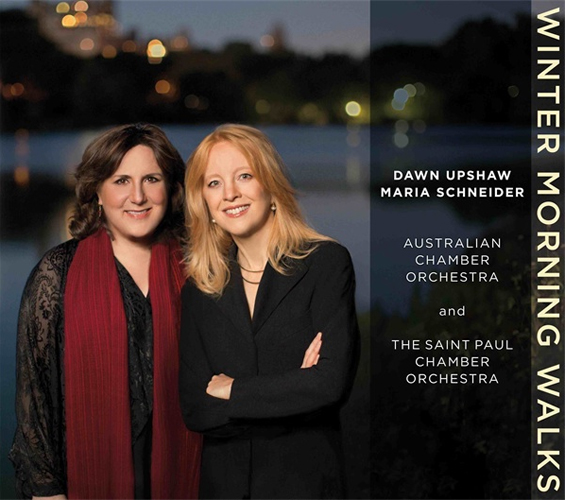
Maria Schneider featuring Dawn Upshaw - Winter Morning Walks (2013)


Od mainstream revijalnog jazza do dobre GMO klasike.

www.mariaschneider.com/


Maria Schneider's Winter Morning Walks was honoured with three 2014 Grammy awards, “Best Contemporary Classical Composition,” “Best Classical Vocal Solo,” and “Best Engineered Album, Classical,” which would seem to settle any questions about where to find it in the record store. And obviously the presence of the celebrated soprano Dawn Upshaw on the recording strengthens the impression of it as a classical work. But as jazz aficionados well know, Schneider recordings such as Coming About andAllegresse are more likely to be found in the jazz department rather than alongside Sibelius and Stravinsky.
With Concert in the Garden (2004) and Sky Blue (2007) both having been chosen as “Jazz Album of the Year” by the Jazz Journalists Association and in the Downbeat Critics Poll, the New York-based and Minnesota-born composer-conductor has clearly come a long way since she first began writing for her seventeen-member collective. To say that her music blurs the lines between jazz and classical is no exaggeration, as her extensive list of commissions includes works created for the Monterey Jazz Festival, the American Dance Festival, and Jazz at Lincoln Center, but also for the Kronos Quartet, the Saint Paul Chamber Orchestra, and the Australian Chamber Orchestra, the latter two of which appear on Schneider's latest recording.
Both compositions on Winter Morning Walks are wondrous creations, and while their combination makes for a cohesive album, there are differences between them that go beyond instrumentation and personnel. Winter Morning Walks, which features poetry by Pulitzer Prize winner and Poet Laureate of the United States (2004-06) Ted Kooser, is made up of nine distinct settings markedly contrasting in tone and style; the five parts that make up Carlos Drummond de Andrade Stories, on the other hand, largely follow one another without interruption, and the material's dreamlike character is strengthened as a result.
The texts featured in Winter Morning Walks are drawn from a book of the same name by Kooser, who composed its pieces during a time when he was recovering from cancer treatment and taking a two-mile walk each morning. Much of the text content concerns the intimate experience of being outdoors in different seasons and times of day, and to her credit Schneider has managed to translate the soul-nourishing stillness of the natural world into lyrical compositions of understated grandeur (hear, for example, how perfectly her sinuous writing matches the image of the married couple “braided together in sleep” in “All Night, in Gusty Winds”). One comes away from the piece sensitive to the appreciation Kooster feels for the country setting and the gratitude he expresses in being able to immerse himself within it.
Though Schneider has the full resources of the Australian Chamber Orchestra at her disposal, the arrangements are anything but ornate. Instead, she presents the songs as chamber-styled meditations where Upshaw's pure voice, strings, and woodwinds predominate, and where an occasional soloist lends the material an orchestral jazz feel. The playing of clarinetist Scott Robinson, bassist Jay Anderson, and pianist Frank Kimbrough establishes a bridge between the classical world of the orchestra and the jazz stylings of Schneider's own group. The vocalizing of Upshaw, still arguably best known for her celebrated performance on the landmark 1992 recording of Gorecki's Symphony No. 3, is as exquisite as ever. The soloists' playing is beautiful, too—consider Robinson's stirring contributions to “How Important It Must Be” a representative example.
The recording's second work sees Upshaw singing texts by Brazilian poet Carlos Drummond de Adrade (1902-87) backed by the Saint Paul Chamber Orchestra. With Schneider's own musicians absent, the instrumental colour is orchestrally purer in this second setting, and an overall darker, even tragic tone, reflective of the poems' content, seeps into the writing. Faint echoes of Villa-Lobos's Bachianas Brasileiras (the well-known fifth, specifically) haunt the “Prologue,” especially in those passages where Upshaw contributes wordless singing, and during one woodwinds-heavy sequence, one pictures Gil Evans listening from above with a smile on his face (interestingly, Schneider was, many moons ago, Evans' musical assistant for three years). In addition, the noir-esque “The Dead in Frock Coats” and “Don't Kill Yourself” call to mind Raymond Chandler'sFarewell My Lovely and Astor Piazzolla, among other things. Despite there being key differences between the recording's two works, the pastoral imagery and hopeful tone of the second's “Souvenir of the Ancient World” draw a firm connecting line from de Adrade to Kooster.
Winter Morning Walks is such an accomplished work, it's hard to imagine what Schneider will do to follow it up. But until the time arrives when her reply to that daunting challenge is revealed, one could do worse than spend time luxuriating in the refined artistry of this special collaborative achievement. - textura.org


Maria Schneider proved her genius as a composer and arranger beyond any doubt with Error! Hyperlink reference not valid. (ArtistShare, 2004), and she did it again on her second masterpiece of orchestral jazz, Sky Blue (ArtistShare, 2007). With Winter Morning Walks, Schneider introduces her first works with major orchestras, the Australian Chamber Orchestra on the nine part "Winter Morning Walks," and the St. Paul Chamber Orchestra on "Carlo Drummond de Andrade Stories," both in partnership with soprano Dawn Upshaw.
"Winter Morning Walks," puts music to the poetry of Ted Kooser, the Poet Laureate of the United States from 2004 to 2006. These short, clear, simple and profound pieces were composed during his recovery from cancer treatment. Upshaw's vocals soar. The Australian Chamber Orchestra—along with long time Schneider compatriots Frank Kimbrough

(piano), Scott Robinson  (reeds), and Jay Anderson (bass)—caress the words, inject small surprises inside the pastel string washes, violins and violas whispering like soft breezes through the prairie grass, making the canopies of the tall trees sing.
After the subtle magnificence, the hushed beauty of "Winter Morning Walks," it's probably best to take a break, or to perhaps listen to the work again. It is an experience to be savored before moving on to "Carlos Drummond de Andrade Stories."
Carlos Drummond de Adrade (1902 to 1987) was one of Brazil's greatest poets. His writing was most often rooted in the everyday, often featuring contrasts between moods of darkness and light. The St. Paul Chamber Orchestra features a broader palette of colors, with the strings joined by woodwinds and brass embracing the vocals. The backdrop behind Upshaw is more colorful here, though the moods are often darker. "The Dead in Frock Coats" throbs with a deep, aching melancholy; while "Don't Kill Yourself" floats back and forth between whimsey and deep despair, narrated by the poet's street-wise and somewhat detached yet sympathetic—even loving—voice.
Winter Morning Walks features two major works by a major artist. Trumpeter Wynton Marsalis has long been an advocate for Duke Ellington as the greatest composer/arranger that the United States ever produced. That's a hard point to argue against. We may now, with the release of "Winter Morning Walks" and "Carlos Drummond de Andrade Stories," have to acknowledge Maria Schneider as our greatest "living" arranger/composer. -  DAN MCCLENAGHAN

Maria Schneider should write a musical. Her song cycle, Winter Morning Walks, features idiomatic vocal writing that wouldn’t be out of place in the Great American Songbook, the canny theatrical sense of Sondheim, and illustrative text settings that would be perfect for a Broadway stage.
Yet Schneider is one of today’s foremost jazz composers, with two Grammys to her credit; multiple albums as the leader of her big band, the Maria Schneider Orchestra; and an association with legendary pianist and composer Gil Evans. She also has ties to the classical world: her newest recording, Winter Morning Walks from 2013, fan-funded through ArtistShare, features the Australian and St. Paul Chamber Orchestras, and coalesced around soprano Dawn Upshaw, for whom both the title work and the Carlos Drummond de Andrade Stories were written.
Upshaw is an incredibly versatile singer, having performed everything from Handel to Crumb to Rodgers and Hammerstein. She easily adapts to Schneider’s style, singing mostly without vibrato in a cabaret-esque voice. Though most of the vocal lines are undemanding, her operatic technique comes in handy during vocalise passages, like “Prologue” from the Andrade Stories, performed with the St. Paul Chamber Orchestra. Her voice swoops and dips evocatively over lush strings and a pulsing Spanish groove, while her clipped staccatos are exactingly precise. The melancholy “The Dead in Frock Coats” from the same set blossoms into a jeweled chord underneath a poignantly beautiful high note on the word “everlasting.”
The next poem of the cycle, “Souvenir of the Ancient World,” describes a simple life of trivial worries over up-surging music that sounds like it could be in the musical “Wicked.” Exotic flavor spikes the last two songs. Enticing rhythms color the dramatic “Don’t Kill Yourself,” which pauses in ominous suspension before slinking away. “Quadrille” is wryly humorous, a skulking tango that fits its ironic poem. Cellist Peter Stumpf and violinists Steven Copes and Ruggero Allifranchini weep with their instruments in mournful solos scattered through the cycle.
Winter Morning Walks sets poetry by Ted Kooser that he wrote daily during early morning perambulations after surviving cancer treatment. Schneider’s music is accordingly sentimental, and quietly depicts Kooser’s understated images of nature. The Australian Chamber Orchestra begins in a mood of expectation, conjuring an icy dawn, on “Perfectly Still This Solstice Morning,” an exquisite highlight. As bassist Jay Anderson, clarinetist Scott Robinson, and pianist Frank Kimbrough enter with smooth improvisations, the scene warms, as though the sun has risen. (The trio are featured throughout the cycle, alternating between improvisation and written-out music).
“When I Switched On a Light” and “Our Finch Feeder” are a drastic contrast, with agitated flutters and nervous builds. The rest of the set is softly gracious and wears its heart on its sleeve, sometimes overly so. But most of the music is a moving evocation of Kooser’s poems, with a hushed strength rippling beneath. The blooming sunrise in “My Wife and I Walk the Cold Road” is a rapturous example, but “How Important It Must Be,” the last song, is the most touching. Simple music beautifully captures Kooser’s grateful glory in life, as “the sun stood/ right at the end of the road/ and waited for me.” -  Daniel Hautzinger
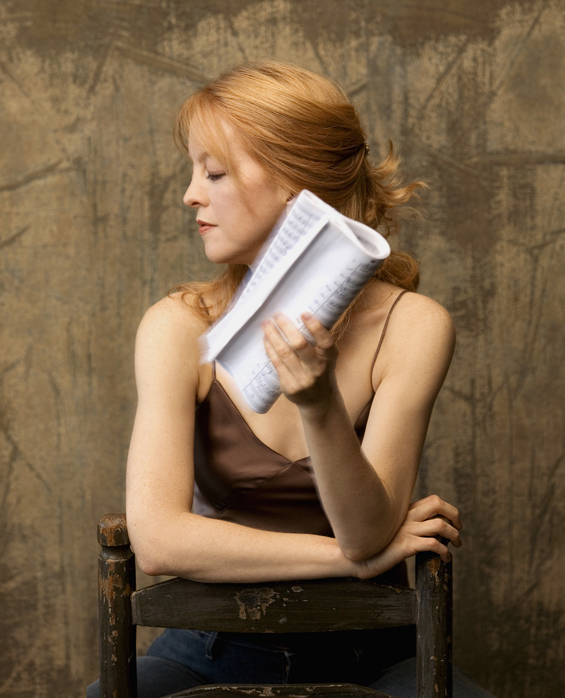

TEN QUESTIONS WITH MARIA SCHNEIDER
Born in Minnesota in 1960, composer-arranger-conductor Maria Schneider has enjoyed a remarkable and illustrious career. After earning her Masters of Music from the Eastman School of Music in 1985, she worked as Gil Evans' musical assistant for three years and studied with Bob Brookmeyer for five before establishing the seventeen-member Maria Schneider Jazz Orchestra in 1993 and carrying on the Ellingtonian tradition of composing pieces with specific soloists in mind. Critics have described her orchestral-jazz music as “evocative, majestic, magical, heart-stoppingly gorgeous, and beyond categorization.”
Though she's issued a modest seven albums since the release of Evanescence in 1994, each of those albums is distinguished by the immense effort and care that went into its creation. Her efforts have been rewarded with multiple awards, among them Grammy Awards for “Best Large Jazz Ensemble Album” in 2004 for Concert in the Garden and “Best Instrumental Composition” in 2007 for “Cerulean Skies” from Sky Blue; Schneider also was honoured as “Best Jazz Composer” and “Best Arranger” in DownBeat's Annual Critics' Poll in 2010, 2011, and 2012. Honoured with three 2014 Grammy awards (“Best Contemporary Classical Composition,” “Best Classical Vocal Solo,” and “Best Engineered Album, Classical”), her most recent recording, Winter Morning Walks (reviewed here) presents a bold new direction for Schneider: its two orchestral works are vocal-based settings whose texts are drawn from the writings of Pulitzer Prize winner Ted Kooser and Brazilian poet Carlos Drummond de Adrade and sung by esteemed soprano Dawn Upshaw—a sumptuous album that's amply deserving of the praise it's received since its 2013 release. In a recent interview with textura, Schneider spoke about the album in detail, her associations with Evans and Brookmeyer, and the challenges facing a composer in the internet age. It is an honour to feature an artist of Schneider's calibre in textura's pages, and we sincerely thank her for taking the time to speak with us.
1. Long ago you studied composition with Bob Brookmeyer and were even a musical assistant to Gil Evans for three years. Is their influence still present in your music today (and in what way specifically), even though it's been decades since you had those particular associations with them.
One could aspire for a lifetime to the greatness of these men. Bob's incredible skill at development is absolutely astounding and unparalleled—the way he could take a simple idea and morph it into so many different things, but making everything all flow so naturally and feel united. It's all so ingeniously constructed, yet it never feels forced. He did that in his improvisation and he did that in his composition. With Gil, his sense of ‘line' is, in my opinion, also unparalleled. Every single member of an orchestra playing his music always has a beautiful melodic contour, even the tuba. Gil wrote music full of tremendous detail that yet never feels cluttered. It's detailed, yet direct and simple somehow without being simplistic. I love those aspects of each of these men, and surely those things influence me on a continual basis, even if I would never claim to even come close to doing in these respects to doing what these men did.
2. In the liner notes to Winter Morning Walks, you state, “In setting poems to music, the poems themselves speak the rhythm, etch the melodic contour, and emotionally elicit the harmony.” Did you find that having the poems as a starting point made the composing process easier, as opposed to started out with a blank canvas in front of you, or were there times when you found yourself longing to be free of the delimiting constraint a text can impose?
Having the words was hugely liberating, but I didn't know that going into this project. I thought that it might be very difficult for me to write with that new limitation, but it was completely the opposite. Like you say, it was a relief not to have a blank canvas. The poems inspired me, and furthermore, it was almost like they told me what they wanted to be. They were like my muse. I miss writing to poetry now that I'm back to writing for the band. I will say this—I looked at a heck of a lot of poetry that I didn't feel a thing from musically. Ted Kooser's poetry is perfect for me. I wish I could write music to his poetry for the rest of my life. It's the whole world he creates; it's the world I come from. It's like going home to the most idyllic aspects of home.
3. Even though you've incorporated vocals into your recordings in the past, specifically Luciana Souza on a small number of pieces on 2004's Concert In The Garden and 2007's Sky Blue, Winter Morning Walks adds a much greater vocal dimension to your music, though of course the development is a natural outgrowth of the project's text-based nature. Was it a greater challenge to compose the vocal melodies on the Winter Morning Walks compositions as opposed to, say, lead melodies for instrumental voices?
Honestly, the vocals on my other music were, for the most part, an afterthought. I didn't write the music with that in mind, with the exception of the third part of the “Bulerías” recorded on Concert in the Garden . Then I started thinking about it a little bit more in the Sky Blue music, and occasionally now when I'm writing, I just hear Luciana's beautiful voice singing the lines. I haven't yet decided if I'll do that again on this new album. It just depends where the music goes.
4. Were you ‘hearing' Dawn Upshaw's voice in your mind as you were composing its pieces and tailoring the material to specifically suit her?
I absolutely was hearing Dawn's voice in my mind when writing the music for Winter Morning Walks . And, as much as hearing her gorgeous sound, I was hearing her amazing diction and wonderful sincerity of her delivery. Dawn is just so completely ‘human' when she sings. I love that about her; her sound is just so real and unmanufactured sounding. What a joy it was to write for and to get to record that voice.
5. Every listener will experience different associations in response to a particular work. As I listen to the two works featured on Winter Morning Walks, I experience associations with Villa-Lobos, film noir, and Piazzolla in response to the second one, while the title piece evokes associations with Robert Frost and Aaron Copland's Appalachian Spring. In the release's liner notes you discuss the second piece's connection to Brazilian music (though you're also careful to clarify that you weren't attempting to turn the “Brazilian poems into Brazilian music” and that “(t)he only poem set with direct Brazilian musical influence is ‘Quadrille'”), which makes me curious about what other associations the two pieces might have for you.
Honestly, I never write music imagining any particular musical influence. I do now hear that the first movement has a little bit of something Villa-Lobos in it. I think that the second movement has a little something that reminds me of Puccini, yet I don't even know which Puccini. The fourth movement, I was definitely going for the drama of flamenco, so that was truly intentional, but it's about a style, not any particular composer. And the last movement, yes, I think you are right, it has a little bit of unintentional Piazzolla in it. But then it also has a little bit of Brazilian Choro in it—a little bit of influence from Egberto Gismonti, although I don't know that he would hear that way. That reminds me of something that happened years ago. I wrote an arrangement of “Days of Wine and Roses” that I really felt was very Brookmeyeresque. When I pointed that out to Bob, he didn't have any feeling of it reminding him of anything he'd ever written—and I was scared I actually came too close.
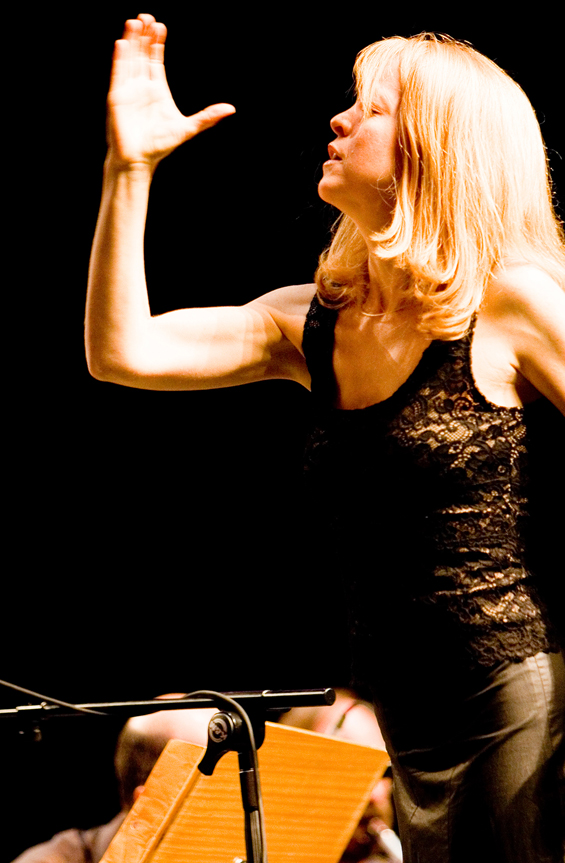
Photo: Dani Gurgel
6. It's interesting that you incorporated the playing of three of your musicians into the arrangement of the title piece yet didn't do the same in the second. Why did you choose to arrange the second piece for the orchestra alone?
The second piece was actually written first. It was commissioned by The Saint Paul Chamber Orchestra, and the instrumentation was pretty much set. After conducting the piece in concert three nights in a row, there was an aspect of performance that I have with my band that I personally was missing. It wasn't the fault of the orchestra, they were spectacular. But it was the nature of writing music that had absolutely no improvisation. After performances, I'm very used to hearing musicians celebrating all the great creative moments that just happened in a concert. I'm used to experiencing the thrill and joy of that myself. In concert, it's really fun to literally watch everybody in the band appreciating each others' creative moments. So, when Dawn asked me to write another piece for her for the Ojai Festival while we were sitting at breakfast the morning after our last SPCO concert, I had already been thinking all night how much I would love to write for Dawn again, but to do it with some element of improvisation. That was the birth of Winter Morning Walks. The musicians in my group all have a keen sense of improvising in a way that doesn't just have to feel like the language of jazz, so I knew they would be able to make the improvisation sound seamless to the music I would write, and not like jazz plopped on top of classical. I wanted to avoid that pitfall at all costs.
7. Without wanting to turn this interview into a People profile, I'm curious as to what a ‘Day in the Life of Maria Schneider' might look like. Are you one of those ultra disciplined artists who resolutely sits down every day for a set number of hours to produce a set amount of work?
It's going to be a bit of a boring and depressing response. Unfortunately, I have to report that because of the nature of the business amidst the Internet, I spend a huge part of every day of my life doing business, probably 70% of my life. I run a jazz orchestra, publish my own music, produce my own records, and raise money for the records through my ArtistShare website, which is a very extensive website. I document much of my creative process to give fans an experience of being inside the music-making, record-making experience. That's basically the model of ArtistShare. And the success I've found through this has afforded me to be able to make records that are now costing from $150,000 to $200,000 a piece. I unfortunately have to waste a lot of time battling companies that are selling or sharing my music illegally on the Internet.
Besides all of this, I plan gigs, and I do clinics and guest-conducting. I tend to go through spurts where I write music intensively and just let everything else go to pot. I wish that I could get up early every day, carve out time and be on a schedule, like back in school, but my life just isn't like that. I have to put out a lot of fires some days, and other days things afford me more time for writing. I'm devoting more and more time to advocating for music creators in regards to laws and issues in relationship with the Internet and various changes in our culture's view of creative work. This is becoming increasingly important to me. When I go teach and students ask how they can do what I've done in their careers, I'm now at a loss. In the economic environment in regards to the Internet and technology, I don't have an answer. Right now, if there isn't a serious change of course, all I can predict is doom. It's very complex and deeply frustrating.
8. Are there specific things you like to do that are non-musical in nature?
I sit on the board of the National Academy of Recording Arts and Sciences, and the most fun thing is that I'm on the board for the Cornell Lab of Ornithology. That brings me to the other great life love of mine, which is birds. I'm very passionate about the environment, bird habitat, and birds themselves. So I do put a fair amount of my life into that world, too. I'm trying to find balance, but it's not easy with so many things going on every day in my life.
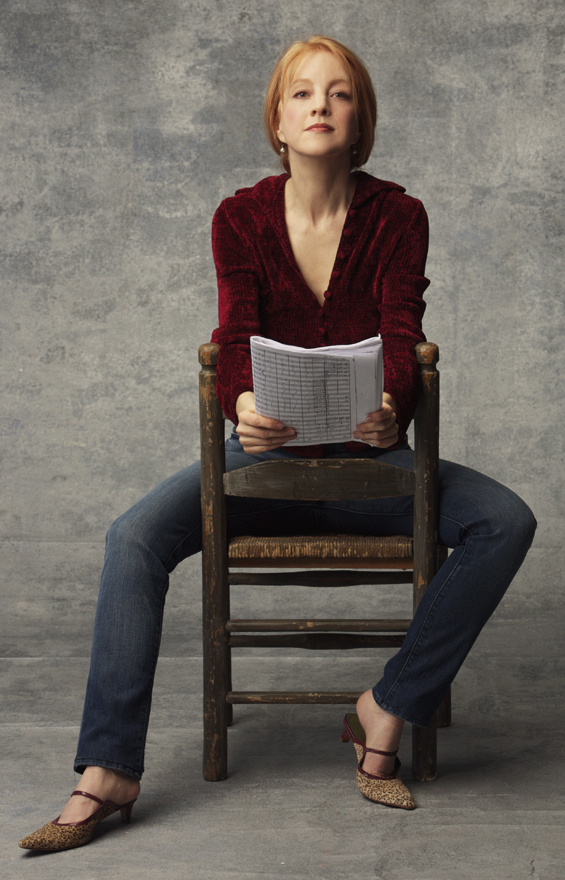
9. While you have created an impressive body of work over the course of your recording career, you've also not saturated the market with recordings. That is, we don't see an excess of Maria Schneider recordings being released annually; instead, considerable time elapses between releases, suggesting that you take a great deal of time to ensure that each one is of the highest quality and has met a high personal standard before making its way into the world.
Firstly, I would say that I think most people make waaaaay too many records. Oh dear, there is so much music out there, and it just makes people appreciate music less. I wish that most people would make far fewer records, and try to make them that much better. Music reflects life experience, and unless you're doing a little bit of real living between records, you won't essentially have anything new to say. On the practical side, as I said before, these records are hugely expensive to make. It takes a long time to write the music, develop the music, and then I have to raise all the money through the Internet. And increasingly, it's harder and harder to sell music, because so many now expect music for free. The other hurdle is people are just so inundated with music, so deeply saturated, that they don't desire to hear anything new. I remember in the old days, I was so hungry for new music. I couldn't wait to go to Tower Records and just expected to drop a bundle of money because I was so in need for music. Who could feel that way now? We're all choking on media coming at us through links, emails, and YouTube! It's really insane. It's all too much.
I also need the time between the records to do the teaching gigs and guest concerts that afford me to pay people that help me, to pay for my life, and to pay myself for a fund in case I don't make my money back on these records. I'm putting out a huge huge financial risk. Most artists are doing that. That's the thing that people don't understand. Artists are now taking on tremendous financial risk to make our own records. So when someone just goes and listens on You Tube for free or whatever, it's killing the artist. The pennies Spotify pays don't buy someone a latte, much less pay the cost of a recording. It's a joke. Most these businesses aren't in the business of music anymore. They're in the business of advertising and big data, and what they need is content, and lots of it. Musicians are being used and getting worse than nothing; their work is being diluted and devalued, and they don't seem to yet know it.
10. Where do you see all of this heading?
I don't know where this is all going, but it's not good. It can't sustain itself. Does everyone want every artist in the world just living on grants? I've taken great pride up to now in being a financially viable business as an artist. It pains me to think that my government won't stand up to companies who essentially have a business model of selling stolen goods. It upsets me that people don't see the obviousness of the theft. What more can I say? When will this stop? Wait until 3D printers destroy manufacturing companies, then everyone will get it. Or maybe everyone will let that go too, because they'll all be so excited they can print something at home that they used to have to buy. I don't know about you, but I never minded spending money on music. It was entirely natural and expected. And, we savoured it more. How did that change? All I can say is, musicians are the canary in the cave.
So, in answer to your question, being so very busy, I couldn't possibly do more records from a time or financial standpoint, even if I wanted to. Check in with me again in ten years. I myself am curious where this will end up—maybe - textura.org

Dennis Hlynsky - Flight Paths of Birds

Amazing Video Clips Visually Isolate the Flight Paths of Birds nature flight birds


Geometrija ptičjeg leta.
Zapravo, sve životinje ostavljaju tragove u vremenu koji se mogu posuti prostorom.


Chances are if you’ve on the internet over the last few years you’ve run into a few amazing bird murmuration videos, like this one from Islands and Rivers or the one we featured on Colossal from Neels Castillion, where countless numbers of starlings flock together and move almost impossibly in concert. Artist Dennis Hlynsky, a professor at the Rhode Island School of Design, wondered what would happen if he could better trace the flight paths of individual birds, what kinds of patterns would emerge from these flying social networks?
Hlynsky first started filming birds in 2005 using a small Flip video recorder, but now uses a Lumix GH2 to record gigabytes of bird footage from locations around Rhode Island. He then edits select clips with After Effects and other tools to create brief visual trails that illustrate the path of each moving bird. Non-moving objects like trees and telephone poles remain stationary, and with the added ambient noise of where he was filming, an amazing balance between abstraction and reality emerges. The birds you see aren’t digitally animated or layered in any way, but are shown just as they’ve flown, creating a sort of temporary time-lapse. Above are three of my favorite videos, but he has many more including the movement of insects, ducks, and other animals. - www.thisiscolossal.com/

Amazing Video Clips Visually Isolate the Flight Paths of Birds nature flight birds

Carp
 

A school of carp swimming and eating what tourists are casting into the water.


STEMS - V3 from Dennis Hlynsky on Vimeo.

the way of ants from Dennis Hlynsky on Vimeo.

György Kurtág - Signs, Games and Messages; Kafka Fragments


Beckett klasične muzike. Intenziviranje najmanjih komadića vremena i čovjeka.


Watch this.

A couple in their mid-80s, married for 65 years, play the piano. Their hands – the skin of which is smooth, shiny and unwrinkled, as if washed clean rather than marked by the decades – don't so much play the keyboard as conjure sounds from it. Their playing dissolves the difference between them and the instrument, and between each other. Their arms criss-cross, as if their four hands make a single composite player; their gestures, their open-mouthed wonder at and commitment to the music (a sequence of pieces by the husband, and transcriptions of Bach), and their smiles to each other, are touchingly similar. They even look alike, with their glasses and short grey hair, their posture at the piano. What you're seeing is private, intimate music-making raised to the level of a joyous miracle. It's one of the treasures of 20th- and 21st-century music.
Hungarian composer, pianist, and teacher György Kurtág and his wife Marta have been playing Kurtág's Jatekok (Games) for the past 40 years, and that ever-expanding set of pieces is just one of the laboratories in which Kurtág has conducted his experiments in the search for musical truth. It's a compositional journey that has often involved reducing music to the level of the fragment, the moment, with individual pieces or movements lasting mere seconds, or a minute, perhaps two. In fact, Kurtág builds whole cycles of pieces from these small shards, like his blistering Kafka-Fragments for violin and soprano, a 40-movement song-cycle of unflinching emotional and existential rawness, or the 12 Microludes for String Quartet, each a shred of pure musical extremity: violence or stasis, complexity or simplicity. Kurtág's apparent obsession with this smallness of time-scale isn't some kind of post-Webernian quest to split the musical atom or to find the structural essence of music. Far from a "reduction", Kurtág's fragments are about musical and, above all, expressive intensification: maximising the effect and impact of every note, every gesture. Listen to any of the Kafka-Fragments to hear what I mean.
Despite their brevity, these tiny pieces are not incomplete as experiences. Take, for example, the seven notes of Flowers We Are, Mere Flowers … ( … embracing sounds) – whose title takes almost as long to read as the piece does to hear – part of the 8th book of Jatekok. (You hear it from 4'10'' into the Kurtágs' performance.) Kurtág precedes the piece with a prelude of nine tolling B flats; the seven notes of Flowers We Are … follow. What you hear are the notes of the C major scale turned into a meditation for four hands. There is nothing more familiar than these elements, but nothing stranger than what happens to them throughout this performance. Paradoxically, precisely because of its conciseness, the piece becomes static and timeless; and those notes, far from meaning anything like "C major" or "tonality" are unmoored from conventional function and allowed to resound and shimmer in a much larger musical space. Hearing Flowers We Are … is like opening a trapdoor in your floor and dropping for a moment into the infinity of the cosmos.
That kind of intensity is something that Kurtág is always looking to create. Often, that's about an expressive or expressionistic violence (hear The Saying of Peter Bornemisza for soprano and piano, or the Messages of the Late Miss RV Troussova for soprano and ensemble to experience some of Kurtág's most emotionally shattering music), but it's just as often about wresting images of beauty and solace from a world of darkness. Some of Kurtág's most beautiful pieces are the ones he has composed as memorials for friends or musicians. They are often pieces that use that paradoxical power of the fragment to suggest a timelessness or spaciousness, for example In Memoriam Andras Mihaly, another of the Jatekok.
The detail of Kurtág's compositional imagination is matched by the inspirational and sometimes forbidding fastidiousness of his teaching of the whole repertoire of classical chamber music and his coaching of his own music. His near-perennial state of dissatisfaction with performers is the stuff of legend among musicians, but so too is the brilliance of his insight and wisdom. And any frustration with his interpreters is matched by a much deeper and more lacerating strain of self-criticism: "I never hear my ideas properly ... No one can hear it … There's nothing to be done … I felt I couldn't go on, I mustn't go on …" – just some of the Beckettian aphorisms that stud his interviews with Balint Andras Varga. (A mirror image can be found in his unconditional admiration for the music of his friend György Ligeti, whom he first met in 1945: "I … love this music from the bottom of my heart, which resounds in Atmosphères as if it welled up inside me, which shakes me so in the Dies Irae [of Ligeti's Requiem], which lifts me on high in the violin concerto.")
Kurtág's music for orchestra has embraced a larger scale in pieces such as Stele, composed for the Berlin Philharmonic and Claudio Abbado, and … concertante … for violin, viola, and orchestra. The three-movement Stele is memorial music that is nonetheless filled with a strange luminescence: the reverberating chordal repetitions in the final movement sound like the tolling of funeral bells (or perhaps the breathing of alien life forms). The first movement is an adagio, an implacable lament that ends with a homage to Bruckner in a passage for four Wagner tubas. But the second movement has the most scintillating moment of all. In the middle of the music's desperate violence, there is a sudden image of strange stillness, a sound made by six flutes, a tuba, and a piano. Kurtág said he wanted the effect to be like "the scene in Tolstoy's War and Peace where Prince Andrei is wounded at Austerlitz for the first time: all of a sudden, he no longer hears the battle but discovers the blue sky above him. That is what the music conjures up." He continues, lamenting that, "I keep telling this story and no one responds." But they do, György! If you are open to it, the devastating poetry of Stele can sear itself on your soul.
This can only give you a small slice of Kurtág's world. Ever since the piece he thinks of as his opus 1, a string quartet written in 1959 after a year of psychoanalytic soul-searching in Paris, Kurtág has composed a huge catalogue that resonates with the music of the past he loves most – Bach, Schubert, Schumann, Beethoven, Bartók, Webern. It also speaks with a fearless directness that bypasses musical tradition and becomes its own idiom. When you hear it in a performance such as the Kurtágs' own, his work creates a world of apparently unmediated feeling. It is full of the joys and despairs of life, which you can see, etched in the faces of György and Marta as they play. - Tom Service

There was a quick handshake and a matter-of-fact "good day." Then we came straight to the point. No warm up or getting used to the piano. I played just three notes at the start of lesson number one, and there was a loud exclamation: "No no no no no no no no!" Students of György Kurtág were subjected to some of the most critical listening they are likely to experience: every single note has a reason, and the player must understand it.
At the start of each lesson, this Hungarian teacher-composer shifts from an austere, withdrawn quietness to leaping, intense, spontaneous and joyous activity, playing the piano, gesticulating enthusiastically and singing. "I understand music only when I teach," he says. "Even if I listen to it or play it myself, it's not the same as working on it and trying to understand it for others. I just love music."
Too soon, the lesson ended, the music stopped, he returned to courteous but dry formalities and there was a long, slow walk down three flights of stairs at Budapest's Liszt Academy - in complete silence.
Words are used sparingly, because they are a matter of seriousness and import to Kurtág, whose music appeared in five concerts at last year's Edinburgh International Festival. With a monastic seclusion and an uncompromising search for bare, Spartan truth, he is seldom persuaded to speak about himself in public.
Yet his relationship to words is very strong. Already speaking Romanian, Hungarian, German, French and English, he learned Russian to read Dostoevsky in the original and has recently added ancient Greek to his repertoire. He draws on these languages to set the texts of a range of great poets including Blok, Sappho, Hölderlin and, most characteristically, Kafka.
Like Bartók, he has never taught composition, but has coached chamber music and piano with an almost unparalleled energy throughout his life. His teaching of chamber music is legendary in Hungary and abroad. His pupils at the Liszt Academy included András Schiff and Zoltán Kocsis, for whom Kurtág's approach provoked a complete revision of what he had understood about music and performance.
Economy of language
Kurtág's need to say only the most fundamental, and his determination to say it in as few words as possible emerges in his works too. "I keep coming back to the realisation that one note is almost enough," he once said - one note to sum up the essence of a sensation, a happening, a shriek, a sob, a gesture. And even one instrument may be enough - many of his works ("Signs" op 5 for viola is one example) limit themselves to a single voice or instrument.
"One can make music out of almost nothing," says Kurtág. That "nothing" rejuetcs rigid system and arbitrary complexity; it also rejects musical or political manifesto. He has been a figure of unrivalled integrity in the eyes of younger composers through his unswaying quest for a true, individual means of expression and his complete dissociation for political pressures.
Kurtág was shut off from democracy and the twentieth century's musical developments for a large part of his life. Born in 1926 in the village of Lugoj (Hungarian name, Lugos) in Romanian Transylvania, a region acquired from Hungary by Romania in the partitioning following World War I, he spent a quiet childhood enjoying playing piano duets with his mother and was especially fond of tangos and foxtrots.
When, aged 13, he heard Schubert's Unfinished Symphony on the radio, he decided he wanted to be a composer. Piano and composition lessons in the larger town of Temesvár (Timisşoara in Romanian) led him in search of Bartók and, with some difficulty, he crossed the border into Hungary in the hope of gaining piano lessons from the great Hungarian composer, whose return from America was expected. This was the autumn of 1945, and alongside the devastation in Budapest brought about by the war, Kurtág was confronted on arrival with the black flag flying on the Liszt Academy building. Bartók had just died in New York.
Writing behind the Curtain
Only from 1955 were Hungarians able too hear a little Schoenberg, middle-period and late Stravinksy and even the most "modern" works of Bartók were banned by the communist party between 1949 and 1953. Radios were permanently jammed and only in 1955-56 were cheap West German record players imported. Kurtág concentrated mainly on his piano studies until about 1954. Following the uprising in 1956, he was able to spend one year studying in Paris. Here, while attending courses of Darius Milhaud and Olivier Messiaen, he worked with the art psychologist Marianne Stein.
He was able to examine his musical equipment and decide how much of it was really needed: a process necessary, perhaps, who had suffered a dictatorship's indoctrination with extravagant, vacuous, rhetorical slogans. Kurtág's works up to this point included two "mass songs," some smaller instrumental works, a Korean Cantata (expressing partisanship with the Koreans at war with the US) and a Viola Concerto modelled on Bartók. The methods learned from Stein, working with very small units of music, gave Kurtág the technical means with which to realise his ideas of simplicity and honesty.
That simplicity allows for direct, personal expression. For Kurtág is anything but the cool academic that his linguistic and literary brilliance might imply: of all composer this century, he must be the one most dedicated to the subjective, human side of music. Inspired by Goethe, his works are full of homages and dedications. The pieces themselves may portray one aspect of the dedicatee, may be in memory of a deceased acquaintance, or may even contain a secret message.
For Kurtág, composition has sometimes provided a means of working through happenings in his life. "Single events, banalities, led to reactions that I could translate into music more easily than into words," he has said. His reluctance to commit himself to words leads him to communicate with friends and colleagues in a unique way: he sends messages through pieces of music rather than in words. Signs, Games and Messages for string trio is a musical diary of personal moods and responses to events.
Space and surprise
Personal experiences have also led to innovations with music: one stimulation to write Gravestone for Stephan, which has instruments surrounding the audience, was an event which happened to him at home. His wife and son had arrived home not realising that he was already there. Sitting at the piano, he began to play Beethoven's Piano Sonata op 110.
Kurtág and his wife at the ivories
They were startled and moved to hear music coming from such an unexpected place: Kurtág realised the power of space and surprise. A sense of theatre id apparent in his Beckett settings too: ...pas a pas - nulle part op 36, is an implicit, secret pantomime and shows a hidden, humorous side to Kurtág.
The profound seriousness, however, the determination to learn and to understand everything possible in his life, remains Kurtág's strongest characteristic. Despite enormous success as a composer, he remains humble and in awe of artistic creation. "Every composition has its own rules aside from what the composer wants," he says. "The more precisely I knew what I was going to write, the less the piece wanted to go. The child decides when it wants to be born, not its mother."
His retreat into silence, or into only the most profound of texts, becomes understandable in the constant quest for truth. As Kafka wrote, in a fragment set for soprano and violin by Kurtág in Kafka-Fragmente op 24, "There is a goal, but no path to it. What we call a path is hesitation." Life is too short for hesitation and prevarication; on with the music.
Kurtág reached the age of thirty-three before he was willing to give any of his works opus numbers. The few works he still acknowledges from before 1959 belong to a period of his life which is quite detached from what followed. After a childhood and schooling in Transylvania, a region of Central Europe acquired from Hungary by Romania following World War I, Kurtág became a student of piano and composition at the Liszt Academy in Budapest.
His early choral piece Beads, his Suite for piano and his Viola Concerto date from this student period 1946-55, demonstrating the composer's intimate acquaintance with the works of Bartók and his consequent understanding of musical structure which was to serve him for several years longer. Between 1949 and 1953, Hungary's Stalinist regime banned middle-period Bartók, thus heightening Bartók's importance for artists seeking a path independent from authoritarian dictates. Only when Kurtág had spent a year in Paris (1957-58) was he able to lift himself beyond this stifling environment to produce his op 1 String Quartet.
Opp 1 to 6, a group which also includes a Wind Quintet and solo piano pieces, presents a clear picture of what Kurtág absorbed in Paris. Short, expressive, highly-concentrated musical motives reveal his discovery of early Webern; the motives' rhythmic vivacity is indebted to Olivier Messiaen's theatrical concept of rhythmic cells as "personnages," something Kurtág absorbed from his analysis classes.
The controlled exploration of music within clearly defined limits (sometimes just two notes) was suggested to Kurtág by Marianne Stein, the art psychologist with whom he worked in Paris, as a way of composing most suited to his temperament. This reduction process also enabled him to cleanse his language of any empty gestures accidentally absorbed from the empty musical rhetoric by which he had been surrounded in communist Hungary.
His master's voice
Kurtág's attachment to speech is also to be sensed in the works from this first period of maturity, something which emerged more concretely in his op 7, The sayings of Péter Bornemisza for soprano and piano. Phrases of music that evidently sprang from figures of speech and retain their communicative urgency now appear in op 7 with the terrifyingly vivid sermons of the 16th century preacher Bornemisza. Op 7 was originally to have been an opera on Bornemisza's translation of Sophocles's Elektra and despite its subsequent metamorphosis, it bears some of Greek Tragedy's horrifying realism.
Op 7 is the culmination of a musical language developed in opp 1 to 6 and led to a need for new musical stimuli. The work's dates, 1963-1968, include a period when Kurtág was not composing, but studied afresh the works of Beethoven, Schubert, Debussy and Bartók (among others) alongside working as an accompanist for the Budapest State Concert Agency. Following op 7's completion, he encountered considerable difficulties with composition, to which another process of simplification and reduction provided a solution.
The result was Games for piano, which he began in 1973. The influence of Milhaud, whose classes Kurtág attended in Paris, emerges for the first time, through Kurtág's acceptance of all ideas as possible future materials without prejudice, even if they are apparently banal on first sight.
Games was initially commissioned and conceived as pieces for children, which added to their liberating effect on the deeply serious and critical Kurtág. They developed into a unique blend of musical diary, analysis (of the works of others) and also compositional workshop. Many of the ideas generated in Games formed seeds for larger works in the ensuing years 1975-1979; Hommage à András Mihály (12 Microludes for String Quartet) op 13 (1977) is one example.
Diffusing unity
The next influence on Kurtág was the Russian language, which he learned especially in order to read Dostoevsky, and which is almost "sacred" for him, in the way that Latin was for Stravinsky. In his Russian works, opp 16 to 19, Kurtág's response to Russian prosody transforms his musical dialect with a poignant lyricism; this is to be heard both in the works for solo soprano and instruments such as Messages of the Late Miss R V Troussova op 17 (1976-1980) and the triumphantly pessimistic set of choruses, Songs of Despair and Sorrow op 18 (1980-1994).
His subsequent development was with instrumental genres: in the 1980s he introduced a spatial dimension to large ensembles, dispersing 'families' of instruments in different locations in the concert hall. Works such as ...quasi una fantasia... op 27 no 1 (1982-1987) explore this idea of "diffused unity," a development which also heralded the most recent work of all.
For aside from Stele op 33 (1993-1994), unique in this period for its formal synthesis, Kurtág now disperses his music either in space or in time. The gradually expanding Messages op 34 (1991-1996...) for orchestra relinquishes a synthesising formal time construct, just as have the other 'Works in Progress' that vary from performance to performance, and will continue to evolve as long as the composer lives.
Bartók's legacy of synthesis between folk music and firm Western structures was both a wonderful gift to, and an overwhelming shadow over, Hungarian composers of Kurtág's generation. Kurtág's most recent works represent his ultimate transcendence and diffusion of Bartók's closed formal constructs, and the constant, invigorating acknowledgement that:

The mind is a free creature.
Neither with chains nor with rope can it be bound,
but all the time, day and night, in our dreams when we sleep,
it wanders.

- Rachel Beckles Willson, Read Rachel Beckle Willson's review of Kurtág in Edinburgh as well.

György Kurtág: Great Hungarian Jewish Composer, No Monk

By Benjamin Ivry

Music generally eludes accurate verbal descriptions, but rarely as often as in the case of 82-year-old Hungarian Jewish composer György Kurtág. On February 1, Kurtag will perform a recital of his piano music with his wife, Márta, at Carnegie Hall’s Zankel Hall. (At that same venue, a day earlier, Peter Eötvös will conduct a concert with more music by Kurtág.) A lean, professorial man with close-cropped gray hair, Kurtág writes music that is aphoristic in its high-pressure concision, as if he were a Hungarian-Jewish version of Anton Webern.
QUITE THE DUO: Márta and György Kurtág at the piano.

As a one-off individualist, Kurtág puts notes in unusual and unexpected places, and no one can imitate his compositional style. More influential to later generations of performers is his work as a chamber music coach, during which he readily admits to “putting students through hell” by examining every measure of a work before they can experience joy from performing it.
Critics repeatedly refer to the composer’s “monastic seclusion,” and one even said that his composing process is “like a monk mortifying the flesh.” Though some might think he resembles one of the extras from the 1986 film “The Name of the Rose,” Kurtág is in fact a doting father and grandfather who is influenced by his Jewish family heritage, and this becomes quite clear on listening to certain works of his.
One such work is “Kafka Fragments” (“Kafka-Fragmente”), for soprano and solo violin. It includes a “Hasidic Dance” set to Kafka’s wistful words: “Once I broke my leg; it was the loveliest experience of my life.” As a teenager, Kurtág studied composition in Temesvar (Timişoara) with A specialist in Jewish folk and liturgical music, Mihály (Max) Eisikovits (1908–1983), who wrote in the preface to his “Songs of the Martyrs: Hassidic Melodies of Maramures” (Sepher-Hermon Press) that nigunim, from a “musical point of view… unquestionably constitute the most original and noble aspect of Jewish folklore.”
“Hasidic Dance,” a portion of “Kafka Fragments,” expresses rough, unsentimental folklike power, as well as the topsy-turvy absurdist element of turning somersaults in the marketplace, associated with the messianic movement. In 1940, when World War II broke out, Kurtág was studying with Eisikovits in Timişoara, from which Jews were not deported as much as elsewhere in the region, and so he managed to survive the war.
In another section of “Kafka Fragments,” labeled “Penetrant Jüdisch” (mistranslated, on the ECM label, in the booklet notes of an otherwise excellent performance as “offensively Jewish”), the German word penetrant means “penetratingly, overpoweringly, insistently.” Kafka’s maxim in the same musical passage (“In the struggle between yourself and the world, side with the world”) underlines how well Kurtág understands Kafkaesque sly wit and resignation to human weakness.
This is only natural, since Kurtág has identified so closely with Kafka as to represent himself as an incarnation of Gregor Samsa in “Metamorphosis.” As recounted in the perceptive 2007 documentary film “György Kurtág: The Matchstick Man,” now available on DVD from Ideale Audience, after Kurtág travels to Paris in the 1950s for further studies, he feels somewhat like a “cockroach striving to change into a human being, seeking light and purity.” Rereading Kafka’s “Metamorphosis” obsessively, he was eventually helped by depth analysis with Hungarian-born psychoanalyst Marianne Stein. The benefits were immediate. In addition to giving him a “moral demeanor,” Stein helped Kurtág, the latter asserts, to “stop lying to myself… [and] concentrate on essential things.” Using a form of art therapy involving the construction of small sculptures out of matchsticks (whence the documentary’s title), cigarette butts and tufts of dust, Kurtág slowly developed what his longtime friend, Romanian-born Jewish composer György Ligeti (1923–2006), called Kurtág’s “fantastic inner concentration” on “tiny, subtle gestures.”
Such aspects are evident in Kurtág’s “Games” (“Játékok”), a still-unfinished work for piano four hands that Kurtág has been working on for three decades, excerpts of which are part of the Carnegie Hall performance. Already brilliantly recorded by Kurtág and Márta on ECM, “Games” interlaces original compositions with transcriptions of Bach, conjuring up a world of Central European domestic music making. The excerpt “Slaps — Squabbles” (“Schläge — Zank”) expresses a conversational spat, with the distracted nagging that is to be expected in any long-term partnership. Arguing, like music, is a domestic form of entertainment. Also in “Games” appears an “Homage to Márta Kurtág,” which on the ECM recording prefaces several solo pieces played by Márta, herself a masterful student of composition who offers advice on every note written by her husband.
Kurtág is not always a miniaturist, and this is notable in “Stele” (1994), a mighty work for large orchestra, composed for Claudio Abbado and the Berlin Philharmonic, in which, like all major artists, he defies generalizations and expectations. His compositional approach, aspiring to the simplicity of Gregorian chants, creates music, Kurtág said, from “almost nothing, without any material so to speak, quite simply because something happens which transforms nothingness into movement.” This approach strongly echoes French-Jewish philosopher Vladimir Jankélévitch (1903–1985), whose book “Le je-ne-sais-quoi et le Presque-rien” (The Indescribable Attribute and the Almost-Nothing) inhabits comparable theoretical terrain.
But although writers make his music seem impossibly ethereal and abstruse, it’s worth recalling that in the 1990s, Kurtág the man relocated to Saint-André-de-Cubzac, a no-frills, down-to-earth small town outside Bordeaux in southwestern France. Offering tourists little except the gravesite of native son Jacques-Yves Cousteau, it’s the town where Kurtág’s son, aspiring composer György Kurtág Jr. — a fan of electronica who is inspired by The Beatles and Jimi Hendrix — lives with his family. According to Junior’s Web site, one of Kurtág’s teenage grandsons, Raphaël, currently aspires to be a dancer in a boy band. The realization of this dream might make some grandfathers react “like a monk mortifying the flesh,” but surely Kurtág will merely offer a Kafka-like smile and shrug of resignation, since he is not just a great composer, but a loving family man, as well.
This domesticity is essential not just to Kurtág, but also to other composers — especially Ligeti — featured in the concert series “Celebrating Hungary,” which runs at New York City’s Carnegie Hall from January 24 to February 14. I well recall asking Ligeti, during a Paris interview that took place around 1990, whether some of the humanitarian awards that he himself had received asked too much saintly activity from a man whose chief responsibility was to write good music. Ligeti agreed absolutely, saying, “Two things are of essential importance to me: composing music and making love to my wife.” So much for the “monastic” school of modern Hungarian composers.
To watch a clip from “György Kurtág: The Matchstick Man” click here. 
- forward.com/

György Kurtág is a Hungarian composer of contemporary music. He was born at Lugoj in Romania, not far from the birthplace of fellow Hungarian György Ligeti. Both young composers hoped to study with Béla Bartók in Budapest in 1945, but B. Bartók died in America. In 1940, he studied piano with Magda Kardos and composition from Max Eisikovits, at Temesvár (Timisoara, Romania). He then moved to Budapest in 1946, enrolling in the Ferenc Liszt Academy of Music, studying composition with Sándor Veress and Ferenc Farkas, as well as piano with Pál Kadosa and chamber music with Leó Weiner. Kurtág officially became a Hungarian citizen in 1948. In the early part of the 1950's, he continued his studies of composition, chamber music, and piano. He was an outstanding student, winning the Erkl prize in 1954 and 1956. Among his early works was a Korean Cantata which expressed solidarity with the North Koreans in the Korean War against the USA, but he reached the age of 33 before he was willing to give any of his works opus numbers.
In the early 1950's the Stalinist regime in Hungary proscribed B. Bartók's later works, and immediately his music became a rallying call for artists taking a stand against authoritarianism. Also banned in Hungary until the mid-1950's was the music of Arnold Schoenberg, and middle and late-period Igor Stravinsky. To escape this creative straitjacket György Kurtág moved to Paris in 1957 to study music with Olivier Messiaen, Darius Milhaud and Max Deutsch. He also had consultations with the Hungarian art psychologist Marianne Stein, and it was her advice that would prove most influential on his future development. While in Paris he wrote his first String Quartet, designating it 'opus 1' to mark a decisive break from his compositions to date. He returned to Budapest in 1958, stopping for a few days in Cologne where he first heard recordings of Stockhausen's Gruppen and Ligeti's recent electronic music. This experience would also prove important in formulating his new compositional voice.
Though the standard of living in democratic France was no doubt higher than communist Hungary, György Kurtág returned home as repetiteur of soloists with the Hungarian National Philharmonia throughout most the 1960s. In 1967 he was appointed professor at the Ferenc Liszt Academy of Music, Budapest, first of piano, then of chamber music. In 1971, he had his second appointment in the west. This time it was a one-year stay in West Berlin as grantee of the DAAD scholarship. His reputation began to gain more ground. He officially retired from the Academy in 1986. During his time his pupils included the renowned pianists András Schiff and Zoltán Kocsis.
After his retirement from the Liszt Academy in 1986, György Kurtág lived in Germany and Austria. In 1987, one year after leaving Hungary, he immediately became a member of the Bayerische Akademie der Schönen Künste, Munich, as well as a member of the Akademie der Künste, Berlin. His works were getting more sought after, and he was relentlessly sought after as an instructor.
Living at a comparatively brisker, international pace, in 1993 György Kurtág was awarded the Prix de Composition Musicale by the Fondation Prince Pierre de Monaco, for his Grabstein für Stephan and Op. 27 No. 2 (Double Concerto); the Herder Prize by the Freiherr-vom-Stein Stiftung, Hamburg; and the Premio Feltrinelli by the Accademia dei Lincei, Rome. That same year (1993), Kurtág was invited to stay in Berlin as composer-in-residence with the Berliner Philharmoniker for two years, and his op. 33 Στηλη (Stele) was written for the orchestra.. This was followed by a residency with the Wiener Konzerthaus and, in 1998, the Kossuth Prize from the Hungarian states for his life's work.
Music
György Kurtág is one of the more highly esteemed composers of the late 20th century. He is not well known outside of Europe, writing little and not prone to acts of self-promotion. Most composers would not have been able to establish a career in this manner.
What little he had written demonstrated itself as the work of genius, beginning with the brief Quartetto per archi opus 1 from 1959. A perfect synthesis of Webern and B. Bartók, this work has an undistracted intelligence about it, a courage that intellectuals required to survive the tyranny of the Soviets. He did seem entirely at odds with the Communists, having written some works with anti-American sentiment, but this appeared exclusively before his visit to Paris in the 1950's. The 1960's and 1970's were been fairly uneventful, and his catalog continued to grow at a startlingly slow rate. However, what works he had written made a large impression.
György Kurtág had carved his place in the Western world while still behind the Iron Curtain, emerging in the 1980's as an indisputably necessary voice. His musical language is highly individual, but it reflects several influences including J.S. Bach, B. Bartók, Alban Berg, L.v. Beethoven, and Messiaen. The crucible that forged Kurtág's music ranges from Guillaume de Machaut, whose music he transcribed for piano, through French Gothic architecture to the plays of Samuel Beckett, the novels of Dostoevsky and the writings of Goethe. He speaks Romanian, Hungarian, German, French, Russian, Ancient Greek and English, and his linguistic skills are evident in the texts he has set, which include Blok, Sappho, Hölderlin, and Kafka.
Many of György Kurtág's compositions are for chamber groups. Messages of the late Miss R.V. Troussova Op. 17 for soprano and chamber ensemble (on poems of Rimma Dalos) was premiered in Paris in 1981 and established his reputation, while the earlier chamber concerto for soprano and piano Sayings of Péter Bornemisza is also frequently performed. His quasi una fantasia… Op. 27 no. 1, first performed in 1988, was the first of several works that exploited spatial effects, an interest that dates back to his encounter with Gruppen in 1958. More recently Kurtág has written for symphonic forces, and among the champions of his larger works is Simon Rattle who programmed Grabstein für Stephan, which surrounds the audience with instruments, with Mahler's Second Symphony in a widely acclaimed Wiener Philharmoniker concert at the 1999 Salzburg Festival. This twelve minute work is an elegy for the singer, husband of Kurtág’s psychology teacher Marianne Stein.
Works (Selection)
wo op. Viola Concerto
Op. 1 String Quartet No. 1 (1959)
Op. 2 Wind Quintett
Op. 3 Eight Pieces for piano
Op. 4 Eight Duos for violin and cimbalom
Op. 5 Signs for viola
Op. 6c Splinters for cimbalom
Op. 6d Splinters for piano
Op. 7 The sayings of P. Bornemisza for soprano and piano
Op. 9 Four Capriccios for soprano and chamber ensemble
Op. 11 Four Songs to poems by János Pilinszky op. 11 for bass voice and ensemble
Op. 12 S. K. Remembrance Noise for soprano and violin
Op. 13 Hommage a András Mihály for string quartet (1977-1978)
Op. 14d Bagatelles for flute, double-bass and piano
Op. 15b The Little Predicament for piccolo, trombone and guitar
Op. 15c Grabstein für Stephan for guitat and instrumental groups (1989)
Op. 15d Hommage a Robert Schumann for Clarinet, Viola, and Piano
Op. 16 Omaggio a Luigi Nono (to poems by Anna Akhmatova and R. Dalos) for mixed voices
Op. 17 Messages of the Late R. V. Troussova for soprano and chamber ensemble
Op. 20 Attila József Fragments for soprano
O. 24 Kafka-Fragmente for soprano and violin
Op. 27/1 ... quasi una fantasia ... for piano and chamber ensemble
Op. 27/2 Double concerto for piano, violoncello and ensemble
Games (Játékok) 7 Volumes so far
Op. 28 Officium breve in memoriam Andreae Szervánszky for string quartet (1988-1989)
Op. 33 Stele for orchestra (1994)
Op. 35a Hölderlin-Gesänge for baritone
Op. 36 ...pas à pas - nulle part...(poems by Beckett) for baritone, string trio, percussion
Op. 42 Concertante for Violin, Viola and Orchestra (2005)

György Kurtág: Three Interviews and Ligeti Homages

Bálint András Varga: György Kurtág: Three Interviews and Ligeti Homages (Hardback)

University of Rochester Press, 2009 

Bálint András Varga is a former head of promotion for Universal Edition and a figure who has to his name a long engagement with contemporary music. His previous books include interviews with Xenakis and Lutoslawski – with both of whom, as with Kurtag, he has had close ties – and on the dust jacket of this new volume on Kurtag, one finds an enthusiastic thumbs-up from Boulez, Peter Eötvös and Kent Nagano.
The book is compiled of three interviews conducted over a number of years, along with a couple of texts by Kurtag in homage to his close friend Ligeti. Neat and well organised, with a catalogue of works, personalia and a comprehensive bibliography, it will mainly be of interest to Kurtág enthusiasts; but it also offers insights on contemporary music, the life of the composer and the mid-twentieth century intellectual-artistic milieu in Europe that will be of wider interest.
Kurtag is notoriously reticent; one imagines he says all he wants to say in his music. When he speaks, Varga tells us at the start of the book, Kurtag 'hardly ever talks in complete sentences… he leaves many of them unfinished or changes direction mid-course.' It follows that though a volume offering Kurtag's views on his own music will be precious, it certainly won't read like a voluble Stravinsky with Robert Craft. And though this volume isn't a rip-roarer, it doesn't make any claim to be. Rather it is a book that in a modest way does its job well – like Kurtag himself.
Its discourse is not so fragmented as you might expect. This is likely due to Varga's having allowed Kurtag and his wife Márta the opportunity to look back over the transcribed interview after the fact and to emend or add to it as they saw fit. The result is a smooth flow, and an ability to elaborate (one imagines) small anecdotes from the initial conversation into fuller accounts. But it also makes the tide of conversation a safe one in its ebb and flow, lacking perhaps that element of danger that would provide an occasional quickening instability. Given that fragmentedness is something one associates with Kurtag's music – allusiveness and an unsteady proximity to silence – it would be interesting to read the undoctored text, syntax rendered with splinters intact.
The interview format ostensibly sees Varga ask Kurtag – accompanied by his wife Marta – the same three questions on three separate occasions over intervals of a number of years (the interviews took place in 1982-85, 1996 and 2007-8). The intention is to see what changes occur over time in Kurtag's opinions and in the weight of his recollections (not a lot as it turns out). The three questions chosen are whether listening to any particular piece of music had brought about a fundamental change in Kurtag's musical thinking; to what extent the sounds of his immediate environment are of significance to his creativity; and up to what point one can speak of a personal style, and where self-repetition begins. As much as to garner straight answers the questions are designed to prompts reflection and reminiscence and to provoke unforseen memory. As it turns out Varga does not really stick to this programme, preferring to let the theme of the interview be determined by what has arisen in previous conversation.
Kurtag's mind wanders freely, visiting various events from his past in close succession and without respect for their chronology. You get the sense that the past has a distinct reality for him that isn't limited to being a time that has passed: it is instead ever present with its own haunting reality. Memories of how hearing Schubert's 'Unfinished' Symphony at an early age led to his wanting to compose music lead on to memories of dancing and playing piano duets with his mother as a child, this gradually merging into an account of his well-known mental troubles during his time in Paris in the 1950s befoe moving back again. Certain key moments in Kurtag's life seem to have for him a magnetic pull, an attraction that informs upon everything else.
The relation of this early Paris stint is particularly fascinating, the pain then experienced rendered vividly: 'In 1956, the world had literally collapsed around me – not just the external world but my inner world too.' A disturbing account is given of how his state developed: 'I made angular movements, almost like playing a pantomime. I even tried to alter my handwriting to an angular, crabbed style. The next stage of this was my starting to make angular forms from matches. A whole symbolic world evolved. I perceived myself as in a worm-like state, totally diminished in humanity. The matchstick forms and balls of dust, along with black stubs (I also smoked) represented me.' The scene appears like something created and which in turn engendered creation in the mind of its subject.
György Kurtág

In the second interview Varga focuses on drawings that Kurtag created around this time, to which Kurtag partly ascribes his breaking free from his mental malaise. Handsome prints of these paintings are reproduced, along with paintings that Kurtag made during the time of another period of creative paralysis in the early seventies, out of which Játékok was born. These abstract monochrome drawings and paintings, by turns spindly and blotchy, are compared with Kurtag’s music for the light they might reciprocally shed on each other. As Kurtag notes, all of his work may be viewed as an ongoing autobiography, albeit one not written in language.
Throughout the interviews we get insight into Kurtag's mindset as a composer. For him, as it was for Schoenberg, composition is largely something involving the unconscious: 'When I know how to do something, when I know what the form will be like, what kind of variations or systems will be in the piece – then I normally don’t write it.' This is obviously not to say that conscious craft doesn't play a role. It is clear from various other remarks made that Kurtag's technical ability and comprehension of his material stems in a large part from his study of scores – an activity he still engages in, speaking in one interview, for instance, of having closely analysed Bartok's fifth string quartet recently. We are also told that Kurtag's appreciation for Webern and Bartok did not in the first come about instinctively through hearing the music. Instead it was through studying the scores and understanding how the works were constructed that Kurtag's appreciation bloomed.
Entitled 'Key Words,' the third interview is by far the longest. Here Varga's approach is to bring to Kurtag certain words he associates with Kurtag's music, for example rite, silence, disperato, memory and so on. Predictably enough, Kurtag does not much elaborate on these leads, preferring to accede to their relevance while bringing the talk back to the more practical matters of specific compositions, their attributes and the experience he has had with performers. The result is an interview peppered with anecdotes and remarks especially relevant to prospective performers of Kurtag's music.
Looming large in this is Kurtag's wife Márta, who contributes in answering the questions. Varga describes their relationship as being one of 'complete harmony', with Márta referred to by the composer as his 'projected self.' 'Those who have experienced the concerts of György and Márta Kurtág, have been able to sense their human and artistic oneness,' a oneness whereby Márta has shared the composer's life for the past sixty years and now too most of his memories. While touching, this relationship is so close that the two can sometimes appear in their sum as one combined or cleft person.
György Ligeti
By Kurtag's request the latter part of the book is taken up with 'Mementos of a Friendship', a portmanteau of two texts written by him on his lifelong friend and compatriot György Ligeti. Both of these texts were originally given as speeches: one in 1993 when Ligeti was alive, the other in 2007 after he had died. For the former Kurtag devised a visual aid whereby his memories occupy different positions on an imaginary stage; for example 'back corner, top, left,' and 'corner, back, right, top'; a technique that for Kurtag eased the process of writing and allowed the memories to emerge by their own accord. The text is mostly made up of anecdotes, moving backwards and forwards through time to give a rounded and animated portrait of Ligeti as Kurtag knew him.
The tone is light and full of affection, admiration and respect. An account is given, for instance, of Ligeti's first arrival in Paris, late on Christmas Eve 1957 with Kurtag awaiting him at the Gare du Nord. Upon arriving, Ligeti proceeds apace on foot through the streets, shirking the metro, leading Kurtag and another friend towards the latter's apartment, the location of which he already knows through having known the outlay of the city since his obsession in youth with maps (which fed into his inventing his own imaginary land, Kylwyria). This image leads to a reflection on how this preoccupation of Ligeti's youth seems hereditarily shared by his son Lucas, and then onto how its encyclopaedic eccentricity helped inspire Kurtag to come up with the capacious form of Játékok. Myriad other scenes flash by: musical evenings in Budapest with the composers and their wives singing tunes from Mozart operas, Ligeti storming out of a production of Le Grand Macabre in Paris in the early eighties; and in the end his deathbed scene, by which time he had lost the ability to speak. - Liam Cagney The seeming disorder of Kurtag's recollections hides their thoughtful and discrete, if unorthodox ordering. These two texts on Ligeti are the only published texts to ever have been penned by Kurtag, and give insight on his general use of form and expression. As with the rest of the book there is much to pore over in them; and in Kurtag's voice – one very ably literate – scenes from the past shift about in response. Referring to Ligeti, he says that despite his death, 'For me he is more alive than ever.' This is true of the past in general for Kurtag, as is evident in the shuffling through his memories that occurs in the interviews.
Though the overall tone of the interviews is sometimes a little dry or even reverential, this is perhaps necessary because of the subject being interviewed – who would likely not yield much information from a racier or more pressing approach. Varga's book, fed with its subject's life and experiences, is probably the closest we will get to Kurtag's music by way of his voice.
By Liam Cagney
Photo: Kurtag courtesy of Editio Musica Budapest