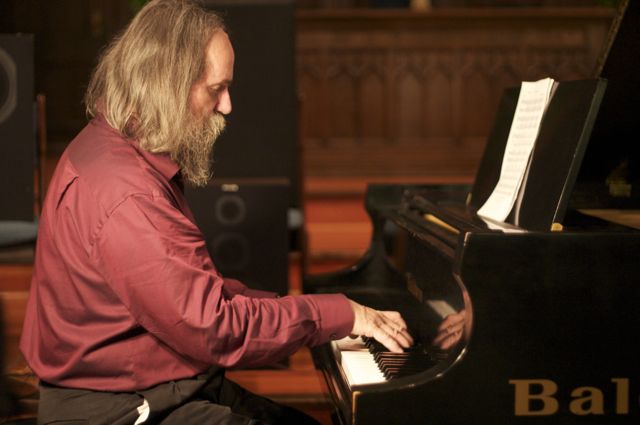
Švedski Ukrajinac novi je opći miljenik klasičarskog svijeta. Kung-fu tehnika za ispiranje neprestano strujećeg klavirskog zvuka.
www.lubomyr.com/
1. Windmills
 .mp3 (1.9 Mb)
2. The Song of Windmill's Ghost
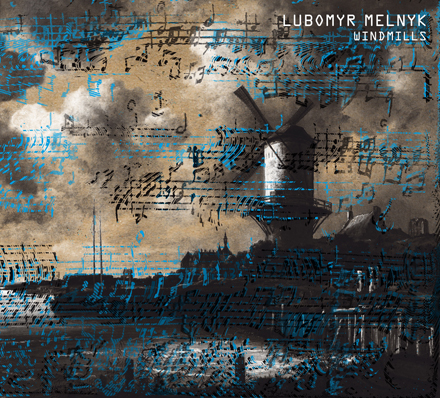
.mp3 (2.2 Mb)Windmills is Lubomyr Melnyk’s latest major work in the last 15 years. It is a tour de force of pianistic excellence, and shows the many sides of Continuous Music, both as pattern music and as melody.
It was begun in 2009 and took 3 years to complete, with the addition of the final song of farewell from windmill’s ghost. The music contains a story based on a very early Walt Disney animation, The Old Windmill. In Lubomyr Melnyk’s version, the windmill is of the old European type, made of heavy stone and wood, standing alone on the top of a hill, facing the onslaught of nature, with wind and rain and storms and everything that it has to face in its 300 year old life. For Lubomyr, the windmill represents a human being, facing so many hardships and trials, standing alone at the top of a hill, we hear the massive but worn gears begin to toil as the wind wakes the windmill from sleep, far away, a terrible storm is brewing, and eventually descends upon windmill with horrendous force, destroying poor windmill... In the music, windmill rises up to heaven, with its wings carrying it up higher and higher... and as it rises, windmill sings its song of farewell, a plaintive melodic theme, its song to mankind, reminding us of the beauties of life and to be grateful to god for all that we have ....
The Song Of Windmill’s Ghost was worked on in many versions, until it was finalised in 2013. It is the synthesis of all the melodic elements which Lubomyr had envisioned for this Song... - www.hinterzimmer-records.com/
Lubomyr Melnyk claims to play the piano in a way that demonstrates superior dexterity over anyone else who has tickled the ivories throughout the instrument’s 350-year tradition: “I know for fact that there is no pianist in the history of piano playing who could even attempt to perform one of the larger pieces I do. […] Neither their mind nor their fingers could even start to play these big pieces.” As bold as that statement might sound, it’s also a certified actuality — Melnyk holds two world records to support it. He’s the world’s fastest pianist, who’s recognized for “sustaining speeds of over 19.5 notes per second in each hand, simultaneously, and the most number of notes in one hour.” I couldn’t help but think of that in relation to some of my favorite contemporary pianists, in order to better understand how these attributes may effect the listener’s perception of Melnyk’s music, particularly on his latest offering, Windmills.
From Bruce Brubaker’s theatrical performances to the stark minimalism of R. Andrew Lee and the jazz/classical crossover of Adam Makowicz, the amount of pianists working today is as endless as the types of music they practice. To assert an unrivaled capability over any of those is most extraordinary — what does it matter if one is faster than another, as long as the music is sublime, right? The clue, I suppose, lies within the pursuit of variation. Melnyk would declare that his own approach, continuous music, isn’t classical, although he has cited a number of classical musicians, especially minimalist composers, as influences. This is due to the nature of continuous music and the swiftness and precision it requires that Melnyk has reason for attempting such a feat, even if those inspirations tend to color the emotional response rendered by his sound.
I recently watched Brubaker illustrate a technique that reminded me of the physical strength that’s often associated with Melnyks’s pace. During his set at King’s Place in London last year, Brubaker premiered Alvin Curran’s “Hope Street Tunnel Blues III,” which is a highly mischievous piece that necessitates great physical exertion from the pianist; “This is actually going to hurt me,” I recall Brubaker saying. That rendition saw him pouring with sweat, not at the rapidity of alternate notes, but at the percussive fashion in which he played single ones. Melnyk plays twice, maybe even three times that speed, and he does it with an elegance that radiates throughout the two tracks encompassing Windmills. This album is a collection of seamless movements, ideas, and adventures that adhere to his style and bolster his reputation, which is often coupled with the physicality that Brubaker demonstrated at his live show, because when you read Melnyk’s world record stats, it’s hard not to imagine him enduring the same amount of bodily strain. Only that’s not the case.
Continuous music isn’t grounded in transcendence, but in the desire to play each note succinctly and with passion in the context of a broader setting. Although Melnyk has talked about the concentration he maintains while performing — where “all motion becomes non-motion. Space and time all become one solid entity and the mind plays like rain on the surface of the road” — he also feels a connection with each of the keys, regardless of speed. From the perspective of the listener, Windmills paints the impression of being transported from everything that surrounds you, representing an unmistakable disconnect from what’s immediately at your side in the physical world by emphasizing certain strands.
These come in sequences across the album that depict Melnyk’s vision of an old mill on top of a cliff, battling the forces of nature. Influenced by a 1937 Disney animation, Melnyk projects the various ecosystems that exist within the mill. In his image, the scene symbolizes humankind facing up to life’s challenges, as a tumultuous storm of cavernous, swelling melodies test our endurance. The story unfolds as sweeping rushes, minimal segues, and bounding set-pieces, which showcase Melnyk’s gift and the evolution of his continuous music while stirring the deepest emotional resonance and tugging incessantly at the heartstrings.
That the music is translated from the conscious mind of the maker through the acoustic body of his instrument, as if undergoing some form of metamorphosis, is quite astounding. In tandem with Brubaker’s onslaught, Melnyk’s body transforms as he plays. “Your flesh alters substance continuously and your mind is in hyper-speed as the world whirls around you like a hurricane with the piano as its vortex,” he said of the experience. Those impressions of harsh environmental powers — tidal fluctuations and forceful winds — remain common interpretations of Melnyk’s sound, where natural elements collide with an artistic intention that charges classical influences through a gauntlet designed to test the very momentum of the human body.
The image that inspired Windmills and the three years of work that went into its production serve as metaphors for perseverance and adaptation, and it rings beautifully with Melnyk’s vision. It’s another staggering accomplishment from a man who has taken the possibilities of composition and improvisation to new heights, fusing the fervor he strives to endure as a performer with the promise of creating an expansive sonic landscape for his audience that’s teeming with life and bounding with possibility. - Birkut
Ukrainian pianist Lubomyr Melnyk calls his work “continuous music”, and it’s easy to see why: with so many notes in such short spaces, one hears a flow into chords that borders on drone. It’s entirely possible that Windmills contains more single notes than any other album on the market. This is the unique appeal of Melnyk, topped only by his attention to detail. He doesn’t just play the piano quickly, or thickly, he plays extraordinarily well, and possesses a sound that is entirely his own.
After being “discovered” after decades in the industry (o sweet fate!), the composer has finally earned the attention he has always deserved. As his first major work of the 21st century, Windmills bears the weight of enormous expectation, and smashes it to pieces. This is a beauty to listen to: flourishes of notes, cascading like waterfalls, swirling like snow. The bonus is that this work is an homage to a prior masterpiece: Walt Disney’s Academy Award winning short film “The Old Mill”. That nine-minute work, scored by Leigh Harline, is a demonstration of animation and scoring at their best; without a single word, the film creates and sustains a mood of anticipation. Although (or perhaps because) this is Disney, one is unsure of the fates of his avian and animal characters. In the first movement, they are seen in their natural settings, gathered around the old mill. The second is playful, a bullfrog and cricket and firefly chorus providing light distraction. The storm arrives in the third, casting all outcomes into doubt; and the fourth portrays the aftermath.
 That chorus of creatures finds its echo in Melnyk, whose notes and tones arrive swiftly and fill every available nook. At times it seems as if a horde of pianos is playing in a crowded room, until one realizes that the sustain pedal is working overtime. With 62 minutes to play with, the composer is free to investigate the aural colors of the initial score without being tied to its specific notes. Echoes of Harline’s work can be intuited, and by extension, echoes of Strauss, whose piece “One Day When We Were Young” was incorporated into the original score. And yet the new score is distinctly Melnyk’s, a vast exploration of premonition and play, catastrophe and recovery. When the bright chords turn to dark and back again, the listener is transported, as if experiencing a storm of their own. This is Melnyk’s intention; as the liner notes describe, his windmill is “meant to represent a human being, facing so many hardships and trials.” But in the end, we are also being “reminded of the beauties of life, and to be grateful to God for all we have”. The spirit of the listener rises and falls on these ladders of notes, a stairway to heaven, a shelter from the storm. - Richard Allen
James Blackshaw & Lubomyr Melnyk, The Watchers
The combination of James Blackshaw and Lubomyr Melnyk is a pairing so natural it seems inevitable, especially when Melnyk's so-called ‘continuous music' style could be just as easily applied to Blackshaw's guitar playing (the pianist even proclaimed, after seeing Blackshaw play live, “You have invented continuous music for guitar!”). When the two first met in 2008, they hatched the idea of a future collaboration, which ultimately came to fruition in 2012 when they convened at the Vortex Jazz Cafe in London for a day of improvisations (spontaneous composition, if you prefer). With Blackshaw playing twelve-string acoustic guitar and Melnyk at the grand piano, no more than two takes per song were done and the entire session was over in six hours, with The Watchers' four long-form settings the wondrous result.
The album embarks in “Tascheter” on a sea of cascading ripples, the musicians pushing forward side-by-side, neither one dominant and Blackshaw's ringing patterns a fitting complement to Melnyk's elegant clusters. Throughout the thirty-six-minute recording, the two act as conduits for the music's seemingly unforced unfolding as it moves patiently through chord progressions and hints at melodic possibilities, subtly rising and falling as it does so. Neither musician solos in the conventional sense of the word, although one might just as easily say that both solo constantly; having said that, Blackshaw's crystal-clear tone does assert itself prominently during the latter half of “Venant” to a point where his repeating melody does stand out from the sonic mass.
Though each player is a master at generating swirling eddies of sound, the most affecting sections, interestingly enough, are those where the density diminishes and the music quietens. That happens most evidently during the album's second half, specifically during “Satevis,” where the slow tempo allows Melnyk's waterfalls to create an impressionistic mass against which the guitarist replies with chiming figures, but most memorably during the closing minute where the instruments' voices gradually scale back until they vanish altogether. The stately closer “Haftorang” is, if anything, even more elegant in the melancholy lines the musicians draw. It's during these moments when the beauty of the music comes most powerfully to the fore, and one leaves the album thinking that a better title might have been The Listeners, given the telepathic level shared by the musicians. - textura.org
Lubomyr Melnyk, Corollaries (2013)
Erased Tapes has done a wonderful thing in bringing pianist Lubomyr Melnyk's music and playing to the masses on this hour-long collection, which was recorded and produced in Berlin by Peter Broderick and also features his contributions on four of the album's five pieces. The press material describes Melnyk as the “pioneer of Continuous Piano Music,” and the recording more than bears that out in its focus on the multi-layered, harmonic waves that his playing generates. Of Ukrainian origin, the classically trained Melnyk was clearly influenced by the minimalist movement of the ‘70s but has nevertheless imposed his own euphonious stamp on the tradition. His playing washes over the listener, bathing him/her in fluid, unbroken streams that modulate smoothly and evolve organically. A lustrous, shimmering soundworld results that eschews dissonance for a harmonious and chiming style that can be soul-stirring.
Broderick's presence is audibly felt in the opening “Pockets of Light” in the violin shadings that subtly complement Melnyk's playing and most explicitly in the brief vocal episode that gently surfaces seven minutes into the nineteen-minute piece. Rather than detracting from the delicate mood established by the hypnotic piano patterns, Broderick's unadorned singing proves to be an enhancement, and the re-appearance of the violin in the piece's closing moments closes the circle effectively, too. “A Warmer Place” opts for a comparatively more restrained approach that finds Melnyk and Broderick fashioning a wondrous moodscape of tinkling keyboard patterns and ambient violin textures.
In keeping with its title, “Nightrail From the Sun” unspools at a more aggressive pace but is most notable for the distance it creates between its sound and the album's other offerings. Here the piano patterns sound somewhat de-naturalized, as if altered electronically, and accompanying elements, though understated in nature, likewise seem more electrical than natural. Such alterations do add contrast, but they also end up taking away from the beauty of the piano's natural sonority.
Broderick's violin playing appears most prominently on “Le Miroir d'amour,” with Melnyk acting more as a restrained accompanist on the beautifully mournful piece. During the opening minutes, the pianist largely sets aside his continuous playing but then re-introduces it to flesh out the material as it moves towards its grandiose conclusion. But perhaps the album's most impressive piece is the one featuring the pianist solo: “The Six Day Moment,” wherein his dramatic playing produces a heartfelt and melancholy music of intense emotional impact. Hearing the almost subliminal way by which its thematic material gradually comes into focus is one of the album's high points. It's Melnyk's music at its purest and the effect, especially when sustained for the full measure of its eleven minutes, is exquisite. - www.textura.org/
Who: Lubomyr Melnyk, conservatory-trained pianist, Ukrainian, living in Sweden
What: I create Continuous Music, a new and unique form of piano music. It's very difficult to play and takes around thirty years to master. No concert pianist in the world, either dead or alive, is (or was) capable of meeting the technical challenges of this new music, but the music also sounds different from other piano music as it creates a constant unbroken flow of sounds and tonality. But probably the biggest difference in my music is the millions of touches it possesses, and the sheer speed of the brain involved in moving the fingers through time and space. The pianist is in another dimension where everything moves in slow motion, so slow that the world stands completely still, even though outside the notes are racing by at hyper-speed. It is this delicious “Standing Still In the Hurricane” that separates my piano work from others but probably the best thing that separates my piano music from the others is that it is physically a joy to play, it really is!
When: I'm projected tour to initiate the release of the new recording Corallaries on the Erased Tapes label.
Musical philosophy: Art and music should be beautiful. They should bring a sense of joy at being alive and a sense of marvel at the miracles of existence. Music should let us look deep into ourselves and into the universe. Music should bring us face to face with all that is divine.
Influences and inspirations: Well, the list is long! The most important of all is an unknown German composer from the 1930s and ‘40s, so unknown I can't even recall his name, but John Cage sent me to one of this guy's “disciples” in New York, ages ago and it changed my art by giving the walls of my cathedral a foundation upon which to stand. From there, I let my soul run free, but, honestly, even if my soul is of the West, my sun is of the East!
This is so strange, because no one really knows what I mean, because no one has taken the jetplane ride with me, but if they knew what it feels like to fly that way, they would never be satisfied with regular propeller travel any more, I mean it! I know that people can hear the difference, they just don't know that what they are hearing is a new class of motor! - www.textura.org/
The Voice of Trees (2011)
1. The Voice of Trees (Part 1)
.mp3 (10.4 Mb)2. The Voice of Trees (Part 2)
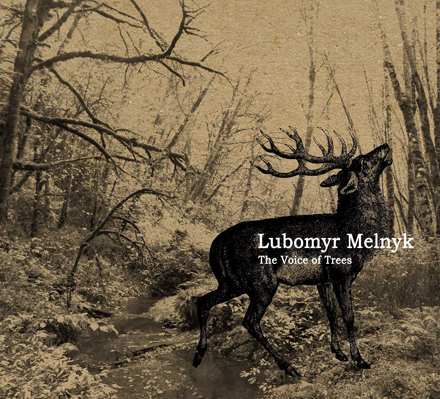
.mp3 (11.1 Mb)The Voice Of Trees was recorded in 1983 but never officially released. It is a 64 minute composition including Lubomyr Melnyk - Canadian composer and pianist of Ukrainian origins - on piano and Melvyn Poore - who became a member of the European ensemble Zeitkratzer many years later - on tuba, both instruments played in real-time and over backing tracks. The Voice of Trees is a work of true and intense beauty. It is a lost masterpiece, as many of Melnyk’s pieces are, that need not hide in the shadow of the Reich/Glass/Riley axis but come to light in the history of twentieth-century composition.

Lubomyr Melnyk / Gregory Euclide, The Village Underground Session
Black rain trickles over a tear-swept canvas of inky imagination and musical possibility. Note after note falls down and ripples outwards in a symmetrical shape of beautiful design. A brush of an artistic hand leaves slowly developing trails that, eventually, shape themselves into smeared tears of black ink. Vines creep across the roots of healthy, upright trees, almost lost in the dense artwork. A brighter chord movement suddenly splashes down, rises up and snakes its way speedily up and along the thin trees, nesting there, in the treetops. This was music that at first flirted with the visual art form, the visual of which then coalesced with the running notes, producing similar sensations that were once unique to each craft, left to blossom before the eyes.
All things are alive. All things are (a)live. Live music is the only way to truly encounter the real heart, soul and passion of music; to feel her against you, heart beating against heart, unedited and undisturbed, where no barriers past, present or future exist between the music and the listener; a pure, aural experience is ensured, ascending from the heart and soul of the musician to the instrument, and from the instrument directly through to the receiver. Daft Punk recently instructed us to “give life back to music”, and the music of Lubomyr Melnyk is doing just that. A record may be produced at an expensive studio, with all of the up-to-date equipment and mixing talents available, but even these admirable traits pale alongside the auto tune-free thrill of live music. Isn’t it amazing?Lubomyr Melnyk is a true musician; he sees clearly the beauty in the minuscule, the beauty that surrounds every single thing. There’s no need to extract the beauty – it’s already there. It is instead transferred effortlessly to his black, Yamaha piano and, one note at a time, accelerates into a rapid succession of notes, taking flight as one entity rather than a thousand, separate notes, soaring high with musical purity. His notes have a life all of their own, and while his music contains elements and influences of minimalism, each and every note will never sound quite the same as the last – this is special to a live performance, and it’s one of the most beautiful gifts bestowed upon live music.
Lubomyr Melnyk is sensational. The 20th of May saw the Ukrainian pianist play two intimate shows in one night at The Village Underground, in Shoreditch, London. An almost cavernous interior gave ample space for Lubomyr’s heart-felt intentions; for the audience to hear a piano, only a piano, without any kind of electronic interface or interference. The acoustics of the larger setting (compared to his January performance at London’s Café Oto) certainly worked in favour of the single, sole piano that was instrumentally alone, but never lonely. It isn’t a physical kind of performance, the kind where electric guitars are worn low around the knees and the wrists ask for a chronic diagnosis of repetitive strain injury. There aren’t any orbs of light or strobe effects – this is music as it perhaps should be – only music, to allow a thorough absorbtion. All of these effects look cool, sure, but it could be argued that a piano performance as such isn’t a typically physical kind of performance. Lubomyr Melnyk’s performances are extremely physical, though. His fingers are in constant motion and the trance-inducing state of mind both clears away the clouds of troubled thoughts and develops a dreamy tonic of a tone – you can drift away in the new found world, without ever sacrificing the fragile involvement of the listener. For Lubomyr’s music is completely involving, almost to the point of no return. It isn’t unusual to see people swaying along as if hypnotized by the rapid selection of melodically inspired notes, enwrapped in a gorgeous, harmonic balm as they soar ever upwards. It may seem strange, but in many places some kind of visual accompaniment may be expected, so that the eyes can devour the notes as well as the heart. In an age of diminishing attention spans, true art often sacrifices itself to the demands of the times; the modern need for indulgence on an immense, and unhealthy, scale.

There was no sign of artistic sacrifice at The Village Underground; both art forms supported and shaped one another in a loving relationship. Lubomyr Melnyk’s style of continuous piano music, technically and musically advanced, continues to take the breath away. This was a unique collaboration, as Lubomyr was joined on stage by Gregory Euclide, the artist responsible for the gorgeous artwork that graced the recently released record, Corollaries. This was a performance that more than satisfied the senses, where the aural overlapped into the visual, and where the notes themselves were lovingly painted with the smoothest of strokes. It’s clear from past experience that Lubomyr has the ability to take to the stage unaccompanied and captivate the audience with beautiful, soul searching music. It was, then, interesting to see him share the stage with Euclide; it’s like a double helping of your favourite ice cream, covered in a sprinkled sauce and oozing down the white like the sprays falling onto the watercolour, streaking the painted thoughts like tears remembering an erased landscape where beautiful, European windmills once stood.
Euclide’s process of painting along to the music leads to new, improvised areas, so that, like the music, every performance and every painting is truly unique to that one moment. No one performance is ever the same, and it’s unclear whether the imaginative black over white canvas is the unfolding painting or the two tone colour of the piano and her keys. Only a couple of times, when the staccato stabs of an introduction synced up perfectly with Euclide’s use of dots and dashes, as if his strokes emanated from an internal metronome, was a sense of preconceived possibility revealed. Euclide’s painting complimented the music perfectly. The addition of a live, constantly evolving painting, that at times seemed to resemble a serene lake of jet black, holding reflections like fluid mirrors, helped to contour the stream of notes arising out of the piano, themselves producing ripples on the very same lake. It added another dimension to the musical experience. A grey-hued excursion in the minor key began a beautiful, musical journey. There was never any chance that the two art-forms would detract from the whole. Lubomy’s second piece featured a prominent chord progression that would cycle around the evolving painting. Occasionally, a dreamy, dissonant chord would surface, as what looked like immense lilacs shaped the frame of the painting, arcing palms of spontaneous creativity. Fragile trees grew as the music spread; in a way, this is the near perfect representation of the music in imagery. Incredibly alive, rooted deeply and always thriving.
The rapid succession of notes need to be heard in a live environment – the notes exist to breathe into the ears of the listener, to surround the inner walls of the building and the outer walls of your mind. Notes showered down a thousand and one colours, all tanned to a healthy degree as they resonated out of the piano. Every note living life to the full. And this mantra can be seen and heard inside his amazing ‘Windmills’ piece – a lengthy piece that’s been around in development for three years, and that recounts the dreamy story of an old, European windmill that falls victim to a violent, unstoppable storm. Even more amazingly, he didn’t begin to write the melodic ideas down until six months ago (can you imagine the sheet music?!) The storms of life can throw us off course, but in the end, there is hope through the finale and the ascension of the higher register; it’s the realisation that beauty is everywhere, and that even the thought itself reveals beautiful creation.
Starting in the low register, the notes within notes stuttered the windmill to life, sometimes stopping as the gears trudged through the motions. Stenciled images uncovered deeper images that were waiting to be discovered all along. Higher notes, optimistic in the face of the black, intense clouds, fought courageously against the lower, rumbling thunder – rolling over with a speed that matched Lubomyr’s speedy finger movements. Visions clouded the eyes as if the storm had descended over the venue (and with the weather we’ve been having, who’s to say there wasn’t a storm overhead?)
The painting seemed to absorb the music, feeding off of the notes in a continuous circle, as if the brush was an arm circling around a windmill’s body. Euclide’s artistic precision could resemble a black-tipped blade, used only for creation instead of a violent tornado and imminent destruction, intent on ripping apart the innocence of major harmony. Imaginative, cohesive and yet ever changing, pools of inky rivers were left, a Heavenly realm awaiting the ascension. A black inked rainbow could be seen arcing over the tip of the canvas, hovering over a major chord. Yet, it could have transformed into a dark, threatening cloud, coming closer and carrying the storm on tips of turbulence.
Lubomyr’s passion is not only for the music and the instrument, but for the purity of her tone, and the rich resonance that is inevitably diluted when she comes into contact with even the tiniest electronic element. I think it’s fair to say that everyone in the room was transfixed, and the continuous applause for the continuous music was further proof that Erased Tapes have found a gem in Lubomyr – it looks like they were meant to be together all along.
This is where the music lives on, but it’s also up to us ourselves to give life back to live music. I urge you to check where he is playing next. It’s truly an honour to hear the music. As the warm rain falls, all you can really do is admire the talent and the musical journey you’ve been privileged enough to experience. If you allow the notes to sink into your heart, they live on long after the music has stilled the air – true, continuous music. - James Catchpole for Fluid Radio
www.erasedtapes.com
www.lubomyr.com
www.gregoryeuclide.com
www.villageunderground.co.uk
 KMH - Piano Music In The Continuous Mode
  The Voice of Trees
  The Song of Galadriel
  Lyrrest
 - Concert-Requiem and Islands
 Poslaniye
  The Lund-St. Petri Symphony
  Swallows
  The Music of Lubomyr Melnyk
 Niche / Nourish / Niche-Xon
 - The Remnants of a Man
 It Was Revealed Unto Us That Man Is The Centre Of The Universe
  Wave-Lox
 - Music At The Palace (Limited Edition)
 Vocalizes and Antiphons
  The Self-Luminous Way

Fifteen Questions with Lubomyr Melnyk
Musical, mystical and multidimensional
A transcendental technique
Continuous Music is a mesmeric example of exactly what a lifetime’s dedication to an instrument can yield. Lubomyr Melnyk’s transcendental technique of piano performance and composition initially took its cues from composers such as Terry Riley and Steve Reich in the 1960s. However, Melnyk’s music stands in stark contrast to the Minimalist creations of these composers by achieving the same meditative effect on audiences by virtue of more rather than less. Through a systematic accumulation of physical sound and sustained, often rapidly played notes, Melnyk’s Continuous Music draws the listener into its wake and gradually places them into the seemingly timeless vortex of his dreamlike sonic maelstrom. On his latest release "Corrolaries" (Erased Tapes) it seems as though, after 40 years of practice, he has mastered the alchemic art of transforming sound into metaphysical experience.When did you start composing - and what or who were your early passions and influences?
I started composing as a child with my earliest influences being the music of Beethoven and Brahms. As I got older, things changed and now the list of influences would be enormous, perhaps even impossible to compile as I consider my work to be so completely unique that there are no influences.
I think every composer is moved by the music of other people, so maybe a better way to say this would be that I consider the influences I have to be peripheral or anything that works on my soul and vision of existence. Some of these have been physical influences, such as dancers, and others have fallen into the metaphysical realm such as certain writings.
My music can’t be separated from my heart and soul because they are one. That which influences me will influence my music.
What do you personally consider to be incisive moments in your work and/or career?
Working with Carolyn Carson at the Paris Opera in the early 1970s along with the extreme hunger and poverty I experienced at that time, brought about pivotal changes for me. Those key elements of truly extreme hunger and having absolutely no money, but continuing to work with music, allowed me to discover the universe of the piano.
Another incisive moment would be during the 1960s when Continuous Music first emerged. That opened up a whole new musical language for me. A language I thought was very beautiful and truly meaningful in a multidimensional way.
What are currently your main compositional challenges?
I’ve allowed the technique of Continuous Music to develop on its own because it’s not something I could limit with a challenge or a goal. However, there are two challenges I would like to overcome.
One of them is that I’d like to create an entirely new aural experience for the audience as an alternative to the concert hall. This would involve a sound system where the piano would be broadcast around the audience using very fast moving speakers that would whirl around them at high speed, surrounding them completely like an ocean of sound.
Unfortunately I just don’t have the technical knowledge to make this a reality but I’d like people to have this experience because when I’m playing music, my being is moved into the sound so that I’m surrounded with it. The sound moves in and out of my body and it’s a truly a mystical experience.
The Continuous Music piano technique is a transcendental technique where the mind actually moves in space, so this idea would allow the audience the next level of experiencing my music and it would become trans-dimensional.
The other challenge is to try and actually have people respond powerfully enough when hearing Continuous Music, that they actually want to play it for themselves.
To be able to take this enormous instrument, attach it to the end of your hands and play with it is just one of the greatest things on the face of this earth. It’s truly an ecstasy and a wonder to experience. That’s the main thing I would like to give people.
What do you usually start with when composing?
I rarely start with a preconceived notion. That only occurs when someone requests something specific, like a poem set to music or something like that.
Usually I just start with a very small seed of an idea. It’s generally something that I find very interesting or have an immediate bond with. Then it may sit for several weeks and start to become a little piece or a miniature. Sometimes it grows into a very big piece over the period of a year or two because it keeps opening up like a road you have not travelled upon before.
The latest large work that I have done is called ‘Windmills’ and it’s taken over two years to get to its final form. Pieces like these are not just musical they are also emotional. By having a piece sit inside your heart and soul for months and months, your eyes eventually open to something new which means a certain amount of time needs to pass before you’ll even discover what’s still missing. So usually I’ll just take it as it is and let it grow or come to its end, as it will naturally do.
How do you see the relationship between timbre and composition?
I’ve given up on that idea because I discovered that every piano on the face of the earth has a unique voice. Trying to write pieces that can recreate the timbre of the piano it was composed on is a dream I had to let go of.
Recently I found that the pianos that have the most mystical and magnificent timbre are upright pianos. They are so cloudy and enormous in their sound. You can just hit one note and BANG! the whole universe opens up in front of your eyes. The problem is that you can sit down at this piano and create something that is an experience of indescribable beauty because of the sound that that piano makes, but if you take those same notes and go to another piano, it can sound very humdrum.
For this reason I gave up long ago trying to associate composition with the timbre of an instrument. You could say that this is the greatest thing about Continuous Music but it’s also its greatest defect.
Classical music will sound pretty righteous when played on any piano because of the relationship between all the notes, whereas with Continuous Music it varies a great deal. At one piano you will experience unbelievable, soul destroying beauty with all of the wonderful harmonics and resonances that happen within the instrument but then at another piano the experience can be dull depending on how that piano responds to those same notes.
The differences between pianos are enormous. For example, between ten million sopranos you could probably classify the variations in timbre within about four or five different types whereas with pianos you’ll have ten million pianos and ten million timbres! It’s truly an instrument beyond description.
In our modern world one of the true terrors of our existence is that pianos are being destroyed and thrown away. They are living creatures, the highest époque of our manufacturing skills. Between the years 1880 and 1930, the perfectionism associated with manufacturing pianos was almost approaching the ideal of the Samurai sword. No one would dream of throwing away an original Samurai sword mainly because they are worth millions of dollars, unlike old pianos. But like these old swords, pianos of this era, are amongst the highest achievements of human beings.
These days people are just too busy with their noses stuck in an iPad to realise the level of human achievement that is all around them so throwing these pianos away is just murder. A piano should be revered as a glorious thing. It’s a reflection of our own selves. To be able to play the piano really well, and I mean really well, is an unbelievable achievement. It’s like taking an entire Chinese circus of tricks and being able to do all of that at the keyboard.
Still, people think nothing of it. They think they can take a bunch of lessons for a few months and that they’ll be able to play a few tunes but it takes a lifetime to master the piano.
What do improvisation and composition mean to you and what, to you, are their respective merits?
That’s a difficult question. I can only speak about Continuous Music because I don’t compose Classical music. I don’t know if anyone even does anymore because it’s so difficult and the level of genius required is so far beyond what I think our society can achieve, so I’ll leave that to other people.
In Continuous Music improvisation is very necessary. To be a great pianist you have to be able to improvise because you have to be able to touch the piano. When I improvise, it’s not as a composer. Composition is just the initial spark, the pianist’s touch and understanding of harmony and melody is still required to complete the piece.
Improvisation allows the emotional side of things to come into play at any given moment and form the music for you. This is different from the written aspect, which contains the emotions of the time it was written. Improvisation is a vague concept that encompasses way too much to apply to my work. Strictly speaking, I seldom improvise in concert or for myself. I usually work on a specific musical concept. Live it’s probably 90% prewritten, and the rest would be something in the moment where the hand or mind reacts and you do something slightly differently, like a different position of a chord.
When the element of improvisation came into our western tradition, I guess around the time of Mozart and especially Beethoven, it was expected that the musician lived within the music so much that they were able to play variations right on the spot. This is a wonderful thing that has been lost to the modern classical culture so I’d love to see more classical musicians trying improvisation.
The trouble is it’s difficult to be a concert pianist when you’re basically trained like a racehorse. You're trained to run the race perfectly and as fast as possible and that’s 100% of your being. If you take that racehorse off the track and put him in the wild fields and say, “here, run as fast as you can and make the most fantastically glorious run that you can do” the horse is going to stand there and say, “ what the hell are you talking about? Where’s the track? I want the track!”
I want to see more horses running free because as a musician you always want to add something new. Continuous music allows you to do this where classical doesn’t.
It also allows you to create a space with certain harmonies and rhythms. You’re free to change a little colour or add a new shape by slightly altering the position of the chords or notes before you move onto the next written situation. So there’s always that element of play and creation even though you’re 90% sticking to the score.
My world needs both. Neither one is satisfactory on its own.
Where the sound can live
Do you feel it important that an audience is able to deduct the processes and ideas behind a work purely on the basis of the music? If so, how do you make them transparent?
It’s important that the audience perceives the music for what it is but I don’t think it’s reasonable to expect everybody is going to perceive the music in the same way. After all, each person will hear the music slightly differently so his or her actual perceptions may vary greatly.
If you were asking, “can the audience perceive the experience of what it’s like to actually play the music?” I would say the answer is no in 99% of cases. There’s a big misunderstanding of what I’m doing technically at the piano with my fingers, my hands and my body but also with regards to what I am doing with my mind. My music is so different from any other piano music that has happened before that I feel I can safely say that people have no idea what's happening or what it’s like to play Continuous music.
It’s like turning your body into a jet or flying like a bird. Your flesh alters substance continuously and your mind is in hyper-speed as the world whirls around you like a hurricane with the piano as its vortex, yet you remain perfectly still.
All motion becomes non-motion. Space and time all become one solid entity and the mind plays like rain on the surface of the road. I don’t think people can comprehend what it’s like.
The relationship between music and other forms of art – such as painting, video art and cinema - has become increasingly important. How do you see this relationship yourself and in how far, do you feel, does music relate to other senses than hearing alone?
What a wonderful question. I do see the arts as interrelated. All have a deep effect on every artist. Art movements that have happened usually resonate into the musical world, but in most cases the musical world follows the visual arts by a few years.
When I was younger the visual arts were extremely important to my growth but what stumps me is, as far as Continuous Music is concerned, I cannot see any specific precursor to that in the visuals arts. It’s quite probable that Continuous music did not come into existence earlier purely because of the art scene and the mentality of humanity prior to the sixties.
How would you define the term “interpretation”? How important is it for you to closely work together with the artists performing your work?
A successful interpretation is when the musician or artist sees the unique beauty inherent in a piece of music and is able to extract that beauty through their performance or interpretation.
An incredible example of this would be film director Stanley Kubrick. He was the most magnificent genius of music I’ve ever seen because through his films, he would interpret a piece of music in a very specific way. I’m thinking of the music from Barry Lyndon.
You will never find a finer performance of Schubert’s ‘Death and the Maiden’ than you will on this soundtrack. If Schubert could have seen this film he would have cried and said “Thank you Stanley, you’re the first person who has ever really understood my music”.
Interpretation has to move your heart and it can only be right or wrong, even though what could be right can have many different faces. The composer sees something beautiful and then pours his heart and soul into a work to capture this beauty. He wants someone to see the same beauty that he has. So if you can see the beauty in the music, your interpretation will be right. You just have to keep your heart and soul open and be ready to laugh and cry.
I am yet to find anyone who can interpret my music at a level where I could say they are actually able to play the piece. None of my students are ready but when the time comes, their fingers will obey their minds and I will be able to gauge the success of their interpretation.
The effect of a piece doesn't merely depend on the performance of the musicians, but also on the place it is performed at. How do you see the relationship between location and sound? In how far do you feel the current system of concert halls is still the right one for your music – or for contemporary music in general?
Thank you. Wow, exactly. You’ve really hit one of the most important elements of Continuous Music with this question. Well, all music really. A concert hall is not the place, aurally, that my music works at its best. The best places for my music have been large or small churches, art galleries and factory venues. In all of these types of spaces there are resonances where the sound can live.
I know from people who play other solo instruments, that reverberant places are very important to the beauty of the sound. If the space is too dry, that’s worst of all.
It’s not just the aural experience of the space that can have an effect on people. The quality of the space can also enhance your mental awareness e.g. in an old factory, an art gallery or a church, where there is something else working on the mind of the listener other than the what’s happening aurally. All of these things affect the listener’s mind.
Continuous music really works best when the room sets the listener’s mind free. Concert halls are fairly restrictive so a different space allows people’s minds to roam free. It’s even better if people can lie down on the floor or walk around and choose different heights to listen from so that they can choose the sound that they want.
Like all existence, every point in space and time is unique. Wherever you are in a space, your sound and mental experience is going to vary greatly so the place is going to have a lot to do with whether or not your ears and mind will explode back into the room.
If you're just sitting in a little velvet seat, stuck in with 500 other people with bare walls on either side of you and one light on the stage in front of you, the music can be beautiful in that space but it becomes more meaningful and beautiful when it’s set free in a huge room with windows or a unique structure.
The role of the composer has always been subject to change. What's your view on the (e.g. political/social/creative) tasks of composers today and how do you try to meet these goals in your work?
From the time of Beethoven the element of mental change for the audience has been part of the scene. Prior to that, music was meant to conform and exist as an object of beauty. Beethoven broke that mould and said “Yes, I will create something magnificent and stunning for your soul and mind but I will also move you into totally new worlds”. From his time onwards, especially up until about 1910, you had composers really trying to move the boundaries of music and concept.
The great works have always been steadfast in their dedication to morality and truth and somehow these are the principles of music. In our time now, it’s an obligation to react and to make music politically important. After all, music is a statement of moral truth.
Everything that was true in music during the sixties or the beginning of the Age of Aquarius has been swept under the carpet and all because of the Orwellian society that we have started to live in. This is a society where human beings have no freedom at all and everyone is under surveillance everywhere they go. In a world where the president cannot open his mouth without lying and the truth is constantly hidden on a huge scale, the composer has a duty to speak about this with their art.
I’ve been working on an opera for a long time now that is about the escape from being a soldier and a life of constantly seeking after money and wealth because I feel that most of the ills of the world have been caused by soldiers. I find it mind-boggling how a human being can give his or her body and soul to someone and do whatever they're told.
To become a robot that does the bidding of another machine is a moral horror and there are thousands of men and women around the world who are willing to do anything for money. It’s so immoral. People are descending into a state of animalistic fear where our purpose in life is just to go to work and buy stuff.
Money is the killer of beauty. Our eyes are changed as soon as diamonds and guns become our main desire and it is also scientifically impossible to experience beauty and still be a soldier.
I would not have felt this 40 years ago. Maybe I was blind but it seems to me that our society is now faced with a catastrophic situation. As a composer, these things have to come out and so I’m hoping that my music, even though it doesn’t have any political structure or purpose, may move people’s minds and souls so that they will somehow grab a hold of themselves and start to see what the human being truly is. We are not creatures here to push buttons and kill people. This is not our purpose of existence.
Music is enemy of bullets so hopefully if people can learn to respond to the beauty of music, they’ll stop their madness.
The real thing
How, do you feel, could contemporary compositions reach the attention of a wider audience?This could happen if music was performed more often in public situations. In the late sixties and seventies there was strong support from the government for arts and culture and so there were a lot of public events. These were situations where people got to hear the music in person and for real. To experience real live music is exhilarating and uplifting. It doesn’t matter what you’re listening to, so long as the musicians are of high quality or are children! It’s these events that spread music.
The real culprit for the reduction of awareness is the lack of funds provided by the government. Without their support, no arts can happen. They used to do it because it was perceived as a valuable thing to do for people but now that has stopped, things may just recede back into a situation like it was two hundred years ago when live music was only available to the wealthy and elite.
We have to provide tonnes of concerts. Not just big venues with one artist either, we need events with lots of different artists. If this can happen our engagement with music will increase dramatically.
The Internet is also important in gaining the attention of a wider audience because it keeps the music alive. If it weren’t for the Internet, music would be dead by now. That said, the Internet does not replace live music and the personal joy gained from the experience of being there. I want people to rediscover the joy of seeing music live.
Go and see more live music!
Music-sharing sites and -blogs as well as a flood of releases in general are presenting both listeners and artists with challenging questions. What's your view on the value of music today? In what way does the abundance of music change our perception of it?
That’s another good question because there is an abundance available online but it’s all just on phonograph. It’s like only looking at art books and never going to a gallery.
If you only read about and listen to music on your computer, that’s OK. It’s better than nothing and I’m grateful for the access it has provided people to my music, but listening to music on computer speakers is nothing like the live experience. You should at least be listening on a decent stereo system.
Experiencing music on the Internet only is like receiving a postcard in the mail. It stimulates your interest and hopefully, like a postcard, it will encourage you to go and investigate the real thing, with your own eyes and ears.
The way I see it, the Internet is great to raise awareness, but we need more live events so that once people’s interest is raised, they can then go and see the real thing.
Composers have traditionally found it hard to secure a living with their art. What are the financial realities you're living with and in which way, do you feel, could they be improved?
I would say that economic hardship is a part of the world for most composers and that’s not a reflection on the quality of their work. I really do not know how I survive because if you look at my yearly income, it’s awfully low but basically, a human being can survive with very little money.
It’s wrong for musicians to place a monetary value on their talents or abilities. Is it right for someone like Pavarotti, who probably had one of the greatest voices in opera ever, to the go and charge more than anyone in the history of opera to see him just because his voice was the best?
I know for fact that there is no pianist in the history of piano playing who could even attempt to perform one of the larger pieces I do. The work is just too damn difficult. Neither their mind nor their fingers could even start to play these big pieces so should I charge more than Rubenstein or some other world famous pianist just because I can do something that they can’t do?
I don’t think that can function but I must admit that no one is likely to offer me that anyway. I’m just speaking hypothetically but in the realm of music that I live in, that way of thinking does not apply. It doesn’t even matter.
Even if I could say I’m not going to perform for less than $20,000 a night because I can do things that no other pianist can do, I wouldn’t. I think that’s wrong. It doesn’t matter that I can do what no other pianist can do. What is important is bringing the beauty and the message of the music, whatever it is, to the people.
Don’t get me wrong, I’d like to earn something from what I do but poverty is not something to be feared. If circumstances dictate that I can’t charge a large fee for what I do, it doesn't matter. I am happy to play anyway. Musicians have to realise that they are more important than money. We have something that other people would die for and that’s the ability to play. There’s a joy in the ability to play an instrument or compose music that you just can’t put a monetary value on. Money must never be the ultimate goal for a musician and for those who it is, I am not interested in listening to their music.
Usually, it is considered that it is the job of the composer to win over an audience. But listening is also an active, rather than just a passive process. How do you see the role of the listener in the musical communication process?
My hope is that the listener will perceive the beauty of the music that I am playing for them. If they feel the beauty of the music the way I feel it, then I am happy. I can’t expect anymore. I know people have other experiences from my music, like metaphysical experiences or whatever, but those things are just little extras, the icing on the cake.
Long ago, when I was starting out, there was no perception at all of what Continuous Music was about and it was very difficult. If the audience feels that the music is beautiful and they love the experience that they have, that’s all I ask.
Please recommend two artists to our readers, which you feel deserve their attention.
The first artist is James Blackshaw, the guitarist. He’s really phenomenal. He’s breaking new ground with his guitar technique so he really stands out for me.
The second artist is Stanley Kubrick, the film director. He deserves to be appreciated because he changed music.
People think that he simply took any old recordings to use in his films but he actually arranged for someone to change the face of the music. He saw the face hidden inside the music and pulled it right out. Holy shit! People think of him as movie director but I think of him as a music director. He does emotionally astounding things with music that tears your soul.
For me as a composer, he was the first person who heard the internal and true face of the composer’s music that he used in his films. He did not use music only as a background to enhance his cinematic message he used the cinema to explain the musical message!
Kubrick showed me that there in fact exists a hidden face within music. A face that is waiting to get out and be seen and understood. I see this face buried behind the stupid glossy performances of classical musicians who miss the point totally of what they are playing, because their hearts are blind to the beauty and suffering of the composer's soul.
He saw and heard this stuff inside, way back inside the music and I am ninety nine percent sure that he was forced to create his own special performances, just like figure skaters have to, by having someone re-orchestrate the pieces of music he wanted to use in order to bring out the drama and passion of the music's face. Handel and Schubert both became glorified by Kubrick's understanding of what their music held inside it, and only Kubrick brought images that cried out in the name of these particular pieces. He created cinema images that make us truly understand what is buried inside these pieces.
www.15questions.net/interview/fifteen-questions-lubomyr-melnyk/page-1/